 Toronto
Winter officially arrives in 116 days, and here is a look at what the Old Farmer’s Almanac and Farmers’ Almanac have predicted for the 2026-27 winter season in Canada.
Farmers’ Almanac
Farmers’ Almanac was founded in 1818 and uses a “top secret mathematical and astronomical formula that relies on sunspot activity, tidal action, planetary position and many other factors” to predict long-range weather.
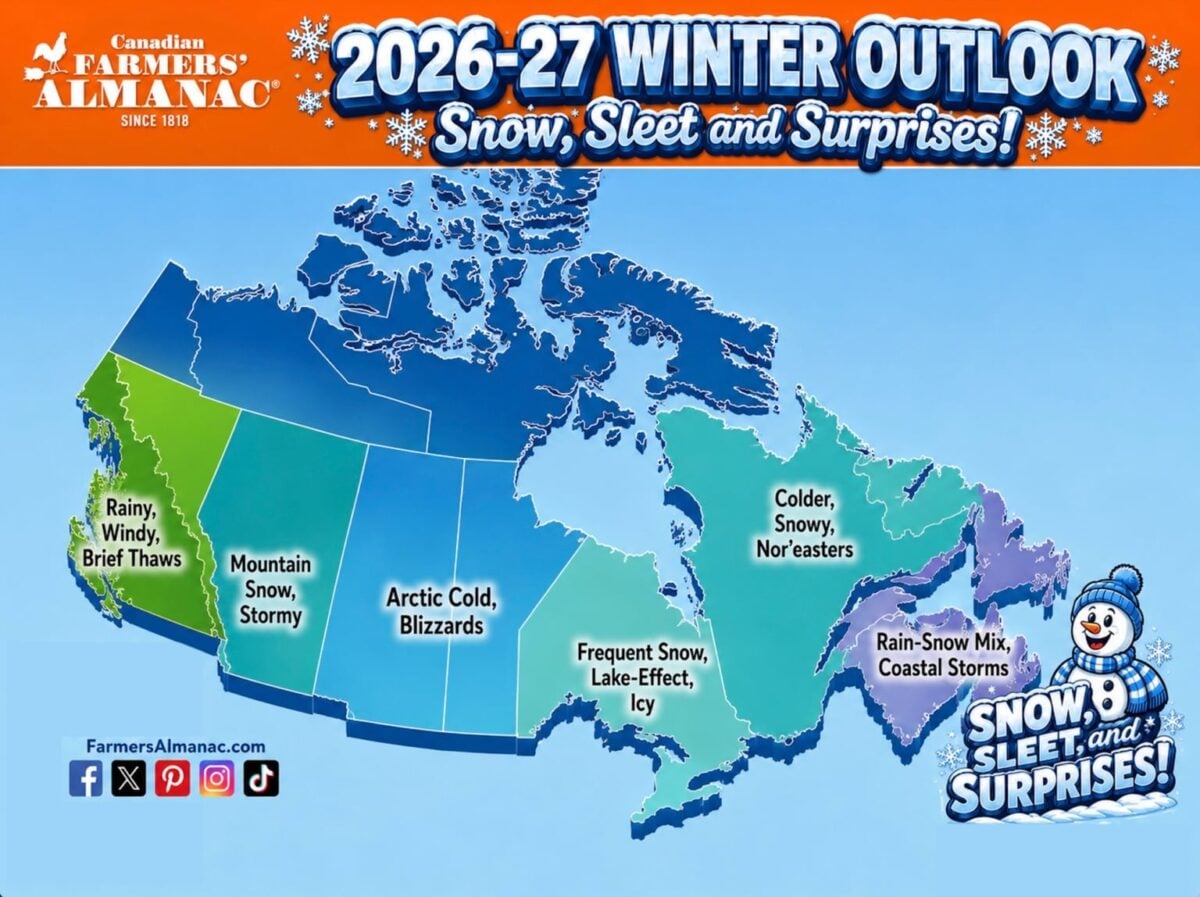
The Farmers’ Almanac is pointing to a season of sharp contrasts rather than one long deep freeze. Its outlook calls for everything from wet and windy weather on the B.C. coast to Arctic cold on the Prairies and frequent snow and ice in Ontario.
The Almanac sums up the season as “Snow, Sleet, and Surprises!”
Credit: Farmers’ Almanac
Along the British Columbia coast, you can expect more rain and wind than persistent snow, with occasional thaws. Interior B.C. is expected to see heavier mountain snow and stormy stretches.
Across Alberta, Saskatchewan and Manitoba, the forecast calls for periodic Arctic cold, strong winds, blowing snow and possible blizzards. January and February are expected to carry the greatest risk of harsher cold outbreaks.
In Ontario, frequent snow, lake-effect snow and icy conditions could make for a messy winter. Southern areas may see storms switch between snow, freezing rain and rain when temperatures hover near 0°C.
Quebec and Labrador are forecast to stay colder and snowier, with the possibility of nor’easter-type storms bringing heavy snow and strong winds.
For Atlantic Canada, the picture is more mixed. You could see snow, sleet, freezing rain, ordinary rain and coastal storms, sometimes within the same system.
Northern Canada is expected to remain firmly wintry, with periodic Arctic outbreaks that could also spill south into other regions.
El Niño may also play a role, helping create regional differences and quick weather changes across the country.
Old Farmer’s Almanac
North America’s oldest continuously published periodical (1792), Old Farmer’s Almanac, provides weather forecasts using Robert Bailey Thomas, the publication’s founder’s formula, refining it based on 30-year averages from NOAA. It is updated every decade and now incorporates sunspots and other solar activities to refine predictions by comparing them with historical weather data.
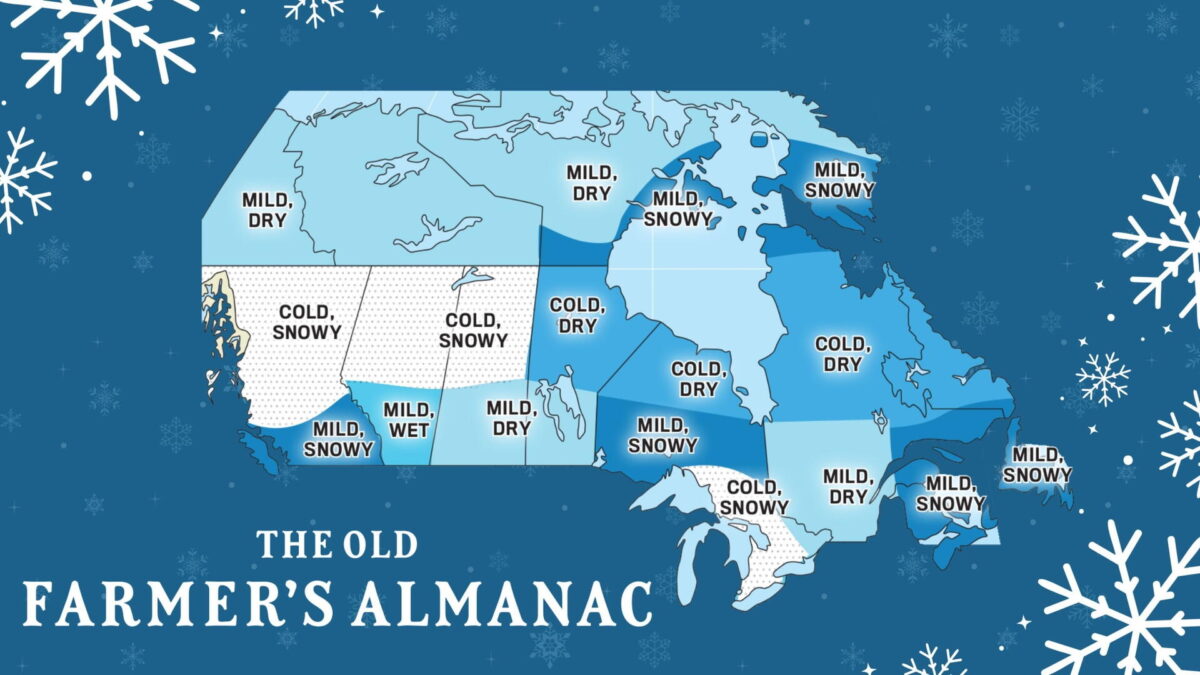
The 2026 edition of the Old Farmer’s Almanac is forecasting a split season across Canada. Much of the south is expected to be near or above normal for temperatures, while parts of southeastern Ontario and central Canada could run colder. Snowfall is another story, with above-normal amounts expected in Atlantic Canada, southern Quebec, southern Ontario, parts of the West and southern Nunavut.
Credit: Old Farmer’s Almanac
As the forecast puts it, “Above normal” is relative. It may not be as cold as usual, but it’s still a Canadian winter!
Southeastern Ontario is expected to be colder than normal, along with a broad stretch from northern Newfoundland and Labrador through central Canada, the northern Prairies and into central and northern British Columbia.
Most of southern Canada, however, is forecast to see near- to above-normal temperatures.
If you are in Atlantic Canada, southern Quebec or southern Ontario, keep the shovel handy. Those regions are expected to see near- to above-normal snowfall.
Southern Ontario may actually be drier overall, but snowfall is still forecast to finish above normal, especially during early and late January and mid-March.
In the West, southern British Columbia is expected to see above-normal precipitation and snowfall, with its snowiest stretches in late December and early to mid-January.
The southern Prairies could have a less severe winter overall, with above-normal temperatures and near- to below-normal snowfall.
Farther north, Yukon and the Northwest Territories are expected to be milder than normal with less snow. Nunavut is more divided, with below-normal snowfall in the north but above-normal snow in the south.
Comparing The Old Farmer’s Almanac and the Farmers’ Almanac Forecast
The biggest difference between The Old Farmer’s Almanac and the Farmers’ Almanac is how severe they expect winter 2026–2027 to be across Canada.
The Old Farmer’s Almanac generally leans milder. It forecasts near- to above-normal temperatures across much of southern Canada, including the southern Prairies, Yukon, Northwest Territories and Nunavut. It still expects above-normal snowfall in southern Ontario, southern Quebec, Atlantic Canada, southern British Columbia and parts of Nunavut.
The Farmers’ Almanac presents a more volatile outlook. It warns of periodic Arctic cold, sharp temperature swings, blizzards across Alberta, Saskatchewan and Manitoba, frequent snow and ice in Ontario, and colder, snowier conditions in Quebec and Labrador.
The Prairies show the clearest disagreement. The Old Farmer’s Almanac expects above-normal temperatures and near- to below-normal snowfall, while the Farmers’ Almanac warns of Arctic outbreaks and blizzards.
Overall, one forecast is milder, while the other emphasizes greater cold, storminess and unpredictability.


Looking for Northern BC weather for October 2025