 Calgary
Canada will experience a partial solar eclipse on August 12 as the path of totality crosses the Arctic, Greenland, Iceland and the Atlantic Ocean before reaching northern Spain and northeastern Portugal.
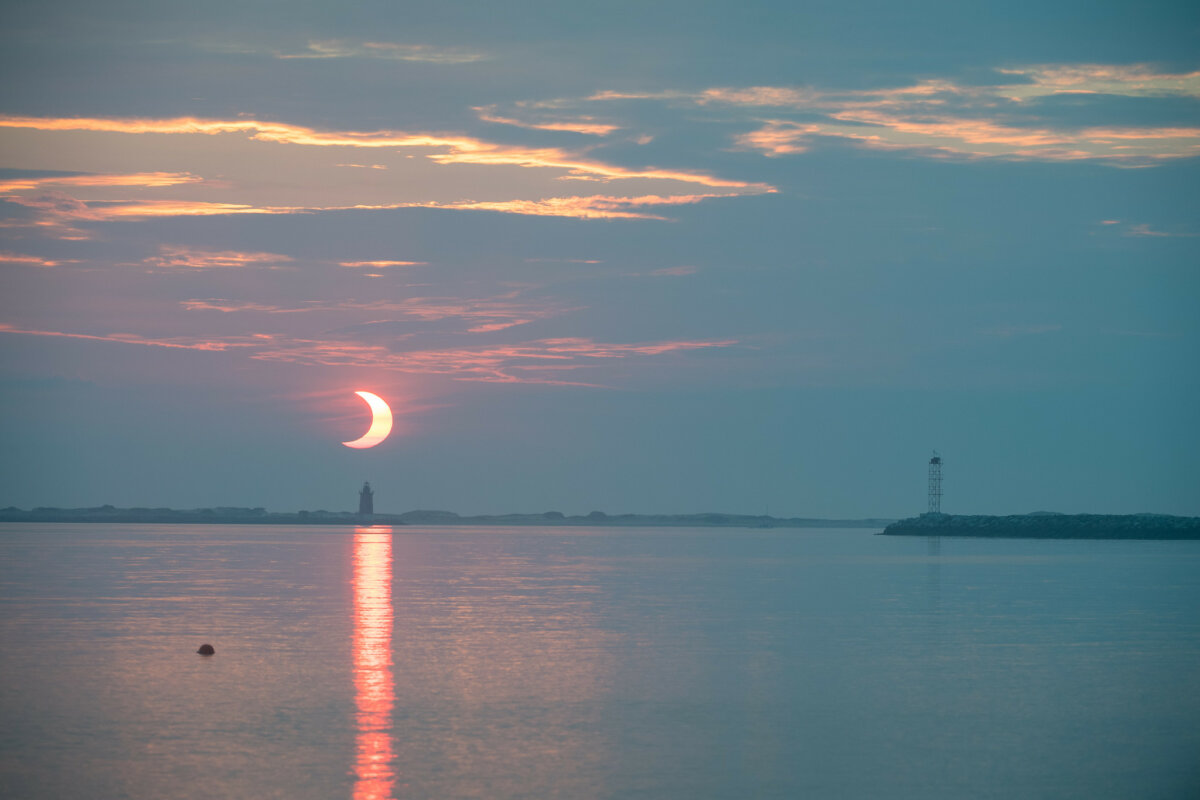
The longest eclipse is viewable from Látrabjarg in Iceland when the totality lasts for 2 minutes, 14 seconds.
Contents:
- Time and Duration of Solar Eclipse in Canada
- How & Where to View Solar Eclipse
- Eclipse Viewing Events in Canada – August 12, 2026
Time and Duration of Solar Eclipse in Canada
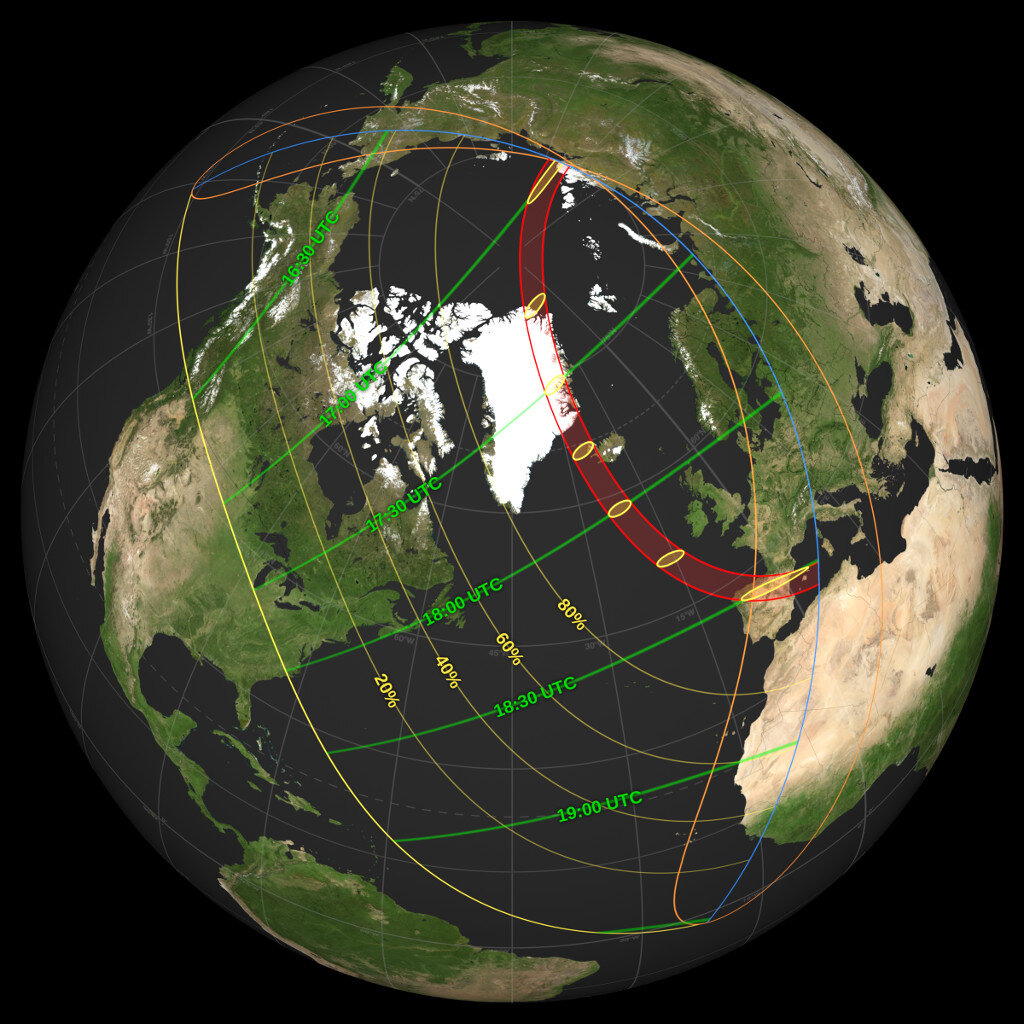
Canada will not lie within the path of totality, where the Moon completely covers the Sun. Instead, observers in northeastern parts of the country will experience a partial solar eclipse, with only a portion of the Sun hidden.
In most of Canada’s largest cities, less than 30% of the Sun will be obscured. The most dramatic view will occur along the northern edge of Nunavut near Greenland. At Canadian Forces Station in Alert, Nunavut, about 93% of the Sun will be covered, creating a noticeable dimming of daylight.
Among Canada’s provincial and territorial capitals, Iqaluit is expected to experience about 61% obscuration, followed by St. John’s at roughly 53%. In both cities, the Moon will appear to take a noticeable bite out of the Sun. Much of Atlantic Canada will also see some of the country’s highest levels of coverage.
The experience will vary considerably by location. Northern and eastern communities will receive the most views, while the southernmost parts of Vancouver Island and British Columbia’s Lower Mainland will miss the eclipse altogether.
| Location ~ Maximum Coverage Area of the Sun’s Disk (obscuration) | Eclipse Duration |
| Iqaluit, NU~ 61% | 12:18 p.m. to 2:28 p.m. Maximum eclipse: 1:24 p.m. |
| St. John’s, NL ~ 53% | 2:28 p.m. to 4:37 p.m. Maximum eclipse: 3:34 p.m. |
| Gander, NL ~ 52% | 2:24 to 4:33 p.m. Maximum eclipse: 3:30 p.m. |
| Labrador City, NL ~ 42% | 1:36 to 3:43 p.m. Maximum eclipse: 2:41 p.m. |
| Channel-Port aux Basques, NL ~ 43% | 2:23 to 4:30 p.m. Maximum eclipse: 3:29 p.m. |
| Sydney, NS ~ 39% | 1:56 to 4:01 p.m. Maximum eclipse: 3:00 p.m. |
| Halifax, NS ~ 31% | 1:58 p.m. to 3:58 p.m. Maximum eclipse: 3:00 p.m. |
| Charlottetown, PEI ~34% | 1:54 p.m. to 3:57 p.m. Maximum eclipse: 2:57 p.m. |
| Fredericton, NB ~ 29% | 1:52 p.m. to 3:52 p.m. Maximum eclipse: 2:53 p.m. |
| Caraquet, NB ~ 35% | 1:49 p.m. to 3:52 p.m. Maximum eclipse: 2:52 p.m. |
| Gaspé, QC ~ 37% | 12:47 p.m. to 2:52 p.m. Maximum eclipse: 1:51 p.m. |
| Montreal, QC ~ 18% | 12:50 p.m. to 2:39 p.m. Maximum eclipse: 1:45 p.m. |
| Quebec City, QC ~ 24% | 12:47 p.m. to 2:43 p.m. Maximum eclipse: 1:46 p.m. |
| Ottawa, ON ~15.5% | 12:49 p.m. to 2:34 p.m. Maximum eclipse: 1:43 p.m. |
| Thunder Bay, ON ~ 7.6% | 12:34 p.m. to 1:59 p.m. Maximum eclipse: 1:16 p.m. |
| Toronto, ON ~ 8% | 12:55 p.m. to 2:23 p.m. Maximum eclipse: 1:40 p.m. |
| Windsor, ON ~ 3% | 1:03 p.m. to 2:08 p.m. Maximum eclipse: 1:36 p.m. |
| Churchill, MB ~ 27.5% | 11:05 a.m. to 12:59 p.m. Maximum eclipse: 12:02 p.m. |
| Winnipeg, MB ~ 5.4% | 11:25 a.m. to 12:40 p.m. Maximum eclipse: 12:02 p.m. |
| Prince Albert, SK ~ 8% | 10:08 a.m. to 11:29 a.m. Maximum eclipse: 10:48 a.m. |
| Saskatoon, SK ~ 5.5% | 10:11 a.m. to 11:23 a.m. Maximum eclipse: 10:47 a.m. |
| Regina, SK ~ 3.3% | 10:19 a.m. to 11:21 a.m. Maximum eclipse: 10:50 a.m. |
| Fort McMurray, AB ~ 14% | 9:56 a.m. to 11:29 a.m. Maximum eclipse: 10:42 a.m. |
| Edmonton, AB ~ 6.5% | 10:02 a.m. to 11:16 a.m. Maximum eclipse: 10:38 a.m. |
| Calgary, AB – 2% | 10:11 a.m. to 11:03 a.m. Maximum eclipse: 10:36 a.m. |
| Yellowknife, NT ~ 28.6% | 9:49 a.m. to 11:36 a.m. Maximum eclipse: 10:42 a.m |
| Whitehorse, YT ~ 23% | 8:40 a.m. to 10:14 a.m. Maximum eclipse: 9:26 a.m |
| Vancouver, Victoria | Not Visible. |
..
There is a slight difference in the percentage calculation using the US Naval Observatory Calculator and the above.
If your location is not listed above, check the Time & Date website.
How & Where to View Solar Eclipse
If the sky is clear (not cloudy) and if you are in the path of the partial eclipse, you can view the eclipse by looking at the Sun during the time of the eclipse from a location of your choosing through special solar filters specially made for the purpose of viewing a solar eclipse.
Remember, it is not safe to view the Sun without appropriate filters.
Ensure you buy genuine glasses through local RASC/Science Centres or reputable stores.
Where to Buy Solar Eclipse Glasses:
- Local RASC/Science Centres.
- List of reputed vendors by NASA
Other Options:
- Do a science project and make a pinhole projector – How to make a pinhole projector.
- Welder’s Mask – A welding mask with a lens rating of 14 (ONLY THAT) is safe for viewing the eclipse. Do not use a welder’s mask if the lens is damaged or scratched or if the shade rating is unknown.
Read the safe viewing article by NASA.
Eclipse Viewing Events in Canada – August 12, 2026
Because the eclipse will be relatively modest, with only limited solar obscuration in most areas, few public viewing events have been planned.
- Point Pelee National Park, Ontario: Watch the partial solar eclipse at Point Pelee National Park with Windsor Centre of the Royal Astronomical Society of Canada. Solar telescopes will be available at the Visitor Centre, where free eclipse glasses will be provided from 12:30 to 1:35 p.m.
- RASC Observatory at TELUS World of Science, Edmonton: View the partial solar eclipse at RASC Observatory in Coronation Park on August 12, from 9:30 a.m. to noon. Admission is free, and RASC volunteers will guide visitors. The all-ages event depends on clear skies and may change with weather conditions without notice.
Check here for a list of RASC Chapters.


