Calgary

Canada’s unemployment rate climbed to 6.7% in October 2026, its highest level in six months, even as total employment remained relatively unchanged.
Statistics Canada’s latest Labour Force Survey, released November 6, shows employment slipped by 4,700 positions. The unemployment rate rose by 0.2 percentage points, marking its second straight monthly increase.
More Canadians were looking for work, with the number of job seekers increasing by 33,000. Meanwhile, the employment rate dropped to 60.5%, its third straight monthly decline.
Young Canadians Face Higher Unemployment
For Canadians aged 15 to 24, unemployment rose to 13.7%, an increase of 0.7 percentage points from September.
Finding work also remains difficult for many already unemployed Canadians. Only 18.9% of people unemployed in September had found jobs by October, compared with 19.8% a year earlier.
Among the country’s 1.5 million unemployed people, 23.7% had been searching for work for at least 27 weeks, up from 21.5% a year earlier.
Alberta Loses Jobs as British Columbia Rebounds
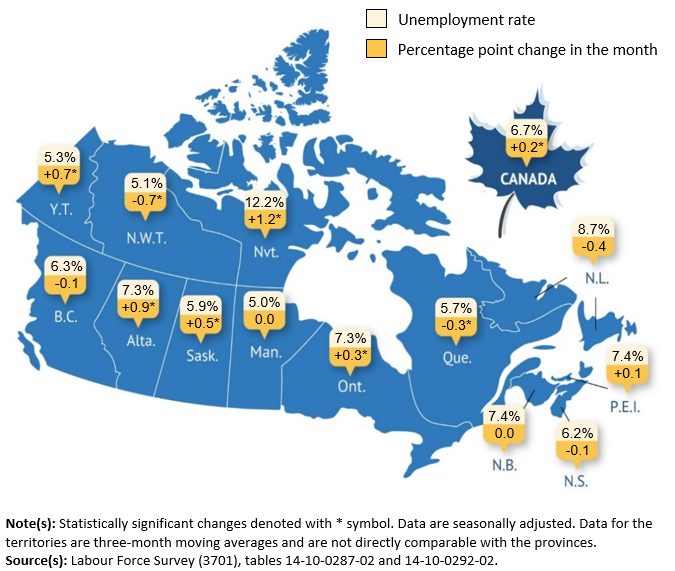
Unemployment rate by province and territory, October 2026 /Labour Force Survey (3701), tables 14-10-0287-02 and 14-10-0292-02. Credit: Statistics Canada
Alberta lost 24,000 jobs, nearly reversing September’s gain of 23,000. Its unemployment rate jumped to 7.3%. British Columbia added 12,000 jobs after losing 20,000 in September, bringing its unemployment rate to 6.3%.
Ontario’s employment was little changed, although unemployment rose to 7.3%. Quebec also saw little employment change after losing 68,000 jobs over August and September. Its unemployment rate fell to 5.7% as fewer people searched for work.
Newfoundland and Labrador gained 2,900 jobs, with unemployment falling to 8.7%. Prince Edward Island lost 1,300 jobs, and its unemployment rate reached 7.4%.
Nova Scotia recorded 2,300 more employed people, with unemployment at 6.2%. New Brunswick’s employment increased by 1,200, while its unemployment rate remained at 7.4%.
Manitoba recorded a smaller employment increase of 800, with unemployment steady at 5.0%. Saskatchewan gained 2,500 employed people, although its unemployment rate rose to 5.9%.
Retail Jobs Decline, Construction Employment Grows
Wholesale and retail trade shed 29,000 jobs in October, extending a year-long decline that has now reached 113,000 positions.
Construction added 16,000 jobs, while educational services gained 15,000.
The number of private sector employees declined by 53,000, while public sector employment increased by 50,000.
Average hourly wages rose 2.2% from a year earlier to $37.89, an increase of 83 cents.
The survey also found that 29.7% of Canadians aged 15 and older lived in households struggling to meet necessary expenses, up from 27.7% in October 2025.
Among major metropolitan areas, Oshawa recorded the highest share at 38.4%, followed by Windsor at 36.9% and Hamilton at 35.9%.
Statistics Canada, Labour Force Survey, October 2026.