Calgary

The Alberta Living Wage Network has released its 2026 living wage rates, showing how much workers need to earn per hour to cover basic expenses in 20 communities across the province.

Unlike the provincial minimum wage of $15 per hour, the living wage represents the actual hourly rate required for a household to meet essential needs, covering food, housing, transportation, child care, and participation in community life, after accounting for taxes and government transfers.
The new calculations range from $18.05 per hour in Medicine Hat to $27.45 in Banff. Calgary’s living wage has increased to $26.90, while Edmonton’s rate now stands at $22.65.
Not every community saw an increase this year. Among the 19 communities with comparable rates from 2025, nine recorded increases and 10 experienced decreases.
2026 Alberta Living Wage: Which Cities Have the Highest Rates?
Banff, included in the calculations for the first time, has the highest living wage among the communities surveyed at $27.45 per hour.
St. Albert follows at $27.20, up from $25.60 in 2025, while Calgary’s rate increased by 40 cents, from $26.50 to $26.90.
Edmonton’s living wage rose from $22.30 to $22.65, an increase of 35 cents.
Red Deer recorded the largest percentage increase among communities with comparable figures, climbing 8.23% from $20.65 to $22.35.
Brooks experienced the largest decline, falling 6.36% from $22 to $20.60. Medicine Hat continues to have the lowest calculated living wage, decreasing slightly from $18.15 to $18.05.
2026 Living Wage Across 20 Alberta Cities and Communities
| City or Community | 2026 Living Wage | 2025 Living Wage |
|---|---|---|
| Banff | $27.45 | New |
| Barrhead | $23.00 | $21.55 |
| Bonnyville | $23.25 | $22.15 |
| Brooks | $20.60 | $22.00 |
| Calgary | $26.90 | $26.50 |
| Cold Lake | $18.70 | $19.10 |
| Drayton Valley | $21.35 | $20.35 |
| Edmonton | $22.65 | $22.30 |
| Fort McMurray | $22.90 | $23.00 |
| Grande Prairie | $21.70 | $21.80 |
| High River | $23.85 | $23.40 |
| Lethbridge | $21.45 | $22.30 |
| Lloydminster (AB/SK) | $21.10 | $21.65 |
| Medicine Hat | $18.05 | $18.15 |
| Red Deer | $22.35 | $20.65 |
| Rocky Mountain House | $21.05 | $21.85 |
| Special Areas | $21.45 | $21.25 |
| Spruce Grove | $22.70 | $23.70 |
| St. Albert | $27.20 | $25.60 |
| Stony Plain | $23.65 | $24.30 |
What Is a Living Wage and How Is It Calculated?
A living wage represents the hourly earnings needed to afford everyday necessities and participate in community life. Unlike minimum wage, it is not a legally mandated pay rate.
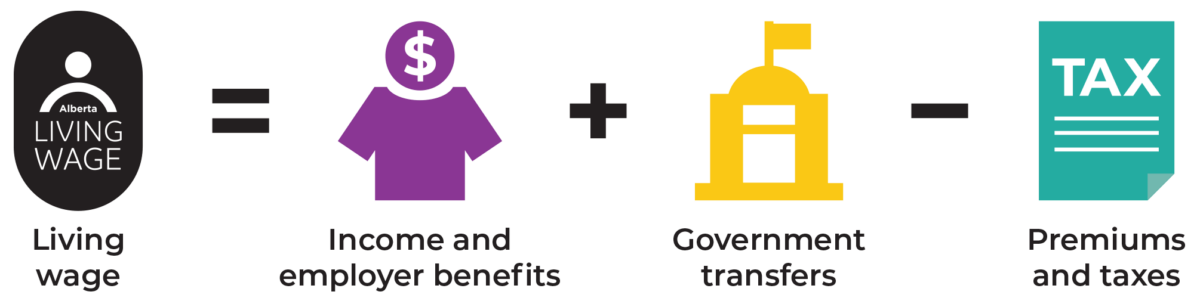
Credit: Alberta Living Wage
The Alberta Living Wage Network bases its calculations on three household types: a two-parent family with two children, a lone parent with one child, and a single adult living alone.
Researchers consider expenses such as housing, groceries, transportation, child care, clothing, education and unexpected costs. Government benefits and income taxes are also included.
The results are weighted according to the prevalence of each household type, producing one living wage rate for each community.
Because living costs and available government supports differ across communities, the amount needed to make ends meet varies throughout Alberta.