Toronto
Canada’s economy picked up noticeably this spring, but the OECD still expects 2026 to be a slow-growth year, especially when compared with the United States.

Credit: sebastiaan stam/ Unsplash
Canada’s economy picked up noticeably this spring, but the OECD still expects 2026 to be a slow-growth year, especially when compared with the United States.
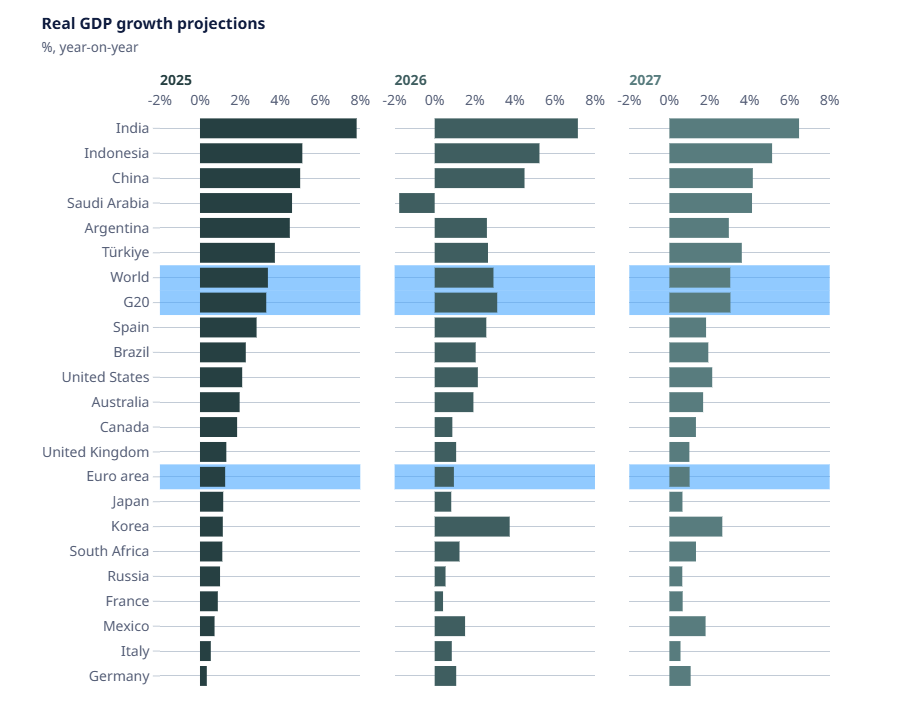
The OECD’s September outlook forecasts Canadian real GDP growth of 0.9 per cent in 2026, strengthening to 1.3 per cent in 2027. The U.S., by comparison, is expected to grow 2.2 per cent this year and 2.1 per cent next year.
The September 2026 OECD Economic Outlook paints a picture of a Canadian economy being pulled in different directions. Investment tied to artificial intelligence and data centres has provided some momentum, while new U.S. tariffs and broader uncertainty around North American trade are creating fresh pressure.
For Canadians, that means the U.S. economy is forecast to expand at more than twice Canada’s pace this year. It does not mean individual Americans will necessarily be twice as well off, since GDP measures economic output rather than household living standards, but it highlights the difference in economic momentum between the two countries.
Canada had a stronger second quarter
The latest official data adds an interesting wrinkle.
Statistics Canada says real GDP grew 0.8 per cent in the second quarter of 2026, following a revised 0.1 per cent increase in the first quarter. Exports, household spending and business capital investment helped drive the spring rebound.
South of the border, the U.S. Bureau of Economic Analysis says real GDP increased at an annualized rate of 2.1 per cent in the first quarter and 1.5 per cent in the second quarter. U.S. growth therefore slowed during the spring.
There is an important difference in how the numbers are reported. The U.S. headline figures are annualized, while Statistics Canada reports the change from one quarter to the next. Converted to a comparable quarterly basis, the U.S. figures work out to roughly 0.5 per cent in Q1 and 0.4 per cent in Q2.
So Canada actually grew faster than the U.S. during the second quarter. The OECD nevertheless expects the U.S. to record substantially stronger growth over 2026 as a whole.
Tariffs remain a Canadian headwind
The OECD points to U.S. trade policy as one reason for caution. New tariffs on Canadian exports are described as a “headwind for certain industries,” although the OECD says the overall economic effect should be limited by their relatively narrow scope. Uncertainty surrounding the future of the United States-Mexico-Canada Agreement could also restrain regional trade.
One bright spot is technology investment. The OECD says investment in data-centre structures and technology equipment helped Canadian growth in the second quarter, with similar effects occurring in the United States and Australia.
Globally, growth is forecast at 2.9 per cent in 2026 and 3.0 per cent in 2027.
The broader message for Canadians is that 2026 remains a slow-growth year. The OECD sees some improvement ahead, but that recovery depends on stronger household spending and investment taking hold while Canada navigates a more uncertain trading relationship with the United States.
OECD Economic Outlook, Interim Report September 2026