Toronto
Residents of Kenora and other parts of northwestern Ontario could skip the annual ritual of turning their clocks back this November.
The Ontario government announced on October 13 that it intends to introduce permanent daylight saving time in communities that follow Central Time, keeping them aligned with neighbouring Manitoba.
The proposed change would take effect by November 1, 2026, when clocks would normally move back one hour as daylight saving time ends.
For affected communities, that means no seasonal clock change this fall.
Which Parts of Ontario Will Be Affected?
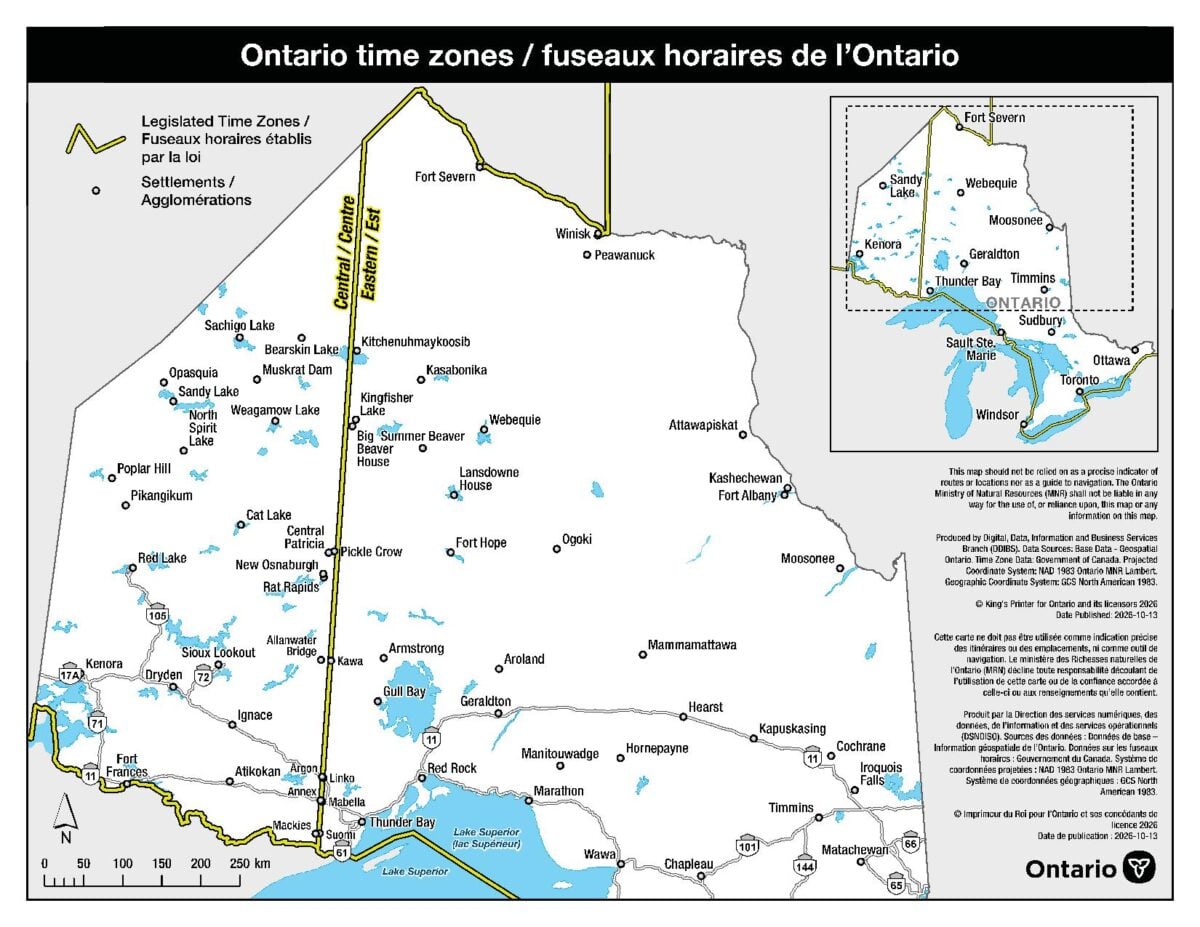
The change would apply to Kenora and northwestern Ontario communities west of the 90th meridian that have historically followed Manitoba’s time.
Under the proposal, these communities would remain on Central Daylight Time throughout the year instead of switching between daylight saving time and standard time.
The proposed change would affect Kenora and other Northwestern Ontario communities that currently observe Central Time and change their clocks seasonally, including Dryden, Fort Frances, Sioux Lookout, Red Lake and Rainy River. Under the proposal, these communities would remain on Central Daylight Time year-round instead of turning their clocks back on November 1, 2026.
Interestingly, that would also mean they would have the same clock time as Toronto and the rest of Eastern Time Ontario during winter, even though they are geographically in the Central Time Zone.
The change would not affect Thunder Bay, which follows Eastern Time and will continue changing its clocks twice a year. Atikokan and Pickle Lake already observe Eastern Standard Time year-round and do not change their clocks seasonally.
The rest of Ontario, including communities in the Eastern Time Zone, would continue changing clocks twice annually.
Why Is Ontario Making the Change?
Manitoba announced on September 17 that it would adopt permanent daylight saving time beginning November 1, 2026.
Ontario says remaining in step with Manitoba would avoid complications for businesses operating across provincial boundaries, as well as residents arranging medical appointments, travel and other services.
Attorney General Doug Downey described the proposal as a way to maintain stability.
“By keeping this part of the province aligned with Manitoba, our government is taking a practical, common-sense approach to avoid unnecessary disruptions and ensure economic stability in communities that reside in Ontario’s central time zone.”
The government says it consulted communities and Indigenous leaders throughout northwestern Ontario following Manitoba’s announcement.
Greg Rickford, Minister of Indigenous Affairs and First Nations Economic Reconciliation, said those discussions produced unanimous regional support for permanent daylight saving time.
Will the Rest of Ontario Stop Changing Clocks?
Not yet.
Ontario passed the Time Amendment Act, 2020, which would allow permanent daylight saving time across the province once brought into force.
However, the government says coordination with neighbouring jurisdictions, including Quebec and New York, remains important for trade, financial markets and broadcasting.
For now, the proposed November 1 change would apply only to affected northwestern Ontario communities, while the rest of the province continues its twice-yearly clock changes.