 Banff
Banff 
It’s that time of the year again! Lighting up the sky in April is the annual Lyrid meteor shower, and you may get to see multiple bright shooting stars, provided the sky is clear.
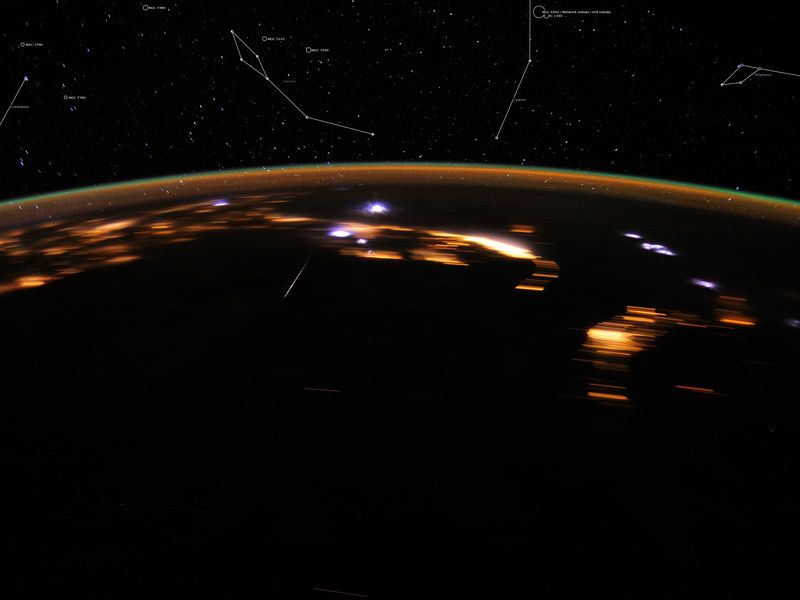
Image from the International Space Station taken during the Lyrid meteor shower on April 21, 2012. Image Credit: NASA
What is a Lyrid meteor shower?
The Lyrid meteor shower is one of the oldest known meteor showers, dating back 2700 years; the first recorded sighting goes back to 687 BC by the Chinese. The Lyrid meteors are pieces of rock and dust from Comet Thatcher(C/1861 G1).
Every year, the Earth will pass through this cloud of debris left in the comet’s orbit (Yes, Comets, like Earth, orbit around the sun, albeit highly elliptical!).
The meteors burn as they enter the Earth’s atmosphere, creating the bright streaks in the sky we call a meteor shower. At their most spectacular (a meteor outburst), the Lyrids are known to surge up to 60 – 100 meteors per hour.
The Lyrids leave glowing trains of ionized gas (these are observable for several seconds) behind them as they burn through the Earth’s atmosphere. At its peak, you could observe 10 to 15 meteors per hour.
When to watch for the Lyrid meteor shower:
The annual Lyrid meteor shower is active from about April 16 to 25.
Those who want to glimpse this celestial phenomenon should get outside during the nights of April 20 and the predawn hours of April 21 and 22.
The Moon: The new moon was on April 17. This means that the moon is a waxing crescent with about 17 per cent illumination. Plus, the moon does not rise during the night hours, making the sky remain relatively dark for most of the night, improving visibility during the early hours of the meteor shower.
Spring Weather: For many in Canada, the spring cloud cover may hinder the view of the shooting stars that you might get to see.
How to see the Lyrid meteor shower:
Required Conditions: Clear Sky away from city lights — Check clear sky (cloud) conditions in your area – here.
The Lyrid meteors appear to radiate from the constellation Lyra the Harp, near the star Vega (one of the brightest stars in the night sky) in the Northeast at around 10 p.m. Though, you will be able to view it from any direction, it is advised that you lie down with your feet facing east to get a more spectacular perspective of the long meteor tails.
Those lucky enough to live far away from city lights can just look up at the sky between moonset and dawn. You may lie down or sit on a lawn chair and look straight up. Let your eyes get adapted to the dark.
Reasonably Dark Areas Near Your Home:
To find reasonably dark areas near your location, check the Darkskyfinder map. Search for a park (or a safe place with no streetlights away from roads/traffic) within the areas coloured dark (mustard) yellow, green, blue, grey or black (transparent).
Before travelling, please check the cloud cover.
Things to note:
- Make sure you switch off the phone, and your eyes need ~ 30 minutes to get adjusted to the dark. If you are carrying a flashlight, cover it with red cellophane wrap or some red filter so that it doesn’t interfere with viewing.
- Watch the night sky for at least 15 to 20 minutes for a chance to spot meteors. The shower can produce more than 80 meteors per hour at its best. You can see the shower with your naked eyes and do not need astronomy equipment.
- Bring a blanket or a lawn chair so that you can sit comfortably to watch the shower.


