Toronto
What are your new year’s resolutions? If it is to save some money, the place to start your budget planning is your take-home pay.
The rise in income tax brackets, TFSA and RRSP limits may help to some extent despite high inflation.
Personal income tax and benefit amounts are indexed to inflation. In 2023, the federal tax bracket is indexed to 6.3%, up from 2.4% in 2022.
If you do not own your own home and plan to buy one in future, you can also save up to $40,000 in Tax-Free First Home Savings Account.
Contents:
- Tax Brackets – Federal & Provincial
- TFSA & RRSP
- Employment Insurance & CPP contributions
- Old Age Security, Goods and Services Tax credit
- Canada Child benefit, Child Disability Benefit
- First Home Savings Account & Multigenerational Home Renovation Tax Credit
Here are all the major changes taking place in 2023:
1. Tax Brackets – Federal & Provincial
2023 Federal Tax Bracket thresholds
| Tax Rate | 2023 | 2022 |
|---|---|---|
| 15% bracket | up to $53,359 | up to $50,197 |
| 20.5% bracket | $53,359 — $106,717 | $50,197 — $100,392 |
| 26% bracket | $106,717 — $165,430 | $100,392 — $155,625 |
| 29% bracket | $165,430 — $235,675 | $155,625 — $221,708 |
| 33% bracket | over $235,675 | over $221,708 |
Basic personal amount: The basic personal amount before any personal tax applies has been increased to $15,000 for those earning $165,430 (29% tax bracket), up from $14,398 for those earning $155,625 (29% tax bracket) in 2022. Those in the 33% will have a basic personal amount of $13,521. Those in the 29% tax bracket will get an adjusted basic personal amount according to the formula: $15,000 – ($235,675 – $165,430) × ($1,479 / $70,245).
An increase in basic personal amounts and indexing rates means you will receive a higher salary in 2023 or owe less tax when you file your 2023 taxes in 2024.
2023 B.C. Tax Brackets
The BC tax brackets and personal tax credit amounts are increased for 2023 by 6%. The basic personal amount for 2023 is $11,981, up from $11,302 in 2022.
| Tax Rate | 2023 | 2022 |
|---|---|---|
| 5.06%u | up to $45,654 | up to $43,070 |
| 7.70% | $45,654 — $91,310 | $43,070 — $86,141 |
| 10.50% | $91,310 — $104,835 | $86,141 — $98,901 |
| 12.29% | $104,835 — $127,299 | $98,901 — $120,094 |
| 14.70% | $127,299 — $172,602 | $120,094 — $162,832 |
| 16.80% | $172,602 — $240,716 | $162,832 — $227,091 |
| 20.50% | over $240,716 | over $227,091 |
2023 Alberta Tax Brackets
Alberta’s basic personal amount will increase to $21,003, and tax bracket thresholds have been increased by six per cent for 2023. The government also increased the 2022 basic personal amount to $19,814 from the previously announced $19,369.
| Tax Rate | 2023 | 2022 |
|---|---|---|
| 10% | up to 142,292 | up to $134,238 |
| 12% | 142,292 — 170,751 | $134,238 — $161,086 |
| 13% | 170,751 — $227,668 | $161,086 — $214,781 |
| 14% | $227,668 — $341,502 | $214,781 — $322,171 |
| 15% | over $341,502 | over $322,171 |
2023 Saskatchewan Tax Brackets
The Saskatchewan tax brackets are increased by 6.3% for 2023. The basic personal amount for 2023 is $17,661, up from $16,615 in 2022.
As per the news release, an individual with an income of $25,000 will see $125 in savings, a family of four with a combined annual income of $75,000 will save $371, and a family of four with a combined annual income of $100,000 will save $362.
| Tax Rate | 2023 | 2022 |
|---|---|---|
| 10.5% | up to $49,720 | up to $46,773 |
| 12.5% | $49,720 — $142,058 | $46,773 — $133,638 |
| 14.5% | over $142,058 | over $133,638 |
2023 Manitoba Tax Brackets
The Manitoba tax brackets are increased by 7% for 2023. The basic personal amount for 2023 is $10,855, up from $10,145 in 2022.
| Tax Rate | 2023 | 2022 |
|---|---|---|
| 10.8% | up to $36,842 | up to $34,431 |
| 12.75% | $36,842.01 — $79,625 | $34,431 — $74,416 |
| 17.4% | over $79,625 | over $74,416 |
2023 Ontario Tax Brackets
Ontario tax bracket thresholds, except for the top two tiers, have been increased by 6.5 per cent for 2023. The basic personal amount is $11,865 in 2023, up from $11,141 in 2022.
| Tax Rate | 2023 | 2022 |
|---|---|---|
| 5.05% | up to $49,231 | up to $46,226 |
| 9.15% | $49,231 — $98,463 | $46,226 — $92,454 |
| 11.16% | $98,463 — $150,000 | $92,454 — $150,000 |
| 12.16% | $150,000 — $220,000 | $150,000 — $220,000 |
| 13.16% | over $220,000 | over $220,000 |
2023 Quebec Tax Brackets
Quebec tax bracket thresholds have been increased by 6.44 per cent for 2023. The basic personal amount is $17,183 in 2023, up from $16,143 in 2022.
| Tax Rate | 2023 | 2022 |
|---|---|---|
| 15 % | up to $49,275 | up to $46,295 |
| 20 % | $49,275 — $98,540 | $46,295 — $92,580 |
| 24 % | $98,540 — $119,910 | $46,295 — $92,580 |
| 25.75% | over $119,910 | over $112,655 |
2023 New Brunswick Tax Brackets
New Brunswick has introduced new tax brackets for the taxation year 2023, which would reduce provincial personal income taxes. The province also eliminated the fourth income bracket and will tax this group at the same rate as the third income bracket – from 17.84 per cent to 16 per cent. Tax bracket thresholds have been increased by 6.3 per cent for 2023.
The basic personal amount is $12,458 in 2023, up from $11,720 in 2022.
| 2023 Tax Rate | 2023 | 2022 Tax Rate | 2022 |
|---|---|---|---|
| 9.4% | up to $47,715 | 9.4% | up to $44,887 |
| 14.0% | $47,715 — $95,431 | 14.82% | $44,887 — $89,775 |
| 16.0% | $95,431 — $176,756 | 16.52% | $89,775 — $145,955 |
| 19.5% | over $176,756 | 17.84% | $145,955 — $166,280 |
| .. | .. | 20.30% | over $166,280 |
2023 Nova Scotia Tax Brackets
There is no change in tax brackets for 2023.
The basic personal amount is $11,481.
| Tax Rate | 2023 | 2022 |
|---|---|---|
| 8.79% | up to $29,590 | up to $29,590 |
| 14.95% | $29,590 — $59,180 | $29,590 — $59,180 |
| 16.67% | $59,180 — $93,000 | $59,180 — $93,000 |
| 17.50% | $93,000 — $150,000 | $93,000 — $150,000 |
| 21.00% | over $150,000 | over $150,000 |
2023 Prince Edward Island Tax Brackets
There is no change in tax brackets for 2023.
The basic personal amount is $12,000 in 2023, up from $11,250 in 2022.
| Tax Rate | 2023 | 2022 |
|---|---|---|
| 9.8% | up to $31,984 | up to $31,984 |
| 13.8% | $31,984 — $63,969 | $31,984 — $63,969 |
| 16.7% | over $63,969 | over $63,969 |
2023 Newfoundland & Labrador Tax Brackets
The NL tax brackets are increased by 6.9% for 2023.
The basic personal amount is $10,382 in 2023, up from $9,804 in 2022.
| Tax Rate | 2023 | 2022 |
|---|---|---|
| 8.7% | up to 142,292 | up to $39,147 |
| 14.5% | $41,457 — $82,913 | $39,147 — $78,294 |
| 15.8% | $82,913 — $148,027 | $78,294 — $139,780 |
| 17.8% | $148,027 — $207,239 | $139,780 — $195,693 |
| 19.8% | $207,239 — $264,750 | $195,693 — $250,000 |
| 20.8% | $264,750 to $529,500 | $250,000 — $500,000 |
| 21.3% | $529,500 — $1,059,000 | $500,000 –$1,000,000 |
| 21.8% | over $1,059,000 | over $1,000,000 |
2023 Yukon Tax Brackets
Except for the top tier, the Yukon tax brackets are increased by 6.3% for 2023.
The basic personal amount is $15,000 in 2023, up from $14,398 in 2022.
| 2023 Tax Rate | 2023 | 2022 |
|---|---|---|
| 6.40% | Up to $53,359 | Up to $50,197 |
| 9% | $53,359 — $106,717 | $50,197 — $100,392 |
| 10.90% | $106,717 — $165,430 | $100,392 — $155,625 |
| 12.80% | $165,430 — $500,000 | $155,625 — $500,000 |
| 15.00% | over $500,000 | over $500,000 |
2023 Northwest Territories Tax Brackets
Northwest Territories tax brackets are increased by 6.3% for 2023.
The basic personal amount is $16,593 in 2023, up from $15,609 in 2022.
| Tax Rate | 2023 | 2022 |
|---|---|---|
| 5.90% | up to $48,326 | up to $45,462 |
| 8.60% | $48,326 — $96,655 | 0ver $45,462 — $90,927 |
| 12.20% | $96,655 — $157,139 | 0ver $90,927 — $147,826 |
| 14.05% | over $157,139 | over $147,826 |
2023 Nunavut Tax Brackets
Nunavut tax brackets are increased by 6.3% for 2023.
The basic personal amount is $17,925 in 2023, up from $16,862 in 2022.
| Tax Rate | 2023 | 2022 |
|---|---|---|
| 4.0% | up to $50,877 | up to $47,862 |
| 7.0% | $50,877 — $101,754 | $47,862 — $95,724 |
| 9.0% | $101,754 — $165,429 | $95,724 — $155,625 |
| 11.5% | over $165,429 | over $155,625 |
II. TFSA & RRSP
The 2023 TFSA contribution limit will be increased to $6,500 from $6,000. This means that the total TFSA limit will be $88,000 for a Canadian resident who has never contributed to the tax-free fund since 2009.
The registered retirement savings plan has been increased to $30,780, up from $29,210 in 2022.
III. Employment Insurance & CPP contributions
The maximum pensionable earnings under the Canada Pension Plan (CPP) for 2023 will be $66,600 — up from $64,900 in 2022. The basic exemption amount for 2023 remains at $3,500. The maximum employer and employee contribution to the plan for 2023 will be $3,754.45 each (5.965%), and the maximum self-employed contribution will be $7,508.90. The maximums in 2022 were $3,499.80 and $6,999.60, respectively.
For Quebec Pension Plan, the maximum contributions by employees and employers will be $4,038.40.
The maximum insurable earnings will increase from $60,300 to $61,500. The employee EI premium rate will be $1.63 per $100 starting January 1, 2023. The premium rate for Quebec workers will be $1.27 in 2023.
As per the Canadian Federation of Independent Business, this increase in CPP and EI amounts to $305 less in take-home income.
More Information:
See Chapter 8 – Rates and amounts on the CRA website for reference for federal and provincial tax brackets mentioned above.
To get a basic idea about your take-home income starting in 2023, use CRA’s Payroll Deductions Online Calculator.
To calculate any pending 2023 taxes or refunds owed based on your 2022 salary, you can use any Canadian tax calculator online.
IV. Old Age Security
The old age security (OAS) repayment increases by $5,151 from 2022 to $86,912 in 2023. This means that, if you are an OAS recipient, your OAS payments will reduce by a recovery tax amount of 15% if your income increases above $86,912.
V. Goods and Services Tax credit, Canada Child benefit, Child Disability Benefit
Goods and services tax credit, the Canada child benefit and Child disability benefit will increase effective July 1st of 2023, which is the beginning of the program year for payments of these income-based benefits.
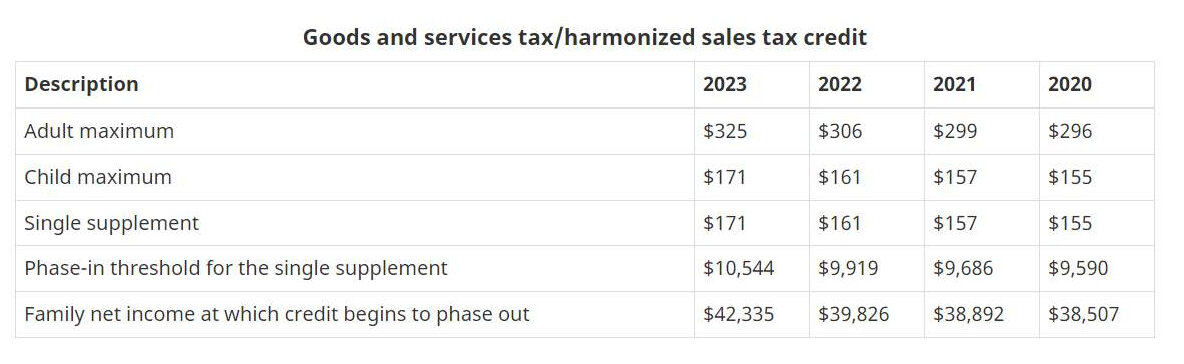
Goods and services tax credit will increase to $325 for a single adult, up from $306. The family net income at which credit begins to phase out will be $42,335, up from $39,826.
The base Canada child benefit for a child under age 6 will be $7,437 and $6,275 for child aged 6 to 17. The family net income at which benefit reduction begins has been increased to $34,863.
The maximum child disability benefit will be $3,173, and the family net income threshold for payment reductions has been increased to $75,537.
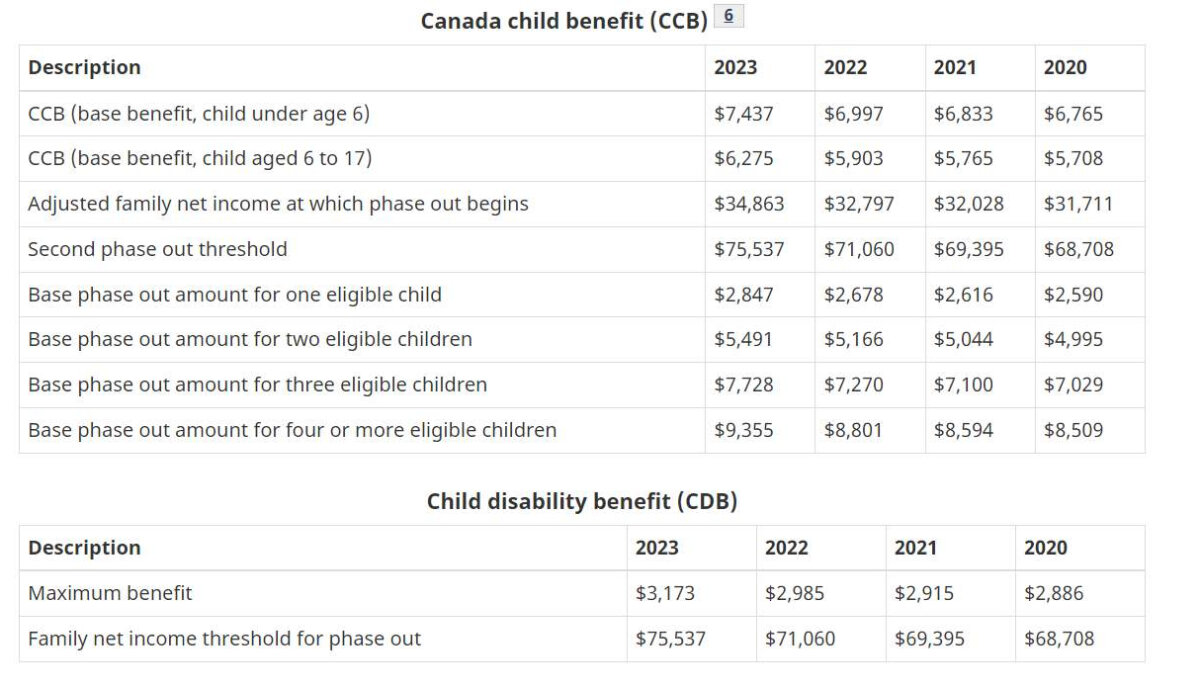
Credit: CRA/Canada.ca
See the Indexation adjustment for personal income tax and benefit amounts webpage on the CRA website for all other changes in 2023, including refundable medical expense supplement, refundable medical expense supplement, and Canada training credit.
VI. First Home Savings Account & Multigenerational Home Renovation Tax Credit
You can also begin a First Home Savings Account if you do not own a home. FHSA is a “tax-free in, tax-free out” account where you can deduct contributions – up to $8,000 per year (the annual maximum) – from income, but the investment growth in the Tax-Free First Home Savings Account will not be taxable. The FHSA is proposed to begin in April of 2023.
If you want to spend the money on home renovations, Canadians living with their parents, grandparents or in multigenerational homes can get a 15% tax credit on up to $50,000 (up to $7,500) of eligible renovation and construction costs of a secondary suite for a senior or an adult with a disability, starting Jan 1st of 2023 under Multigenerational Home Renovation Tax Credit.