Calgary
Canada’s population edged lower over the latest quarter, marking a sharp change from the rapid growth seen in recent years. Preliminary estimates from Statistics Canada point to a decline driven largely by shifts in temporary migration, reflecting recent policy changes that have reduced the number of people staying in the country on short-term permits.
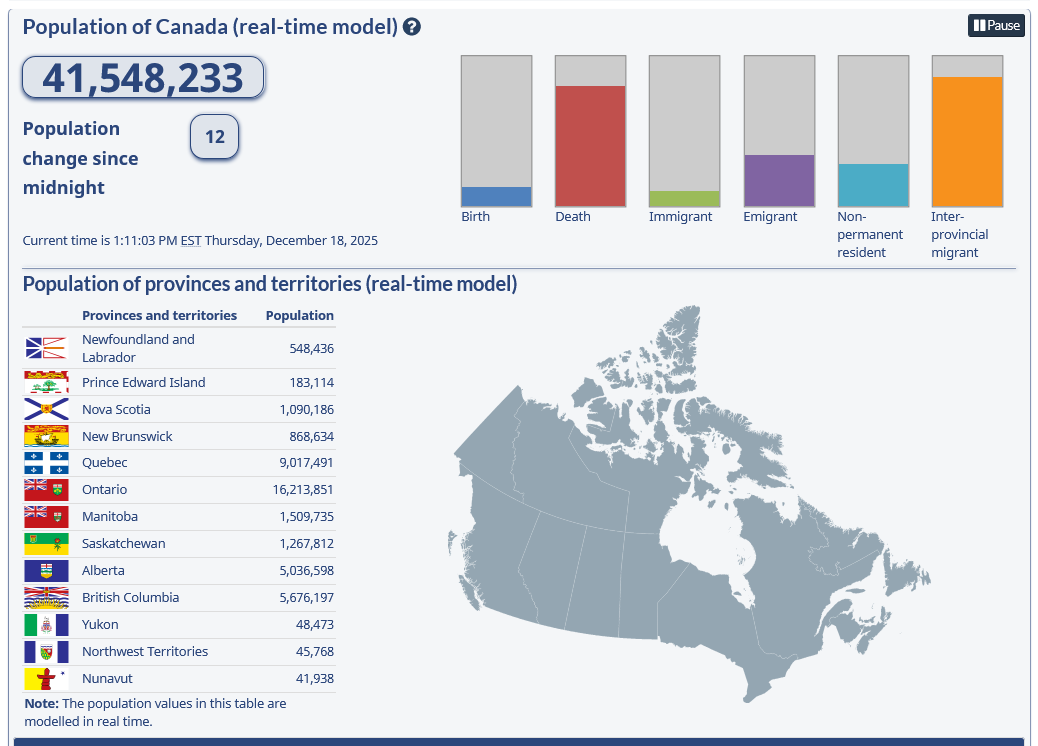
The national population fell by 76,068 people, or 0.2%, reaching 41,575,585. While the figures are subject to revision as more complete data become available, they offer an early snapshot of how demographic patterns are evolving.
Here are the highlights of the third quarter report on Canada’s population estimates:
- Canada recorded a population decrease of 76,068 people in the third quarter, contrasting with gains of 231,803 in the same period a year earlier.
Two years ago, population growth reached a historic high of 418,634 people, the fastest quarterly increase since comparable data from the 1950s. - Ontario posted the largest percentage drop in population (-0.4%), followed by British Columbia (-0.3%). Manitoba and the Northwest Territories each declined by 0.2%. Alberta and Nunavut were the only jurisdictions to grow, both at 0.2%, although Alberta’s increase was its weakest since the second quarter of 2021.
- The number of non-permanent residents fell by 176,479, the largest quarterly drop since comparable records began in 1971. Ontario saw the biggest reduction (-107,280), followed by British Columbia (-26,242), Quebec (-15,989) and Alberta (-10,605). Canada counted 2,847,737 non-permanent residents, or 6.8% of the population, down from 3,024,216, or 7.3%. Outflows reached a record 339,505 as permits expired, compared with 163,026 new permits issued.
- The largest decreases came from study permit holders only (-73,682) and those holding both work and study permits (-67,616). Ontario (-47,511) and British Columbia (-14,291) accounted for most of the drop in study permit holders.
- Asylum claimants and related groups increased by 7,324, reaching a record 504,767, though this was the smallest quarterly rise since early 2022.
- Canada welcomed 102,867 permanent immigrants, consistent with recent quarters and aligned with the federal immigration levels plan.
- Natural increase remained modest at 17,600, reflecting “ultra-low fertility,” and was outweighed by net international migration losses of 93,668.
- Canada admitted 102,867 permanent immigrants, consistent with recent quarters and aligned with federal immigration targets.
- Natural increase was modest at 17,600 and was outweighed by net international migration losses of 93,668, reflecting the country’s ultra-low fertility levels.
- Interprovincial migration totalled 75,758 moves, down 5.5% from a year earlier and closer to pre-pandemic levels. Alberta posted the most significant net gain (+5,652), followed by British Columbia (+1,504). Ontario’s net loss was just 972 people, its smallest quarterly loss since late 2020.