Toronto
Canada is reshaping how the country builds and buys military equipment, arguing that a shifting global landscape requires a more self-reliant approach.
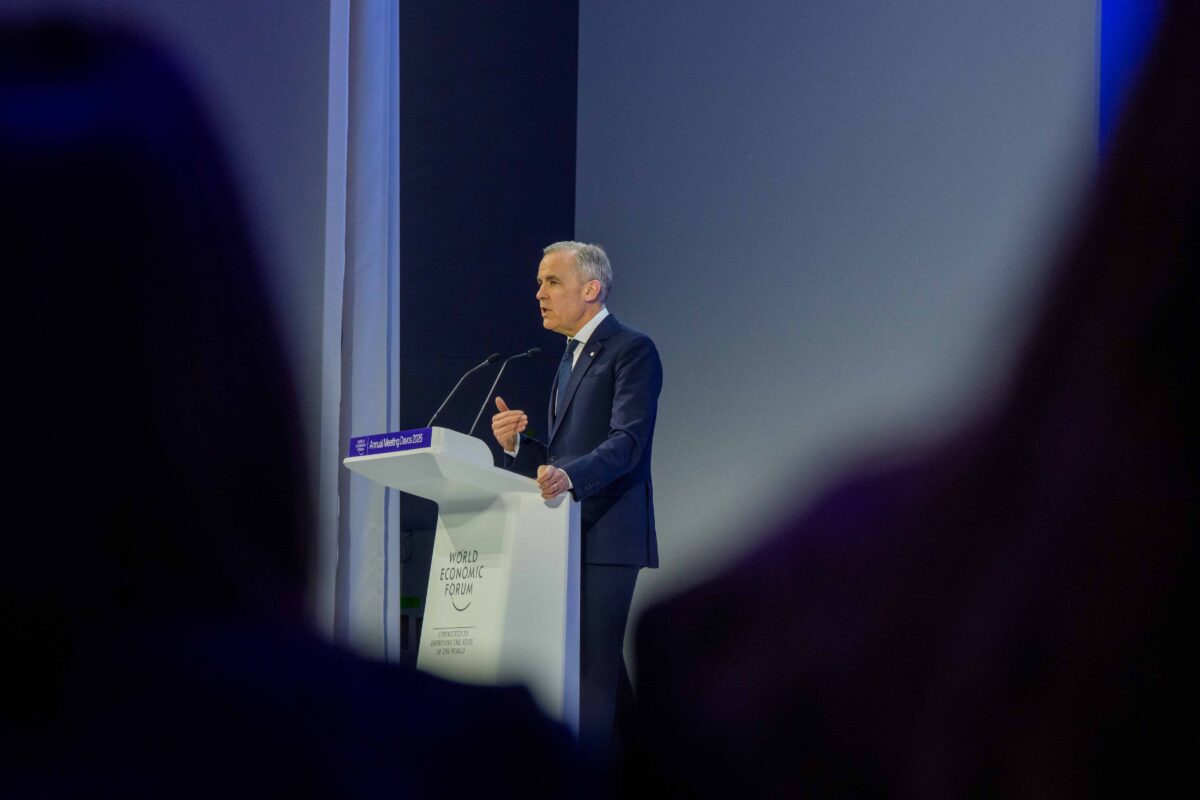
Prime Minister Mark Carney at Davos on January 20, 2026/Credit: Lars Hagberg/PMO
Prime Minister Mark Carney has launched Canada’s first Defence Industrial Strategy, a plan centred on prioritizing domestic suppliers, accelerating procurement and strengthening the Canadian Armed Forces (CAF). The government says Canada is on track to meet NATO’s two per cent spending benchmark this fiscal year, while applications to join the CAF have risen nearly 13 per cent.
At the core of the strategy is a shift away from what officials describe as a slow and overly complex procurement system that has relied heavily on foreign suppliers. The new framework aims to give Canadian firms more predictable demand and increase the share of defence contracts awarded domestically to 70 per cent. It also targets a 50 per cent increase in defence exports and a 240 per cent rise in industry revenues.
Over the next decade, Ottawa points to $180 billion in defence procurement opportunities and $290 billion in related capital investments, with an estimated $125 billion downstream economic benefit by 2035. The plan forecasts 125,000 high-paying jobs across supply chains. It also sets fleet readiness goals: 75 per cent serviceability for maritime assets, 80 per cent for land fleets and 85 per cent for aerospace.
A new Defence Investment Agency will oversee streamlined processes and joint procurement efforts. Financial measures include a $4 billion Defence Platform at the Business Development Bank of Canada, $379.2 million for a Regional Defence Investment Initiative and $656.9 million to support defence and dual-use technology development. Additional commitments include $105 million for a Drone Innovation Hub and $459 million for a research aircraft platform.
The strategy also introduces a Canadian Defence Industry Resilience Program, including domestic production of nitrocellulose, and a Canada Defence Skills Agenda to address workforce gaps.
In total, the government describes the initiative as an investment of more than half a trillion dollars aimed at strengthening sovereignty, industry capacity and military readiness.