 Calgary
The average asking rent for residential properties in Canada fell 3.2% year-over-year in September to $2,123, according to the October 2025 National Rent Report by Rentals.ca and Urbanation.
This marks the 12th straight month of annual declines and the first two-year rent decrease since January 2022, following a 38-month period of steady rent increases that ended in September 2024.
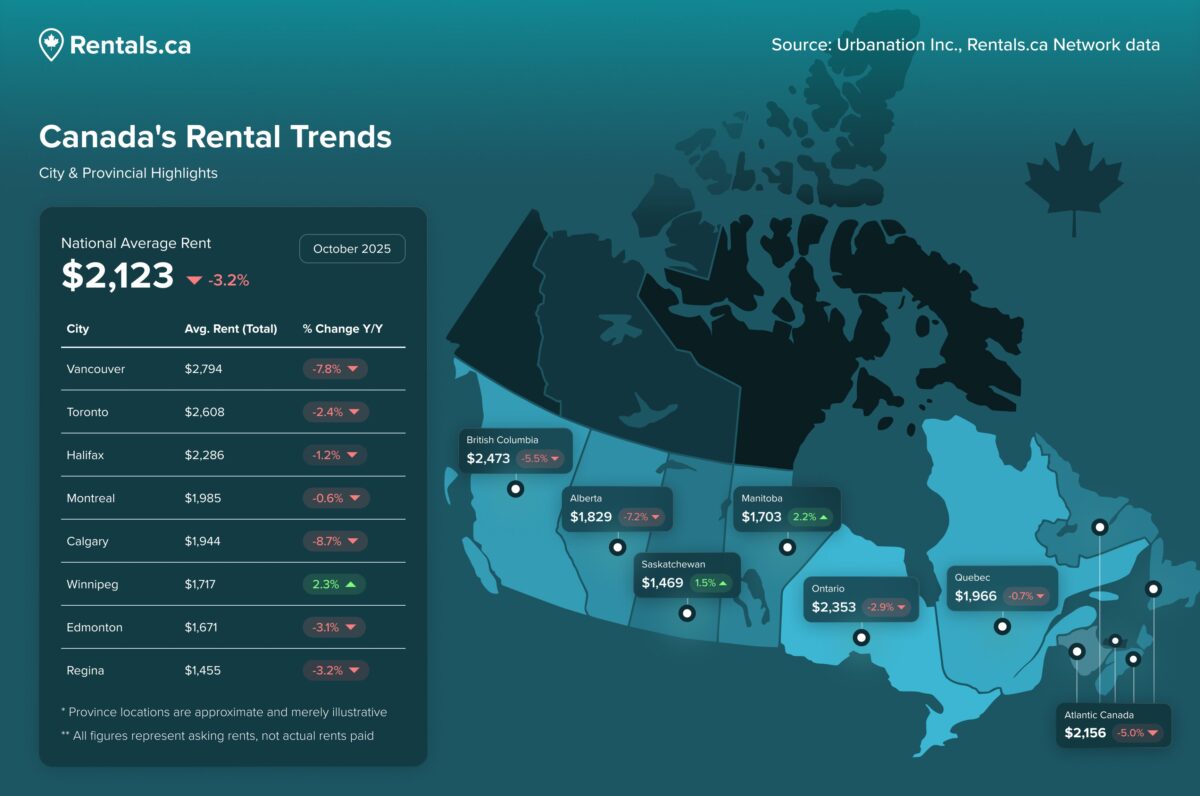
Urbanation President Shaun Hildebrand attributed the trend to an increase in rental supply exceeding demand, noting that affordability levels are the best seen in two years, particularly in Vancouver and Toronto, where rents have hit four-year lows.
Rents across all housing types fell, reflecting record apartment completions, slower population growth among non-permanent residents, and a softer job market. Despite the year-over-year decline, rent levels have remained stable in recent months, with the three-month moving average showing no change in September.
Key Findings
National Overview
- Average rent declined 3.2% year-over-year to $2,123.
- Purpose-built rentals averaged $2,093 (-2.1%), condos $2,226 (-3.0%), and houses/townhouses $2,178 (-5.5%).
- One-bedroom units saw the steepest annual drop (-4.1% to $1,836).
Provincial Trends
- British Columbia and Alberta recorded the sharpest rent drops for apartments, both down 5.5% to $2,430 and $1,734, respectively.
- Ontario and Nova Scotia followed with -2.7% to $2,316 and -2.2% to $2,293, respectively.
- Manitoba was the only province with rent growth (+2.6% to $1,680).
City Highlights
- Rents fell in all six major cities, led by Vancouver (-8.2% to $2,776) and Calgary (-7.4% to $1,897).
- Toronto rents dropped 2.9% to $2,592, the smallest decline in over a year.
- Kingston led the country in apartment rent growth, rising 19.9% year-over-year, while Coquitlam saw the largest drop at 15%.
Shared Accommodations
- Average rent across four provinces dropped 6.6% to $943.
- Vancouver led declines with a 14.7% decrease to $1,268.


