 Kelowna
In March, the average asking rent for residential properties across Canada was $2,181, marking an 8.8% increase from the previous year, though showing a slight slowdown from February’s 10.5% growth rate, according to the National Rent Report by Rentals.ca and Urbanation.
This moderation reflects a 0.6% month-over-month decline in March.
“The March data showed early signs of rent increases easing at the national level, weighed down by recent declines in key markets in Vancouver and Toronto,” said Shaun Hildebrand, President of Urbanation, in a statement.
“As population growth slows with caps on non-permanent residents and supply increases as rental completions continue to rise, rent growth should continue to moderate towards more sustainable levels.”
Here are the highlights of the April National Rent Report:
- Rental Growth: Over the past four years, since March 2020, asking rents have risen by a total of 21%, averaging an annual increase of just over 5%.
- Purpose-Built and Condo Rent: Asking rents for purpose-built apartments saw a 12.7% year-on-year increase to $2,117 in March, while rents for condo apartments grew only 3.9% annually to $2,321.
- Provincial Variations: Alberta recorded a significant rent increase of 18.3% over the past year, the highest in the country, with average rents at $1,728. Saskatchewan closely followed with an 18.2% increase. In contrast, rents in B.C. dropped 1.9% year-over-year to $2,494.
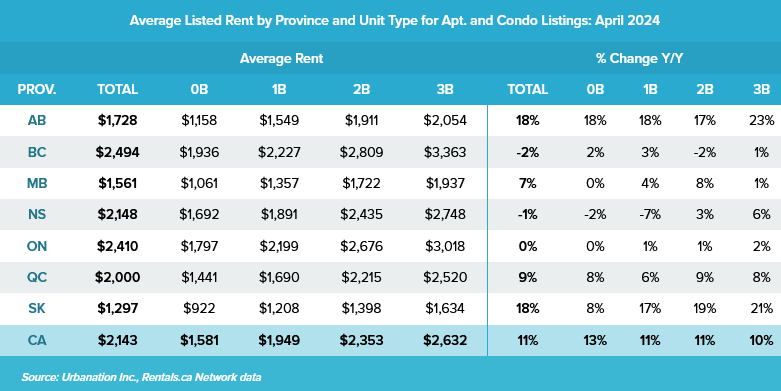
Credit: National Rent Report
- Studio and One-Bedroom Apartments: Rents for the smallest unit types in purpose-built apartments saw significant increases, with studios and one-bedrooms rising 14.9% and 13.6% respectively.
- Ontario and B.C.: In Ontario, rents declined 0.9% from February to March, reaching a 10-month low of $2,410. In British Columbia, despite a slight month-over-month increase, rents fell annually by 1.9%.
- Vancouver’s Declining Rents: Vancouver experienced a 4.9% year-over-year decrease in rents, with March figures falling below $3,000 for the first time since July 2022.
- Toronto and Montreal: Toronto rents decreased by 1.3% year-over-year, while Montreal saw a 9.3% increase, setting a new record-high average of $2,051.
- Calgary and Edmonton: Calgary’s rents increased by 9.8% annually, while Edmonton, though cheaper, saw a substantial 20.9% rise in three-bedroom apartment rents.
- Roommate Rents: In March, the average asking rent for shared accommodations in Canada remained above $1,000 for the fourth consecutive month. British Columbia recorded the highest average at $1,195, followed by Vancouver and Toronto with $1,416 and $1,273 respectively. Ontario’s average was $1,089, while rents in Quebec and Alberta were lower, at $900 and $876.
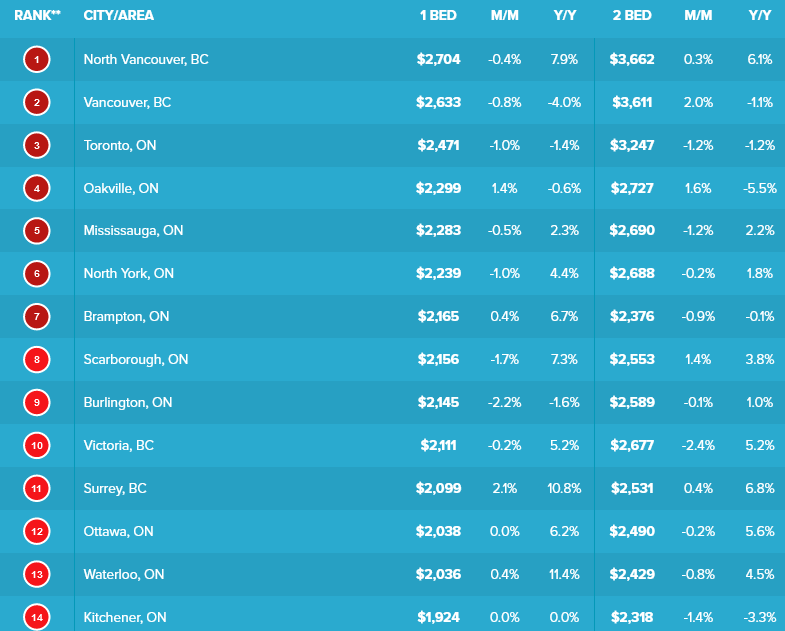
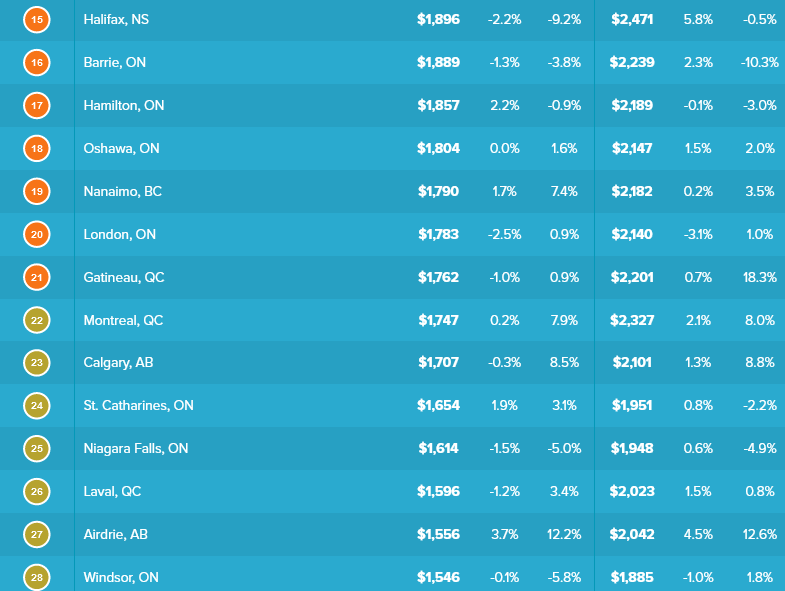
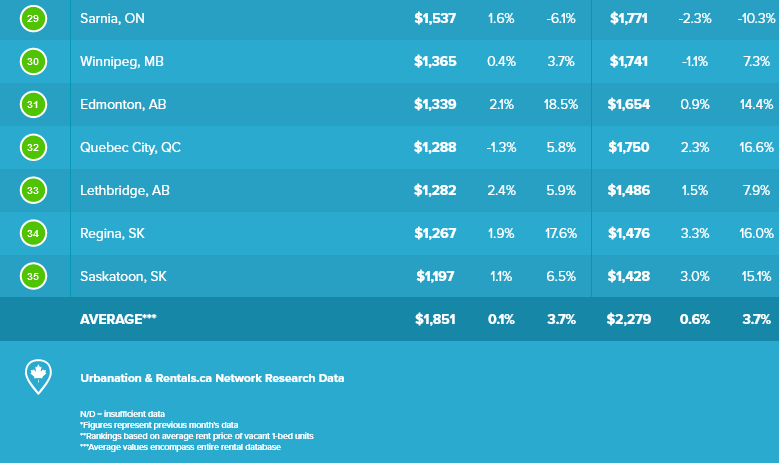
The National Rent Report
The National Rent Report analyzes monthly, quarterly, and annual rental market rates and trends on a national, provincial, and municipal level across all listings on the Rentals.ca Network for Canada. Urbanation, a Toronto-based real estate research firm, analyzes Rentals.ca Network data and writes the report.


