Toronto
A celestial treat awaits early risers this week as you can see all 5 planets visible with the naked eyes aligned together in the sky.
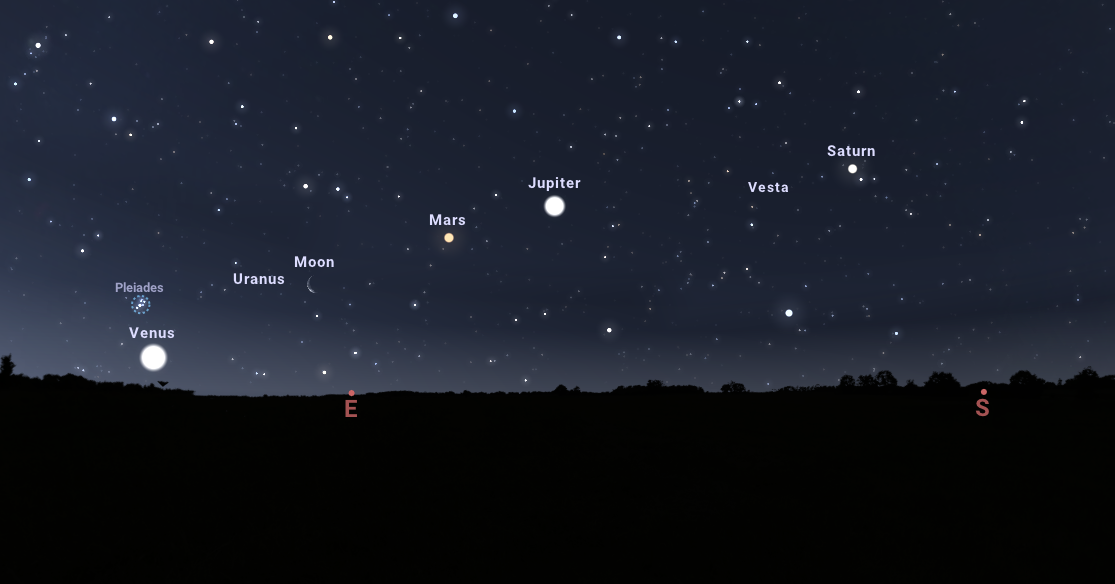
Stellarium Screenshot/Simulated (by To Do Canada) Toronto Sky before Mercury rise
Commonly called a ‘Planet Parade’, this alignment is not a common occurrence. So if you look up in the dawn sky, you can see these planets aligned and positioned in their original order from the Sun: bright Mercury, brightest Venus, reddish Mars, very bright Jupiter and the yellowish Saturn.
Of course, when we say they appear in a row, it doesn’t mean they line up in a precise straight line. Because they are swinging in their different orbits in a three-dimensional space, the alignment is never perfect. However, because they all orbit in approximately the same plane as Earth, for all intends and purposes, they appear in the same part of the sky as if they are in a row.
What to see:
Mercury, Venus, Mars, Jupiter, and Saturn are aligned together and in their natural order from the Sun.
When to See:
The planets have gradually been aligning in recent months. The best views of the 5 planet alignment can be seen until June 27, when Mercury gets easier to spot across the southeastern horizon.
By June 24th, a waning crescent moon will also join the parade and will be positioned between Venus and Mars. If you think of it as Earth’s proxy, how cool is that sight! Mercury, Venus, “Earth” (moon), Mars, Jupiter and Saturn – 6 planets in perfect order to show your kids!
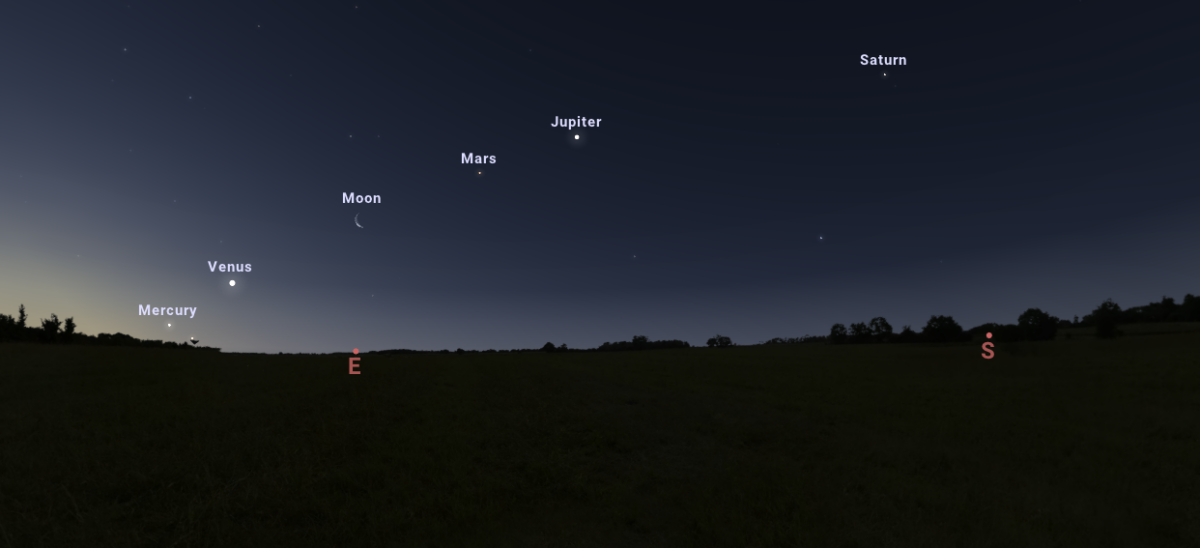
Stellarium/ Simulated (by To Do Canada) Edmonton Sky just before sunrise on June 24th
You will get about an hour to enjoy the sight from when Mercury pops above the horizon until the rising Sun washes the sky. Hence the best time to see the planetary alignment is just before sunrise.
How To See:
Find a clear view of the eastern horizon. You can get a good view of the event 30 minutes before sunrise. The planets will extend across the sky from low in the east to high in the south. Binoculars will aid your viewing. If you have a quality telescope, you might be able to spot a very pale green Uranus and the blue-hued Neptune.
You can use mobile apps like Stellarium, Star Walk 2 or Sky Tonight to locate and identify the planets on the sky.
Keep your binoculars handy, set your alarm and wake up on time! The next sequential five-planet alignment will happen in 2040.