 Toronto
 Reclaim, Redefine, Repurpose
Artist Profile: John Leenders
 Reclaim, Redefine, Repurpose
They say one man’s trash is another man’s treasure. This statement is especially true when it comes to the works of artist and furniture designer John Leenders, who uses reclaimed materials to create one-of-a-kind masterpieces. The rural resourcefulness and eclectic style of this Erin, Ontario-based artist takes him to offbeat places such as salvage yards and antique shops, which for Leenders, are filled with inspiration.
Chicken farmer turned self-taught artist, Leenders’ meticulous creative process begins with collecting objects that appeal to him and have a distinct look. Materials may sit idle for some time, patiently waiting while he finds all the right pieces to come together, completing his vision. He employs various woodworking and welding techniques, yet is conscientious about maintaining the handmade quality of his furniture. However, regardless of any preconceived plan or sketch, the materials dictate the furniture’s ultimate design. Leenders’ philosophy is to encourage the materials to continue their story. Choosing to use reclaimed materials is not only environmentally friendly. It allows the found objects to live on.
To Leenders, the most satisfying aspect of using reclaimed materials is the inimitable color, grain and character of reclaimed wood. Unlike a conventional new table, a table made from reclaimed wood with a live edge looks like its source, a tree. In using reclaimed wood Leenders believes one is reminded of the table’s origins and story – the number of years the tree has stood tall, taken care of us, providing shade and oxygen, creating homes for animals. Even in death the tree can live on as a table. Leenders says, “the best way to use the table is not to be concerned with keeping it pristine, but letting children stick forks in it, letting it get stained, letting it continue its story. When grandchildren, friends and guests pass through you tell them about the stains and scratches that are on the table and it is still continuing its story.” The table becomes more than another piece of furniture, it becomes integrated into the family.
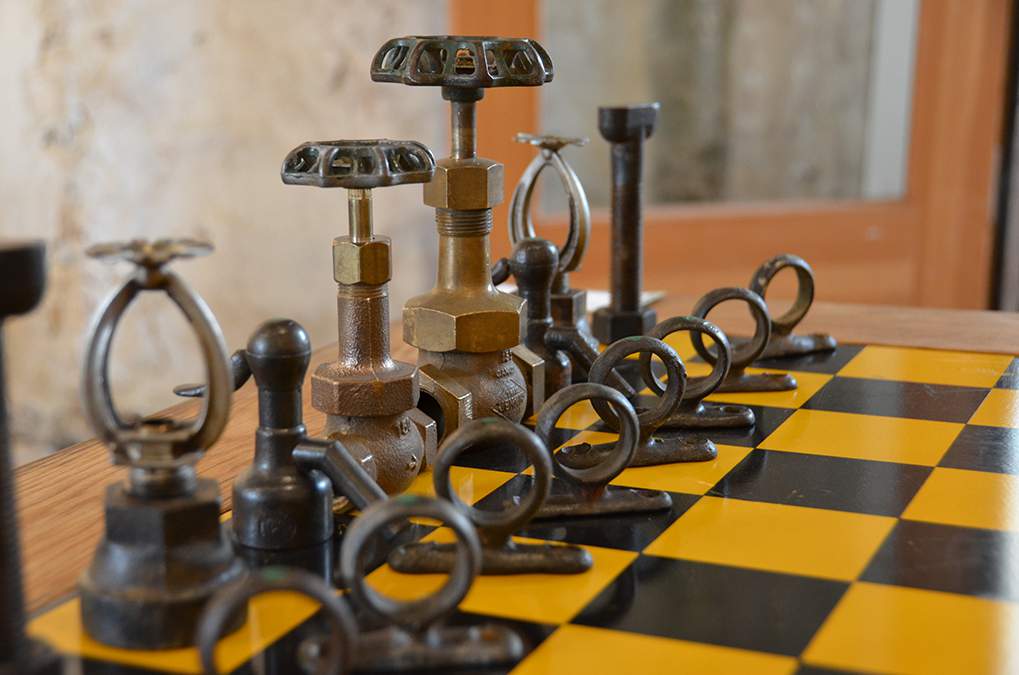
Leenders’ high regard and respect for his materials’ provenance is clearly evident in one of his pieces featured in the Noodle Gallery at the Alton Mill. Constructed with oak from an old horse fence, a checkerboard traffic sign, and vintage plumbing/industrial parts, Leenders’ rustic chess table assigns the component parts to new roles that reflect their original functions.
 The king and queen, indisputably the most important pieces in chess, are much like the plumbing valves Leenders uses to represent them. Valves regulate the flow of water that is crucial to a plumbing system. Without valves the system would not function. Without a king and queen a kingdom would not function.
Leenders’ pawns are made from old-fashioned pipe holders or “standoffs,” used to hold pipes a distance away from a wall. In the game of chess, pawns are the only pieces that stand in the front row, keeping distance, and separating the king from the opposition.
Rooks represent castle walls, carrying the load from the opposition and protecting the king, queen, bishops and knights. Similarly Leenders’ rooks, made from pipe hangers, are designed to absorb the load from the pipe and distribute it amongst the surrounding structures.
The bishop’s role is to defend. In chess, this piece also has the ability to move (or reach) long distances. Sprinkler heads are used as bishops on Leenders’ chess table. Their purpose off the chess table is to protect and, once danger is detected, diffuse the situation by spraying water that reaches and covers long distances.
Lastly, Leenders uses the tops of soda siphons as his knights. These valves allow a portion of the contents to be dispensed while maintaining pressure on the inside of the bottle and preventing the remaining soda from going flat. Likewise in chess, once the knights leave the sides of the king and queen, protecting them by attacking the opposition, the pressure remains on the other pieces to continue to protect the monarchs, preventing them from being captured.
The artist’s philosophy of reclaiming, redefining and repurposing is evident throughout his work. A mirror he has created incorporates outdoor faucets, complete with “water drops” of blown glass; a floor lamp marries tall streetlights to a manhole cover base; a vintage drill press also becomes a source of light as a lamp. Leenders’ imagination, use of materials and craftsmanship produce extremely clever, engaging works of art.
John Leenders’ chess table and other works are on display at the Noodle Gallery in the Alton Mill Arts Centre.
To visit the gallery or for more information about his work contact gallery director and owner Monica Kerr-Coster: monica@noodlegallery.com, 647-505-8995, www.noodlegallery.com.