 Toronto
Feed Ontario released its 2024 Hunger Report today, highlighting that over one million people accessed food banks in Ontario between April 1, 2023, and March 31, 2024.
Credit: Joel Muniz/ Unsplash
This marks a 25% increase from the previous year and represents one in 16 Ontarians—surpassing the entire population of Nova Scotia.
Economic pressures such as soaring housing costs and precarious employment are cited as primary drivers. Over the past four years, there’s been an 80% rise in households renting and a 109% increase in individuals experiencing homelessness. Notably, one in four food bank visitors are employed, with 42% earning minimum wage or less.
Carolyn Stewart, Executive Director of Feed Ontario, emphasized, “We need immediate and bold action against poverty.”
2024 Hunger Report Highlights and Trends
Credit: Feed Ontario
Food bank use data
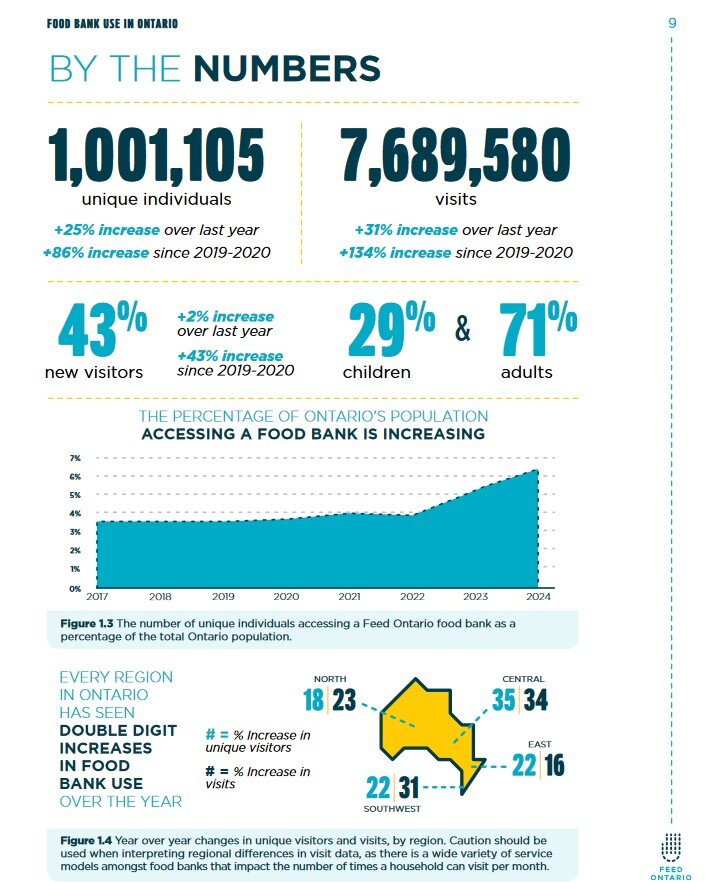
- Unique Individuals: Over 1 million people accessed a food bank in Ontario between April 1, 2023, and March 31, 2024, an increase of 25% over last year and 86% since 2019-2020.
- This represents 1 in 16 Ontarians and is greater than the entire population of Nova Scotia.
- Visits: Ontario’s food banks were visited a total of 7,689,580 times throughout the year, an increase of 31% over last year and 134% since 2019-2020.
- First-time users: 2 in 5 visitors had never accessed a food bank before, an increase of 43% since 2019-20.
Drivers of food bank use
- Unaffordable housing: 76% of visitors are rental tenants and 9% are experiencing some form of homelessness (precarious housing, unsheltered, emergency shelter, etc.).
- Precarious employment: Food bank visitors who cited employment as their primary source of income increased by 91% over pre-pandemic levels and 17% over the previous year.
- Inadequate social supports: Social assistance remains the primary source of income for the majority of food bank visitors with 30% relying on OW and 29% relying on ODSP.
Food Bank Sustainability
- Reduction in food support: 38% of food banks have reported having to reduce the amount of food they can give.
- Reduction in wrap-around supports: Half (50%) of all food banks that offered wrap-around supports have been forced to cut or reduce programming due to insufficient resources.
The report urges the government to adopt a new poverty reduction strategy, enhance Ontario Works and the Ontario Disability Support Program, improve labor laws, and invest in affordable housing.
Resource limitations have led 38% of food banks to reduce the amount of food provided, while half have cut support programs.
As food banks are not government-funded and rely solely on donations, Stewart appeals for public support: “If you are in a position to give, your donation will make an incredible difference.”
Every dollar donated enables Feed Ontario to provide two meals to those in need.


