 Toronto
More than a quarter of Canadians continued to experience financial strain this fall, though conditions have eased since 2022.
In October 2025, 27.7% of Canadians aged 15 and older reported living in households that found it difficult to meet basic expenses such as housing, food, transportation and clothing. This marks a decline from the 35.5% peak recorded in October 2022, according to new data from Statistics Canada.
Households that rent remained more vulnerable, with 37.0% reporting financial difficulties, compared with 23.6% among homeowners. Both figures fell slightly from a year earlier. Younger Canadians were also more affected: 31.0% of those aged 15 to 24 and 30.7% of those aged 25 to 54 reported household hardship, compared to 22.5% among people aged 55 and older.
Financial pressure was greatest among core-aged single parents, 46.8% of whom lived in households struggling to meet essential costs. Among couples with children, the rate was 32.4%, while it stood at 25.3% for couples without children.
Unemployment remained a key factor. In households with at least one unemployed member, 46.1% reported difficulty covering expenses, nearly double the 25.8% rate in households without unemployed individuals.
Regional differences were pronounced. Areas of Southern Ontario, where unemployment rates exceeded the national 3-month average of 7.0%, reported the highest financial stress levels. These included Windsor, Oshawa, Barrie, Kitchener–Cambridge–Waterloo, and Toronto.
In contrast, the lowest proportions were recorded in Québec City, Montréal, Halifax and Victoria, where unemployment rates remained below the national level.
Unemployment Rate (3-month average) and Financial Difficulty by CMA – October 2025
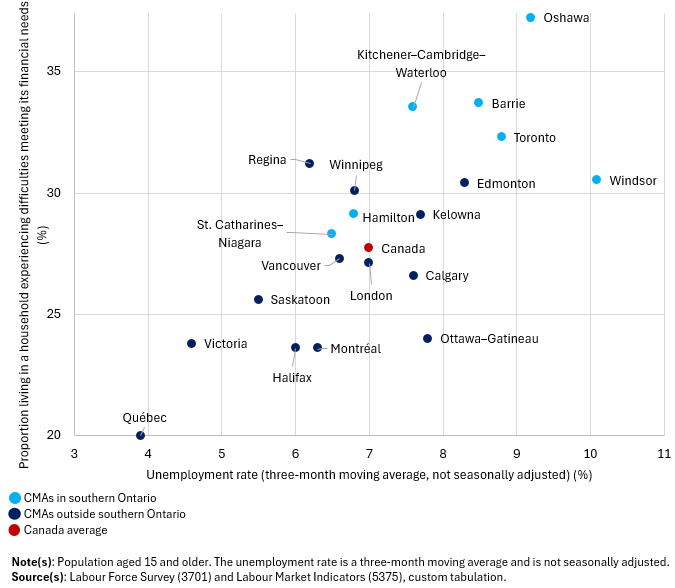
- Windsor, ON – Unemployment rate: 10.1% | Financial difficulty: 30.5%
- Oshawa, ON – Unemployment rate: 9.2% | Financial difficulty: 37.2%
- Toronto, ON – Unemployment rate: 8.8% | Financial difficulty: 32.3%
- Barrie, ON – Unemployment rate: 8.5% | Financial difficulty: 33.7%
- Edmonton, AB – Unemployment rate: 8.3% | Financial difficulty: 30.4%
- Ottawa–Gatineau, ON–QC – Unemployment rate: 7.8% | Financial difficulty: 24.0%
- KW Region, ON – Unemployment rate: 7.6% | Financial difficulty: 33.5%
- Calgary, AB – Unemployment rate: 7.6% | Financial difficulty: 26.6%
- Kelowna, BC – Unemployment rate: 7.7% | Financial difficulty: 29.1%
- Canada (overall) – Unemployment rate: 7.0% | Financial difficulty: 27.7%
- London, ON – Unemployment rate: 7.0% | Financial difficulty: 27.1%
- Winnipeg, MB – Unemployment rate: 6.8% | Financial difficulty: 30.1%
- Hamilton, ON – Unemployment rate: 6.8% | Financial difficulty: 29.1%
- Vancouver, BC – Unemployment rate: 6.6% | Financial difficulty: 27.3%
- St. Catharines–Niagara, ON – Unemployment rate: 6.5% | Financial difficulty: 28.3%
- Regina, SK – Unemployment rate: 6.2% | Financial difficulty: 31.2%
- Montréal, QC – Unemployment rate: 6.3% | Financial difficulty: 23.6%
- Halifax, NS – Unemployment rate: 6.0% | Financial difficulty: 23.6%
- Saskatoon, SK – Unemployment rate: 5.5% | Financial difficulty: 25.6%
- Victoria, BC – Unemployment rate: 4.6% | Financial difficulty: 23.8%
- Québec City, QC – Unemployment rate: 3.9% | Financial difficulty: 20.0%


