 Cape Breton Island
Weather permitting, you can experience the January 31 full moon and total lunar eclipse, if you live on the West Coast of Canada.
Why is the January 31st full moon – a Super Blue Blood Moon?
- It is the second full moon of the month – called a “blue moon.
- It is a super moon because the Moon, will appear approximately 14% brighter that usual since the Moon is in perigee — closer to Earth in the lunar orbit.
- When the Moon is in the Earth’s shadow, Light refracted through Earth’s atmosphere tints the moon red causing a “blood moon.”
Also during the morning of January 31, super blue moon will pass through Earth’s shadow causing total lunar eclipse.
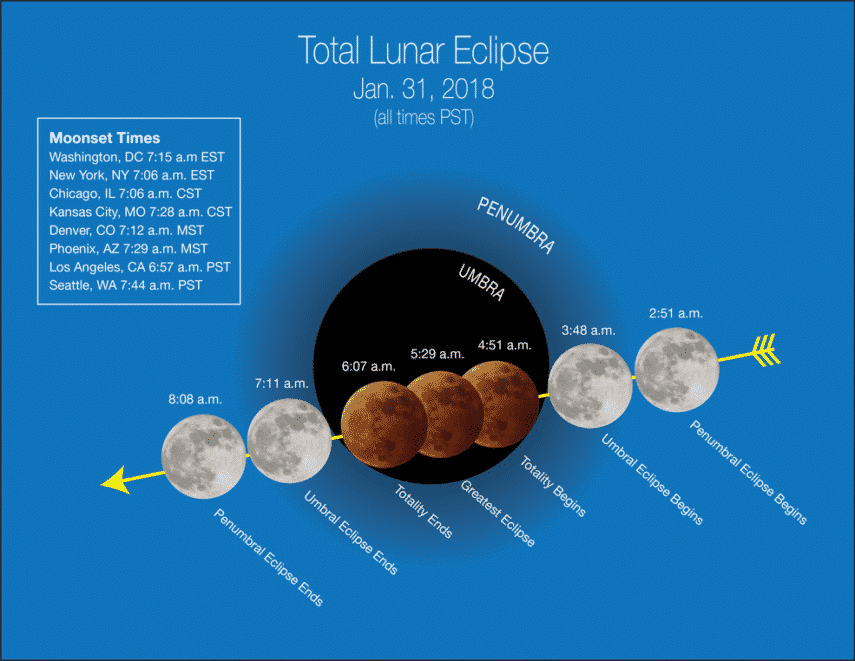
Credit: NASA
Lunar Eclipse Time in Pacific Standard Time:
Partial eclipse begins at 3:48 a.m.
Total eclipse begins at 4:51 a.m.
Greatest eclipse at 5:29 a.m.
Total eclipse ends at 6:07 a.m.
Partial eclipse ends at 7:10 a.m.
How to view Lunar Eclipse:
If you live in east coast: You can only see the initial stages of the eclipse before moonset. The darker part of Earth’s shadow will begin to blanket part of the Moon with a reddish tint at 6:48 a.m. EST, but the Moon will set less than a half-hour later. “
According to NASA blogger Gordon Johnson “So your best opportunity if you live in the East is to head outside about 6:45 a.m. and get to a high place to watch the start of the eclipse—make sure you have a clear line of sight to the horizon in the west-northwest, opposite from where the Sun will rise”. You can read more here.
The next lunar eclipse that can be viewed from Canada is on January 20-21, 2019.
You can also see the live stream here.