 Cape Breton Island
Alberta and Nova Scotia are the best places to do business in terms of regulatory efficiency, according to the latest 2024 Red Tape Report Card by the Canadian Federation of Independent Business (CFIB).

Per the news release, the 2024 Red Tape Report Card evaluates governments on regulatory accountability, regulatory burden, and political priority. It assesses how governments track and constrain regulations, the extent of regulatory restrictions, and the emphasis placed on reducing red tape and modernizing regulations by top political leaders and councils.
According to Keyli Loeppky, the CFIB’s director of interprovincial affairs, the evaluation framework focuses on regulatory accountability, the extent of regulatory burdens, and the prioritization of regulatory reduction and modernization by the governments.
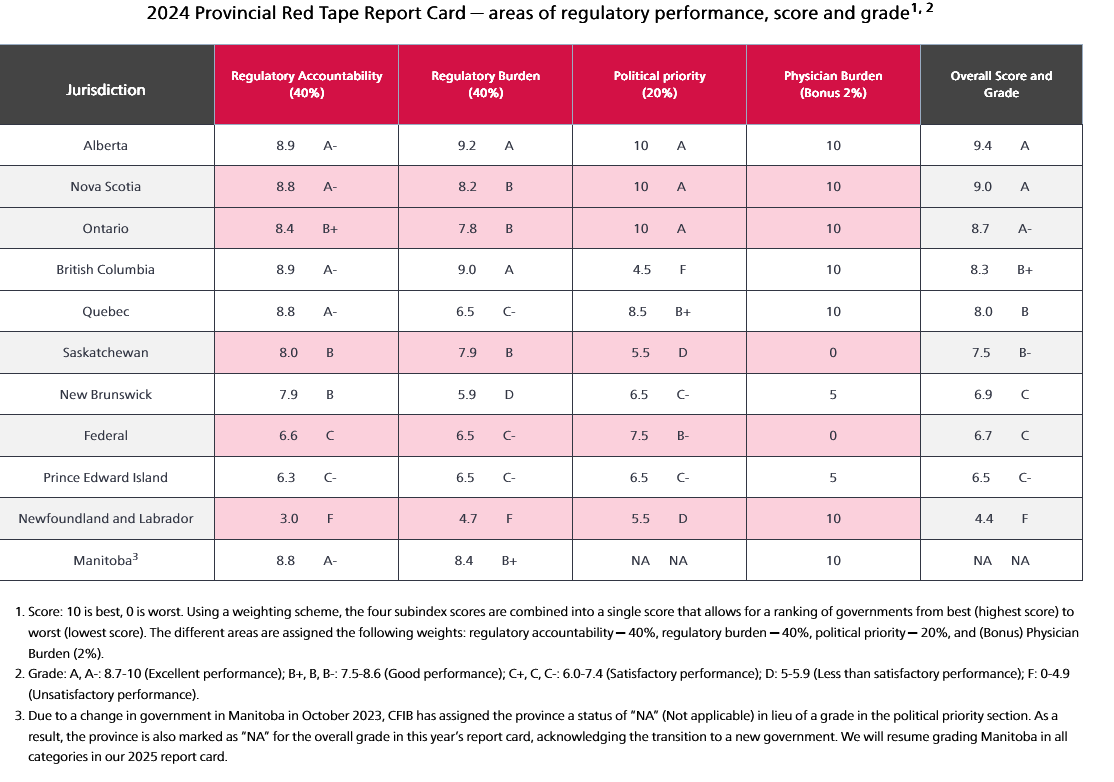
Alberta and Nova Scotia top the chart with “A” grades, demonstrating strong regulatory accountability, low regulatory burden, and high political prioritization, alongside full marks for reducing physicians’ administrative burden.
The CFIB reported last year that Canadian doctors spend 18.5 million hours annually on non-essential administrative tasks, equating to the time for 55.6 million patient visits. A noteworthy aspect of this year’s assessment was the challenge posed to governments to alleviate the administrative load on physicians, thereby enhancing healthcare delivery. While most jurisdictions responded positively to this challenge, Saskatchewan and the federal government did not make notable progress in this area.
The annual evaluation, now in its 14th year, coincides with the CFIB’s Red Tape Awareness Week, spotlighting the efforts of provincial governments to minimize bureaucratic hurdles.
Credit: CFIB
Ontario and British Columbia are close contenders, with “A-” and “B+” overall grades, respectively. These provinces show a commendable approach to regulation management, although British Columbia falls short in making it a political priority, scoring an “F” in that category.
Quebec and Saskatchewan hover in the middle with “B” and “B-” grades, respectively.
New Brunswick, despite a “C” overall grade, shows remarkable progress from the previous “D” grade, indicating efforts towards better regulation management. Per the news release, New Brunswick earned the title of most improved jurisdiction.
Prince Edward Island received a satisfactory score of “C-” in all categories.
At the bottom, Newfoundland and Labrador receive an “F” for overall performance, reflecting acute challenges in regulatory accountability and burden, and only slightly better in political priority.
Manitoba was not assessed for overall scores due to a recent government change, but it maintains an “A-” in regulatory accountability and “B+” in regulatory burden.
The federal government was awarded a “C” grade, indicating satisfactory performance.
Loeppky emphasizes that reducing red tape is crucial not only for improving public policy areas like healthcare and housing but also for easing the operational environment for small businesses and making life more affordable for Canadians.


