 Kitchener
On April 8, 2024, a rare and awe-inspiring event will captivate the world as a total solar eclipse graces the skies.
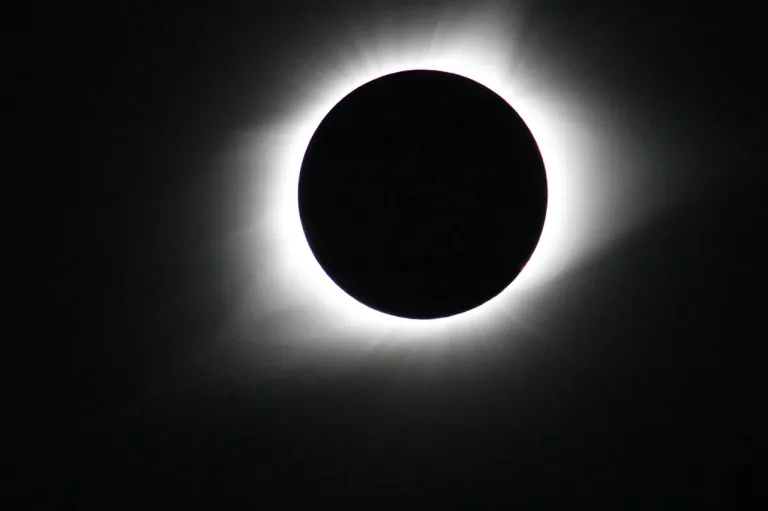
Image of total solar eclipse on August 21, 2017, taken from Madras, Oregon. Credit: NASA/Nat Gopalswamy
This celestial phenomenon occurs when the moon passes between the Earth and the Sun, casting a shadow upon the Earth’s surface. Spectators within the path of totality will witness the Sun completely obscured, revealing the magnificent solar corona.
The eclipse’s path crosses through several provinces, including Ontario, Quebec, New Brunswick, and Newfoundland and Labrador, allowing a substantial portion of the Canadian population to experience this natural wonder.
When & How can you see the partial eclipse in the Kitchener-Waterloo Region:
Kitchener-Waterloo Region will witness a partial solar eclipse, with approximately 99% of the Sun obscured by the Moon.
See the table below for the duration of totality for different communities across Kitchener-Waterloo Region:
| Community | Partial phase | Max-eclipse | Magnitude |
|---|---|---|---|
| Kitchener | 02:03 pm to 04:30 pm | 3:18:23 pm | 99.1% |
| Cambridge | 02:03 pm to 04:30 pm | 3:18:37 pm | 99.3% |
| Waterloo | 02:03 pm to 04:30 pm | 3:18 pm | 99% |
| Woolwich | 02:03 pm to 04:30 pm | 3:18:29 pm | 98.7% |
| Baden | 02:03 pm to 04:30 pm | 3:18:10 pm | 99% |
| Wellesley | 02:03 pm to 04:30 pm | 3:18:10 pm | 98.5% |
| North Dumfries | 02:03 pm to 04:30 pm | 3:18:30 pm | 99.5% |
Where to go: If you are a person just interested in seeing the eclipse (not interested in eclipse photography with surrounding landscape view etc), you can enjoy the partial eclipse from your house if the view along the southwest is unobstructed by trees or other high buildings.
The sun during the maximum eclipse will be at around 45 to 50 deg altitude from the horizon. Depending on your location 45 deg is sufficiently high to see the sun from your house.
To verify whether the view of the partial eclipse will be the sun obstructed from your location, check the position of the sun the day before at around 3:20 p.m.
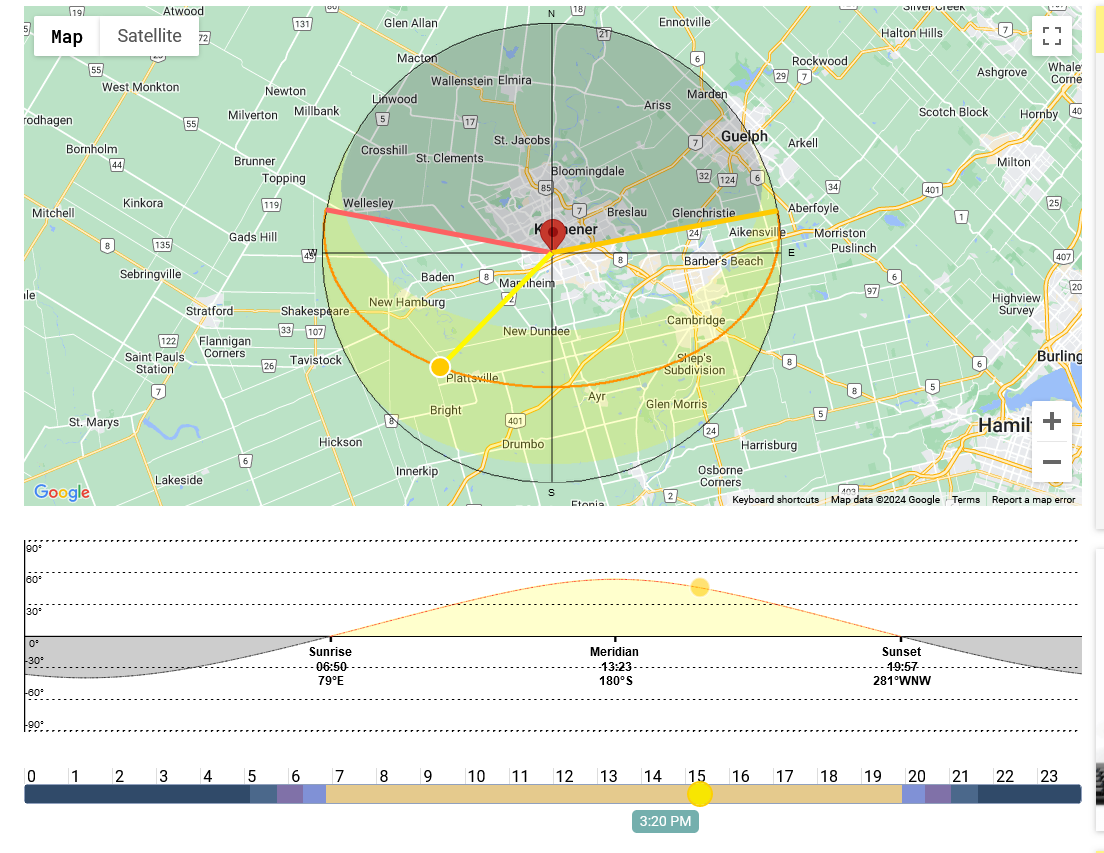
You can also visit parking lots of strip malls, parks, open fields, or high points with minimal obstruction to the southwest horizon near your house for hassle-free viewing
Where to see the total eclipse and avoid the crowds:
While viewing from the KW Region, you can experience a 99% eclipse, which might seem almost complete. However, given the Sun’s immense size and power, the visual and experiential difference between a total and partial eclipse is significant. Luckily, the path of totality is within a half-hour to one-hour drive, offering a chance for a day trip to witness the full eclipse in nearby locations.
Since big cities like Hamilton and Niagara Falls, which fall in the path of totality, are expected to see huge crowds, it is better to head to parks in Southwestern Ontario.
Options include Essex, Kingsville, Point Pelee National Park, towns along Lake Erie from Essex to Fort Erie, Rondeau Provincial Park, Leamington, St. Thomas, Bradford, towns in Haldimand County, Dunnville, Aylmer and more!
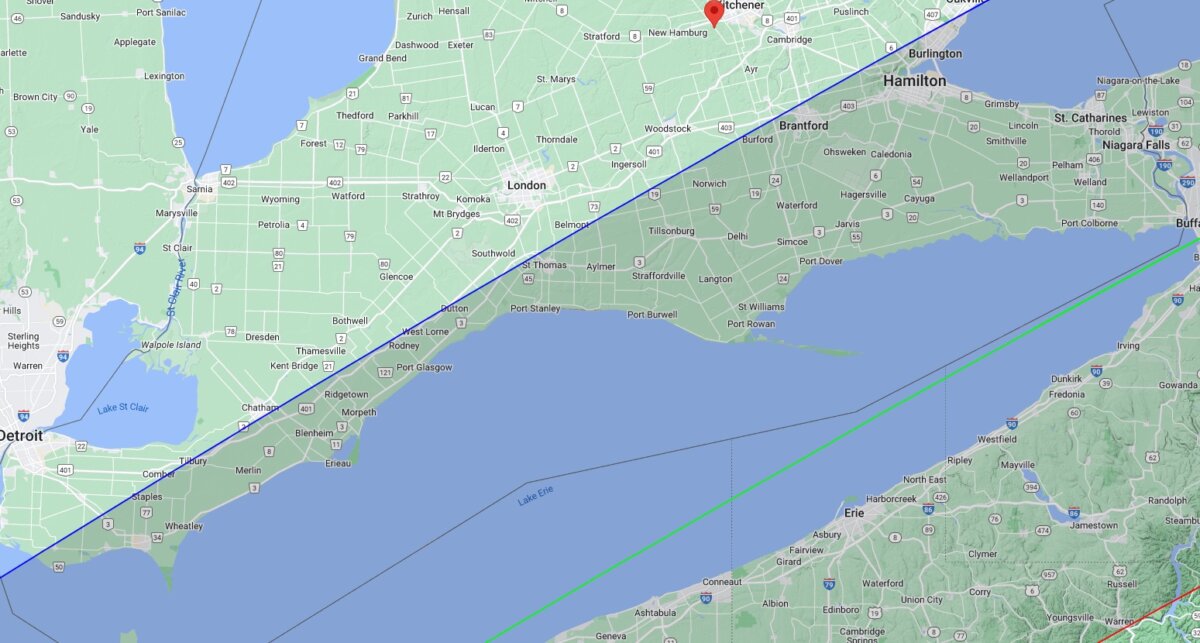
Solar eclipse events near Kitchener-Waterloo Region
There are a few eclipse viewing parties and events across the Region.
- TheMuseum has planned many events on Eclipse Day, April 8, including an eclipse simulation in StarLab, eclipse crafts for kids, and other activities.
- Eclipse Party at MacNaughton Observatory and Johnson Green in the University of Guelph on April 8th
- Observing site at No. 6 RCAF Museum in Dunnville (to avoid the traffic in Niagara/Hamilton areas).
In addition, there are online viewing simulators.
How to safely watch the eclipse
Observing a solar eclipse without adequate protection poses a significant risk of permanent eye damage. It’s important that you only use eclipse glasses that adhere to the ISO 12312-2:2015 standard. These specialized glasses are designed to filter out harmful solar radiation, protect your eyes from the intense brightness of the Sun, and allow safe viewing of the eclipse’s partial phases. Please visit your nearby library to inquire about complimentary eclipse glasses.
Be cautious with cameras or binoculars, as their lenses can intensify sunlight and cause harm. For those without eclipse glasses or handheld solar viewers, constructing a pinhole projector offers a safe means of indirect observation. Remember to supervise children and inspect viewing equipment for any signs of damage before use.
Skin safety is also important during an eclipse, as the Sun’s rays can still be intense even during partial phases. Remember to apply sunscreen, wear a hat, and protective clothing to prevent sunburn and skin damage. By following these safety guidelines, you can fully enjoy the wonder of a solar eclipse while protecting both your vision and your skin from harm.


