 Calgary
Fostering more grocery competition is essential for Canada’s economy and the well-being of consumers says Competition Bureau in their Retail Grocery Market Study Report.
Competition Bureau says Canada’s grocery industry is highly concentrated, with Loblaws, Sobeys, and Metro collectively reporting over $100 billion in sales and $3.6 billion in profits in 2022. The dominance of these giants makes it challenging for new players and regional independents to enter the market. The concentrated nature of Canada’s grocery industry limits competition, hindering consumers from enjoying competitive prices and product choices.
Price Margins:
The Canadian grocery industry has seen food prices rise at the fastest rate in over 40 years, leading to concerns about inadequate competition. Although rising costs for grocers may partly explain price increases, gross profit margins provide a more revealing metric.
In the last five years, Canada’s largest grocers have seen a modest yet significant increase in food gross margins, a trend that predates pandemic-related supply chain disruptions and current inflation.
Competition Bureau says this ability to raise margins suggests potential for more competition within Canada’s grocery sector.
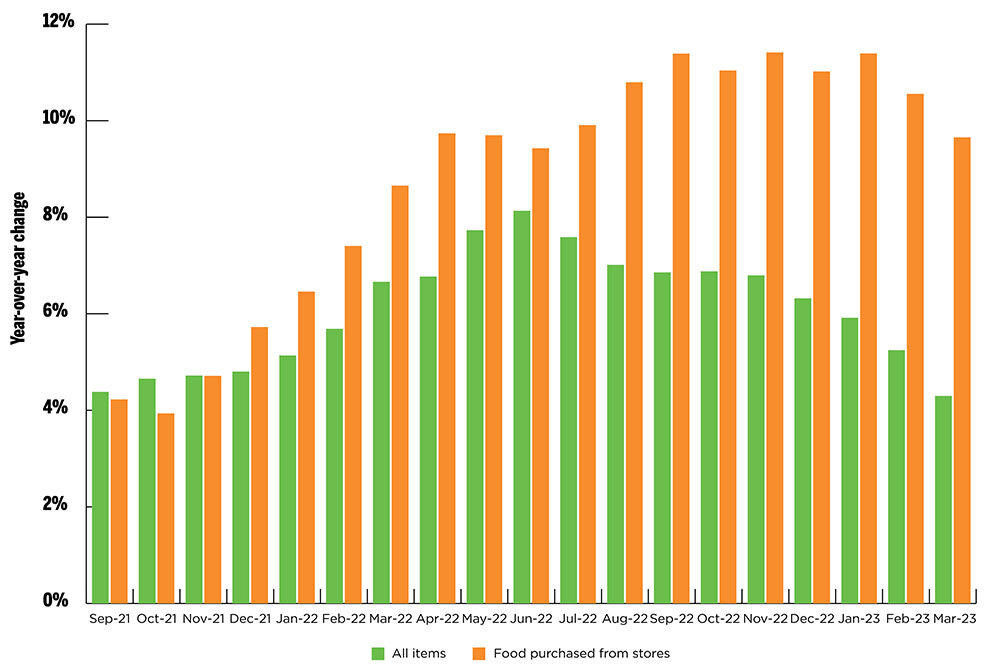
Change in Food Prices vs. Consumer Price Index, monthly from September 2021 to March 2023/Credit: Competition Bureau
Public Opinion Survey:
Competition Bureau surveyed Canadians as part of their study and consumer survey on grocery competition yielded five key findings:
- Proximity is a significant factor in choosing grocery stores. Consumers often stay within a 20-minute radius from their homes for their shopping, disregarding stores farther away.
- The level of competition in grocery retail varies between urban and rural communities, with fewer options in smaller towns and remote areas.
- Despite the emergence of alternative retail formats, most Canadians still prefer shopping at supermarkets due to their range of products and pricing strategies.
- Online grocery shopping is gaining traction, with approximately a third of Canadians reporting use of online services for their grocery needs.
- Loyalty programs significantly influence consumer choices, encouraging regular shopping at specific stores that offer rewards or points.
Grocery Competition in Canada:
The report finds that Canada’s grocery industry is dominated by five major corporations: Loblaws, Sobeys, Metro, Costco, and Walmart, a factor causing concern among Canadians who desire more choice and competitive pricing. Independent grocers offer some variation, but their presence is inconsistent and contingent on location. These independents, while important to their communities, face daunting challenges to expand and compete nationally with industry giants.
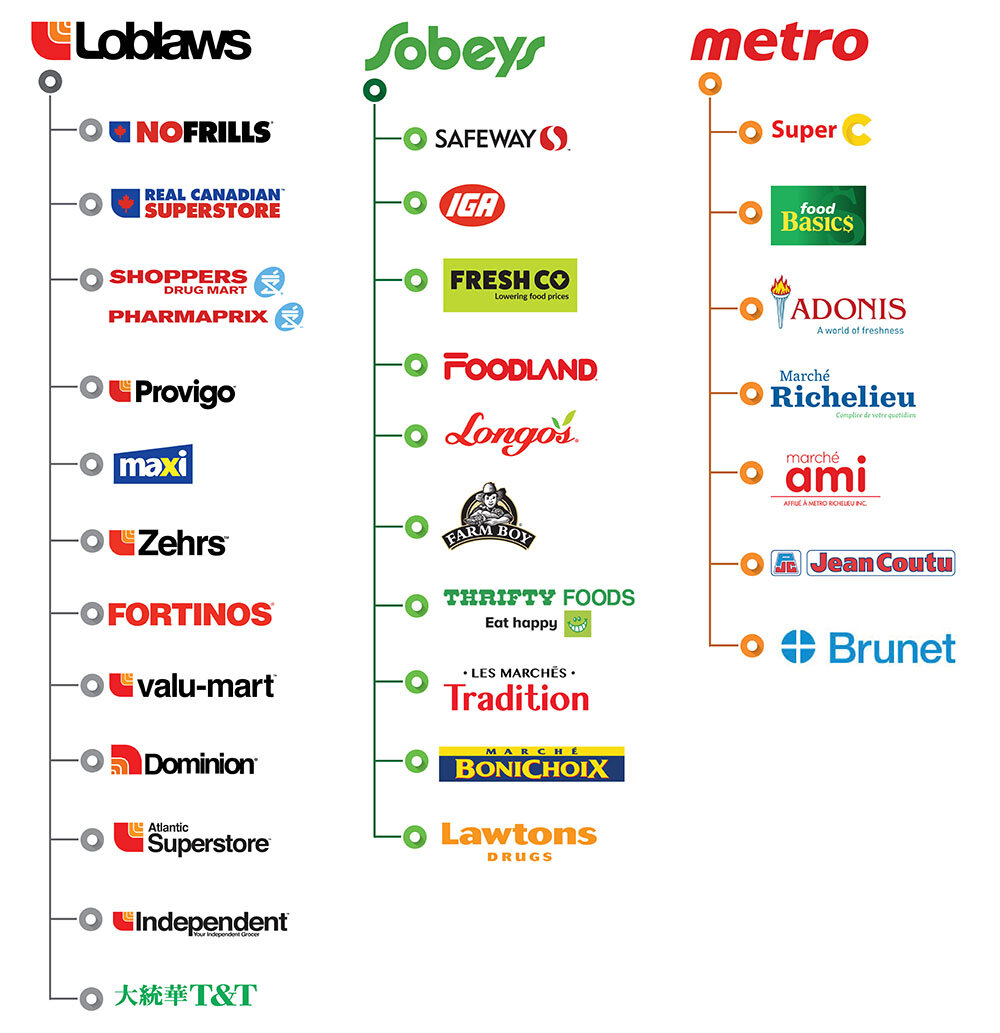
Stores owned by or affiliated with Loblaws, Sobeys, or Metro/Credit: Competition Bureau
In 2022, Loblaws, Sobeys, and Metro reported over $100 billion in combined sales, further emphasizing the concentration of the industry. Costco and Walmart, although having different business models, also significantly contribute to grocery sales. However, the collective control these companies wield means less competition from discount grocery chains.
Larger chains, like Loblaws, Sobeys, and Metro also own most of the prominent discount stores in the country, reducing competition from standalone discount grocers, unlike in other countries where supermarkets must compete with low-cost stores such as ALDI or Lidl.
The Canadian Federation of Independent Grocers indicates that there are approximately 6,900 independent grocery stores, ranging from single-store, family-run businesses to independent chains. Many offer a unique product range, including international and specialty foods, catering to specific customer preferences.
Competition Bureau says Canadians are concerned that grocers keep getting bought out by their competitors, leading to fewer choices in their communities. For example, when the Competition Act was introduced in 1986, there were at least eight large grocery chains across the country, each owned by a different company.
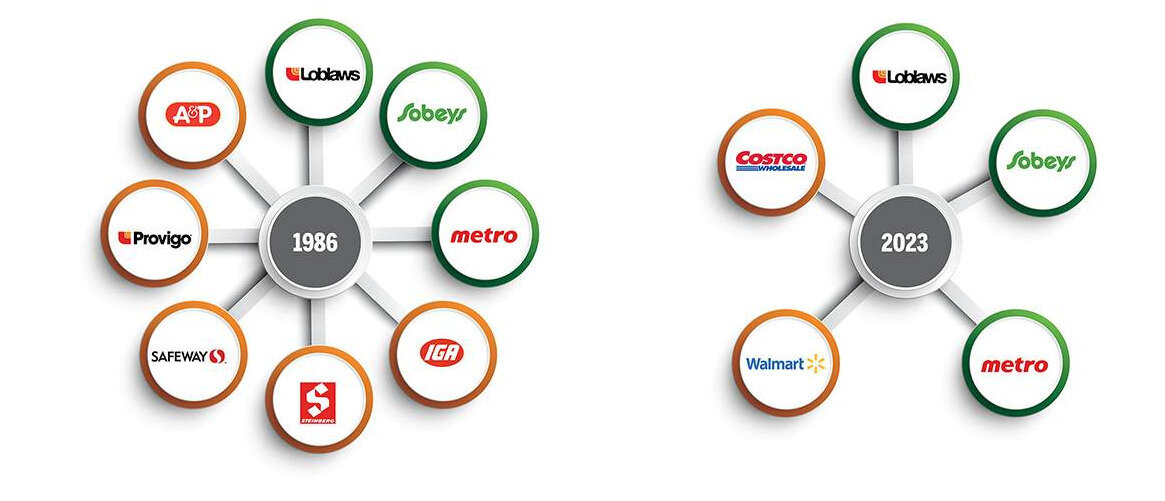
Comparison of Canada’s retail grocery landscape in 1986 and 2023
However, these independents face considerable obstacles. Consolidation fears, dependencies on large competitors for stock, and a lack of supplier payments challenge their competitiveness. Furthermore, they grapple with real estate accessibility issues. Consequently, without substantial government intervention, the scope for independents to grow significantly and impact the competitive landscape is limited.
The report finds that the grocery landscape in Canada is an oligopoly that is largely location-dependent. Urban Canadians typically have access to more stores, while rural citizens often rely on single, local options.
Competition Bureau Recommendations:
To address these issues, the report recommends the need for more grocery competition in Canada. The report makes four recommendations to governments to meaningfully improve competition in the grocery industry:
- Governments at all levels should take steps to encourage and support the emergence of new grocery businesses, including those operating online.
- Policies that aid the growth of independent grocers and enable the expansion of discount grocers would enhance competition, leading to lower prices, improved product quality, and increased innovation.
- Competition Bureau says to empower consumers and promote informed purchasing decisions, provincial and territorial governments should consider introducing accessible and harmonized unit pricing requirements. This would allow Canadians to compare prices effectively and encourage competition in the industry.
- Measures should be taken to limit or ban property controls in the grocery industry. These controls restrict the use of real estate by competing grocers, making it difficult for new stores to open and reducing competition in communities.
“As we have witnessed the highest cost-of-living increases seen in a generation, Canadians are recognizing the relationship between a lack of competition and rising prices,” said, Matthew Boswell, Commissioner of Competition.
“By acting now, governments at all levels can take steps towards creating a more competitive grocery industry. Competition can help lower prices and make life more affordable for Canadians.”


