Toronto
Canada’s labour market showed little movement in March, offering a picture of stability rather than momentum.
Source(s): Labour Force Survey (3701), tables 14-10-0287-02 and 14-10-0292-02./Credit: Statistics Canada
Employment edged up by 14,000 positions, a modest 0.1% increase, while the employment rate held at 60.6%. The unemployment rate stayed unchanged at 6.7%, suggesting conditions neither improved nor worsened in a meaningful way.
After declines earlier in the year, March felt like a pause. Both full-time and part-time work levels were largely steady, and participation in the labour force remained at 64.9%, slightly lower than a year ago.
Wages, however, told a different story. Average hourly earnings rose 4.7% compared with a year earlier, reaching $37.73. That marks the fastest pace of wage growth since late 2024, with workers aged 55 and older seeing the strongest gains at 5.2%.
Industry shifts were uneven. “Other services,” which includes repair and personal services, added 15,000 jobs. Natural resources followed with a gain of 10,000. Meanwhile, finance, real estate, and leasing sectors lost 11,000 positions, their first notable drop in over a year.
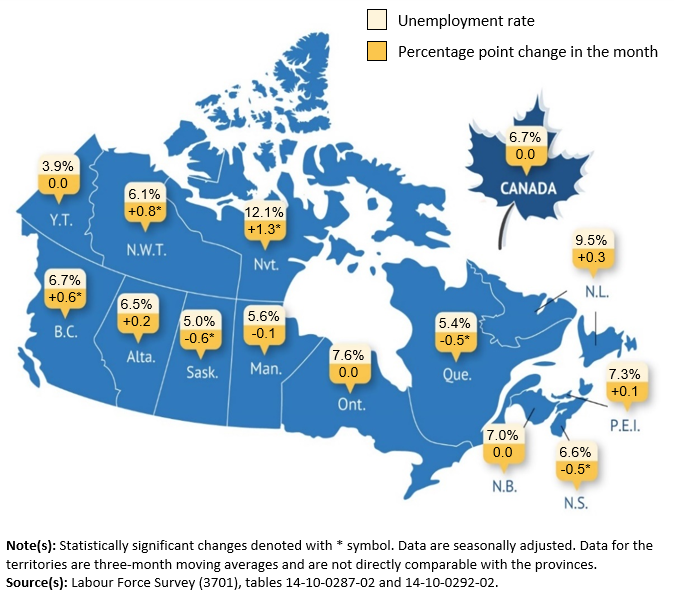
At the provincial level, some regions are clearly doing better than others. Saskatchewan posted the lowest unemployment rate at 5.0%, dropping 0.6 percentage points from February. Manitoba followed at 5.6%, holding relatively steady. Quebec also improved, with its rate falling to 5.4%.
In Atlantic Canada, Nova Scotia saw a notable decline to 6.6%, while New Brunswick remained at 7.0%. Prince Edward Island edged up slightly to 7.3%, and Newfoundland and Labrador continued to record the highest provincial rate at 9.5%.
Ontario stood at 7.6%, unchanged from February, reflecting ongoing pressure in parts of the province. British Columbia reached 6.7%, rising 0.6 points, while Alberta came in at 6.5%, up slightly.
The territorial data shows sharper contrasts. Yukon reported a low 3.9%, while Nunavut remained the highest in the country at 12.1%.
Source(s): Labour Force Survey (3701), table 14-10-0459-01./Statistics Canada
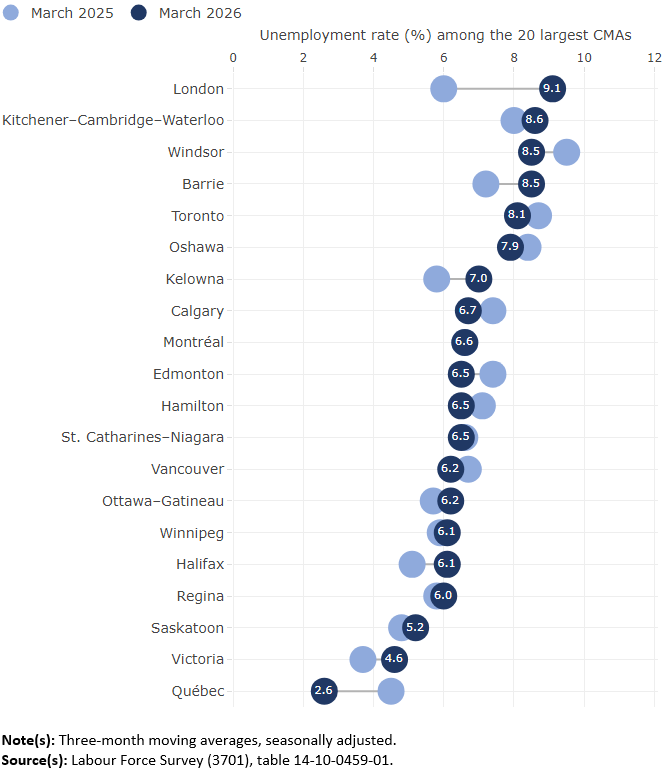
Zooming into cities, the divide becomes even more pronounced. Southern Ontario dominates the list of highest unemployment rates. London recorded 9.1%, followed by Kitchener–Cambridge–Waterloo at 8.6%, Windsor and Barrie both at 8.5%, and Toronto at 8.1%.
Elsewhere, rates were more moderate. Calgary stood at 6.7%, Montréal at 6.6%, and Edmonton at 6.5%. Vancouver came in lower at 6.2%, alongside Ottawa–Gatineau.
A few cities stood out on the lower end. Victoria reported 4.6%, while Québec City posted the lowest rate among major urban centres at just 2.6%.
Taken together, March’s data suggests a labour market that looks stable nationally but uneven locally, with regional disparities continuing to shape the employment landscape.