Toronto
Canada’s labour market showed few signs of momentum in April, with employment essentially flat and unemployment ticking higher as more people looked for work.
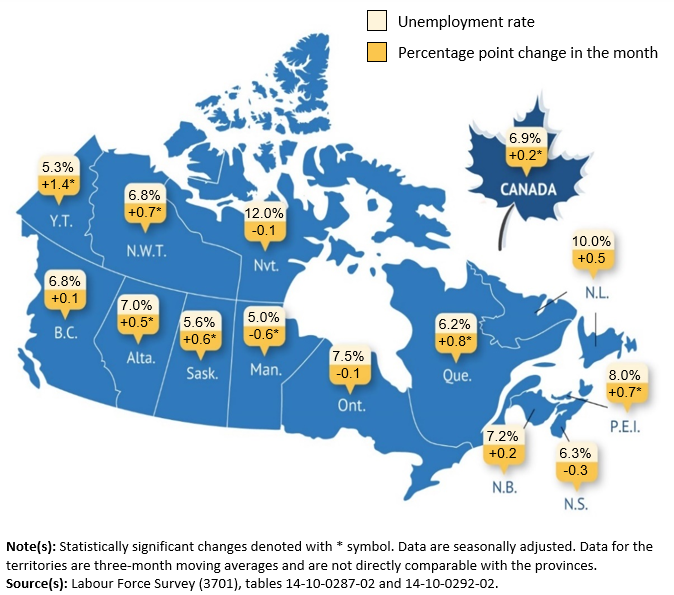
The country lost 18,000 jobs during the month, following a sharper decline in February, while the unemployment rate climbed to 6.9%, up from 6.7% in March, according to Statistics Canada. Full-time positions continued to weaken, even as part-time work edged up.
Here are the highlights of the monthly report:
Unemployment Climbs as More Canadians Search for Work
Statistics Canada says the increase in unemployment was driven largely by a rise in job seekers. Statistics showed 51,000 more people were searching for work in April, pushing the unemployment rate to 6.9%. Long-term unemployment also remained elevated. About 22.5% of unemployed Canadians had been looking for work for at least 27 weeks, well above pre-pandemic averages.
The labour force participation rate rose slightly to 65.0%, reflecting the increase in people actively looking for jobs. Among core-aged workers aged 25 to 54, participation climbed to 88.5%.
Youth Continue to Face a Tough Job Market
Young Canadians continued to struggle more than other age groups. The unemployment rate for people aged 15 to 24 rose to 14.3%. Student job seekers faced even greater difficulty, with unemployment among students reaching 16.0%, compared with 13.5% for non-students.
Core-aged men also saw pressure build, with their unemployment rate rising to 6.1%, while the rate for core-aged women held steady at 5.9%.
Ontario Gains While Quebec Loses Jobs
Provincial figures painted a mixed picture. Ontario added 42,000 jobs in April, helping lower its unemployment rate slightly to 7.5%. Quebec moved in the opposite direction, losing 43,000 positions, with much of the decline centred in Montréal. Quebec’s unemployment rate rose to 6.2%, while Montréal reached 7.7%, its highest level since 2016 outside the pandemic years.
Newfoundland and Labrador reported a 10.0% unemployment rate, while Prince Edward Island reached 8.0%. Alberta’s unemployment rate rose to 7.0% and Saskatchewan’s to 5.6%. British Columbia stood at 6.8%, while Nova Scotia improved modestly to 6.3%. Nunavut continued to record the highest overall unemployment rate in Canada at 12.0%, despite a slight monthly decline. Manitoba recorded the country’s lowest unemployment rate at 5.0%, down 0.6 points.
Health Care Sector Continues to Drive Employment Growth
Statistics Canada finds that the largest monthly employment declines were in information, culture and recreation, which lost 24,800 jobs, followed by construction (-15,700) and other services (-12,700), including repair and personal services. Transportation, retail trade and natural resources also posted losses.
Gains were led by business, building and support services, which added 21,500 jobs, while health care and social assistance gained 17,500 positions and accommodation and food services added 13,000. Over the past year, health care and social assistance stood out with employment rising by 119,000 jobs, or 4.1%.
Wage Growth Remains Strong
Despite softer hiring, wage growth stayed relatively firm. Employees earned an average of $37.77 per hour in April, up 4.5% from a year earlier. Higher-paid workers saw the strongest wage gains, particularly those in the top half of the wage distribution.