 Regina
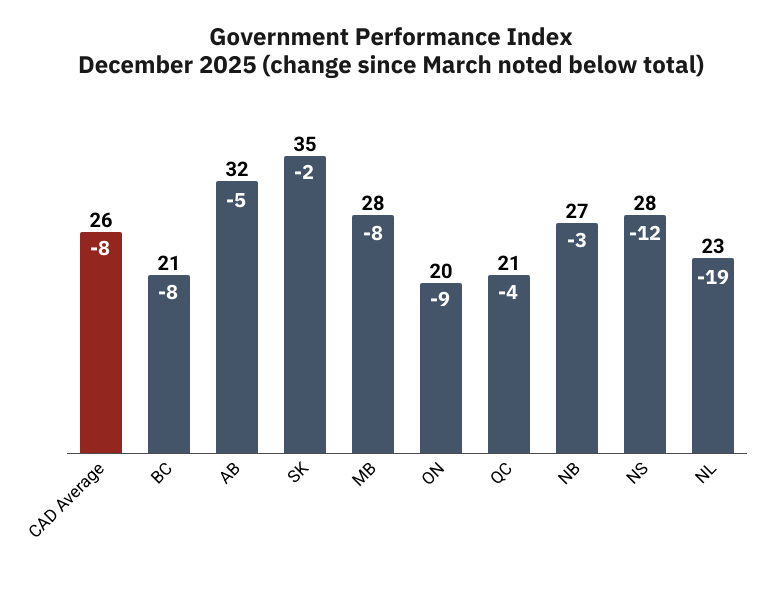
Provincial governments are finishing the year under heavier public scrutiny, with affordability and health care driving much of the dissatisfaction. New data from the non-profit Angus Reid Institute tracks views through its Government Performance Index, which combines satisfaction across 16 provincial issues and weights the topics residents say matter most.
Credit: Angus Reid Institute
Nationally, the average index fell from 34 in March to 26 more recently, a drop of about one-quarter. Provincially, scores range from 35 in Saskatchewan to 20 in Ontario. Data for Prince Edward Island were not released due to population and sampling limits.
- British Columbia’s government ranks near the bottom of the GPI. The top issues are cost of living, health care, housing affordability, the economy and public safety, and the BC NDP is not rated strongly on any. Past BC NDP supporters still criticize cost of living (66%), health care (63%), housing affordability (73%) and public safety (65%). The fiscal year deficit is reported to exceed $11 billion.
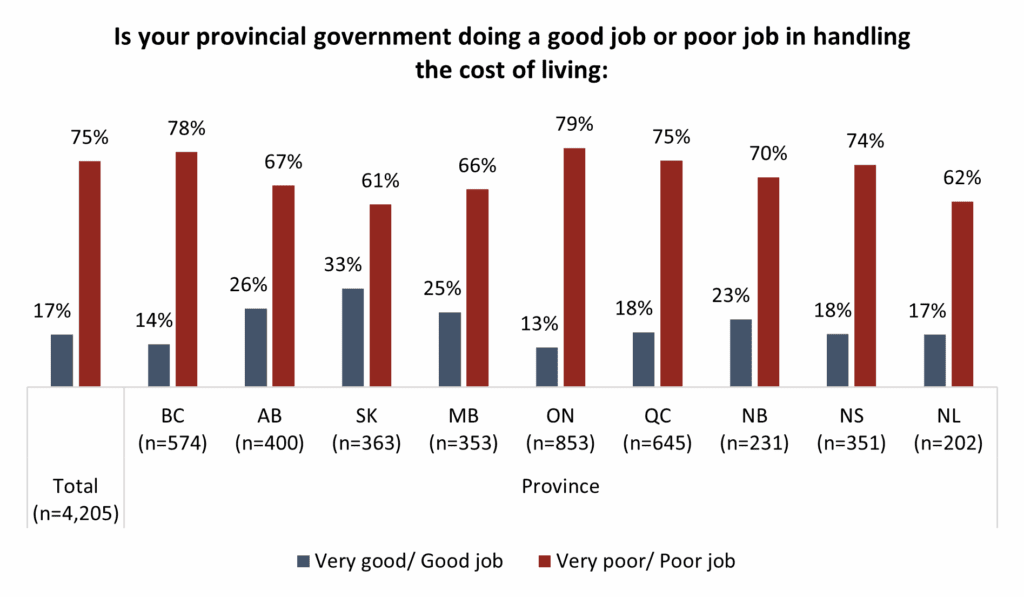
- Alberta scores 32 on the GPI, near the top, but warning signs remain. On health care, 68% say the UCP government is doing a poor job; on cost of living, 67% say the same. Education drew attention after teachers walked off the job and were legislated back; only 32% say education is handled well versus 62% poorly. Vote intention shows 48% for the UCP.
- Saskatchewan leads with a GPI of 35, though the score has fallen from 44 since early 2023 under Premier Scott Moe. The economy is the government’s best-rated file, with 52% saying it has done a good job. Health care is its weakest, with 72% calling it a poor job. Vote intention shows 55% for the Saskatchewan Party and 39% for the opposition.
Credit: Angus Reid Institute
- Manitoba shows a gap between leadership popularity and government satisfaction. Premier Wab Kinew remains the most popular provincial leader in ARI’s premier ratings, but on each of Manitoba’s top five issues, at least half say the government is doing a poor job. Kinew draws 25% approval among 2023 PC voters, compared with 8% for David Eby, 13% for Danielle Smith and 13% for Scott Moe.
- Ontario posts the lowest GPI score at 20. On core concerns, criticism is dominant: 79% say the government is doing a poor job on cost of living, 77% on health care and 83% on housing affordability. Even PC voters are negative — 68% rate inflation handling poorly, 69% say housing is mishandled and 63% criticize health care. Vote intention: PCs 41%, Liberals 28%, NDP 23%.
- In Quebec, Premier François Legault and the CAQ face widespread dissatisfaction on the province’s top issues. Residents say the government is doing a poor job on health care (80%), cost of living (76%), housing affordability (78%), the economy (58%) and education (63%). Vote intention places the Parti Québécois at 40%, ahead of Liberals (18%) and Conservatives (16%); CAQ sits at 13%.
- New Brunswick residents remain more critical than supportive of the Liberal government under Premier Susan Holt on the top two issues. Majorities say the government is doing a poor job on the cost of living (69%) and health care (67%). The province’s overall performance has improved compared with the period under former PC premier Blaine Higgs, narrowing a previously noted 10-point gap versus the national average. Liberals lead PCs by 17 points in vote intention.
- Nova Scotia performs better than many peers on the GPI, but core dissatisfaction remains. Health care is the top issue; 63% say Premier Tim Houston’s Progressive Conservatives are doing a poor job on it. Cost of living is next, and 74% say the government needs improvement in this area. The province has invested significantly in health care, and criticism has been lower in 2025 than in earlier years. Vote intention shows 47% for Houston’s PCs.
- In Newfoundland and Labrador, residents are not giving Premier Tony Wakeham and the Progressive Conservatives much leeway on key issues. On health care, cost of living, public safety, the economy and housing affordability, more people rate performance poorly than well. Wakeham’s PCs won a majority with 44.4% of the vote, edging Liberals by less than one point and gaining six more seats. Current vote intention has PCs and Liberals in a statistical tie.
Angus Reid Institute surveyed 4,025 Canadian adults online from Nov. 26 to Dec. 1, 2025, using the Angus Reid Forum, and weighted by census benchmarks for region, gender, age, income, and education.


