 Toronto
As its name suggests, C/2023 A3 is a non-periodic comet discovered in January 2023, with “Tsuchinshan-ATLAS” honouring the Purple Mountain Observatory in China and the ATLAS telescope in South Africa that identified it.

This rare comet promises to be one of the brightest comets of 2024.
Having briefly disappeared into the Sun’s glare after reaching perihelion on September 27, Comet A3 will soon emerge into view again, offering an incredible spectacle as it travels across the evening sky.
Comet C/2023 A3 (Tsuchinshan-ATLAS) predicted apparent magnitude as it becomes visible in the Northern Hemisphere.
Credit: Vito Technology pic.twitter.com/RqRQViqu0O
— RASC Winnipeg (@RASC_Winnipeg) September 23, 2024
Here’s everything you need to know to catch this rare celestial sight.
When to See Comet C/2023 A3 (Tsuchinshan-ATLAS):
Comet A3 passed closest to the Sun (perihelion) on September 27, 2024, and has since been travelling the inner solar system. It will become visible again in the evening sky starting around mid-October.
The comet will be brightest and most visible around October 11-12, when it will be at its closest point to Earth, only 0.47 AU (70 million km) away. During this period, the comet could reach a magnitude of -5, making it bright enough to be seen without a telescope or binoculars.
This is an absolutely amazing simulation of the behavior of Comet C/2023 A3 (Tsuchinshan-ATLAS) by @nlefaudeux 🤩 #Comet #Astronomy #TsuchinshanATLAS #Cometa #CometC2023A3 #Tsuchinshan #C2023A3 #FollowTheComet pic.twitter.com/lpAWezXzp4
— Yuri Beletsky (@YBeletsky) September 27, 2024
While the comet is the brightest on October 11 & 12, skywatchers in most of Canada may not be able to see it with the naked eye as it will only be visible at the western horizon (depending on your location), just at sunset. After sunset, the comet disappears below the horizon.
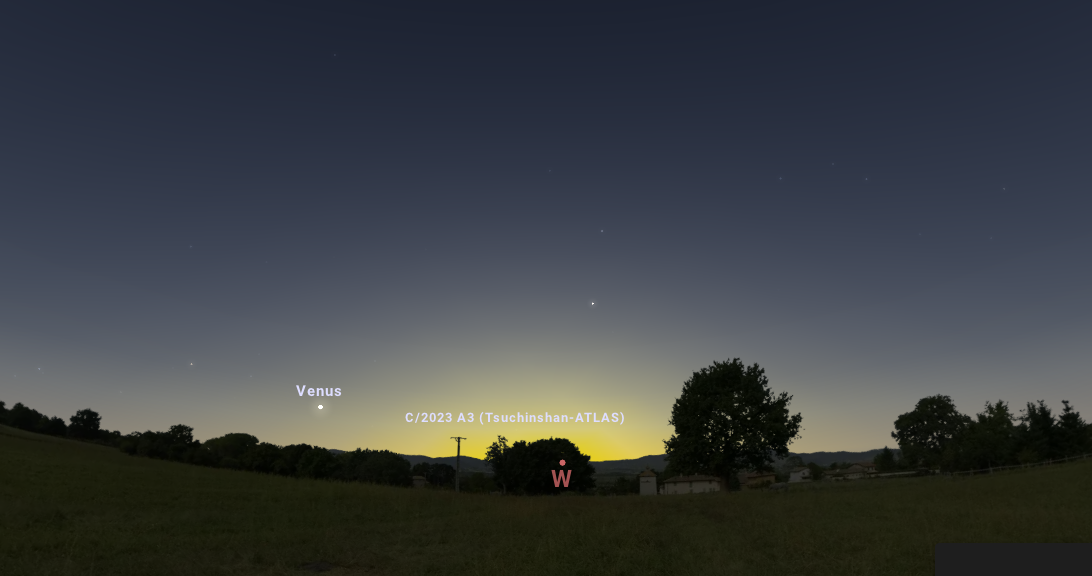
Comet C/2023 A3 (Tsuchinshan-ATLAS) at sunset Screenshot: Stellarium
The comet will continue to be visible through late October as it moves higher in the sky each night and swiftly passes through the constellations Serpens Caput and Ophiuchus.
How & Where to See Comet C/2023 A3 (Tsuchinshan-ATLAS):
Comet viewing is best done away from city lights, where the sky is darkest. Parks or rural areas with minimal light pollution will offer the clearest views.
Check clear sky (cloud) conditions in your area – here.
Starting October 14, look low in the western sky just after sunset. As the days progress, Comet A3 will appear higher each evening, making it easier to spot.
While the comet might be visible to the naked eye, a pair of binoculars or a small telescope will greatly enhance your view, revealing the comet’s tail and details of its coma.
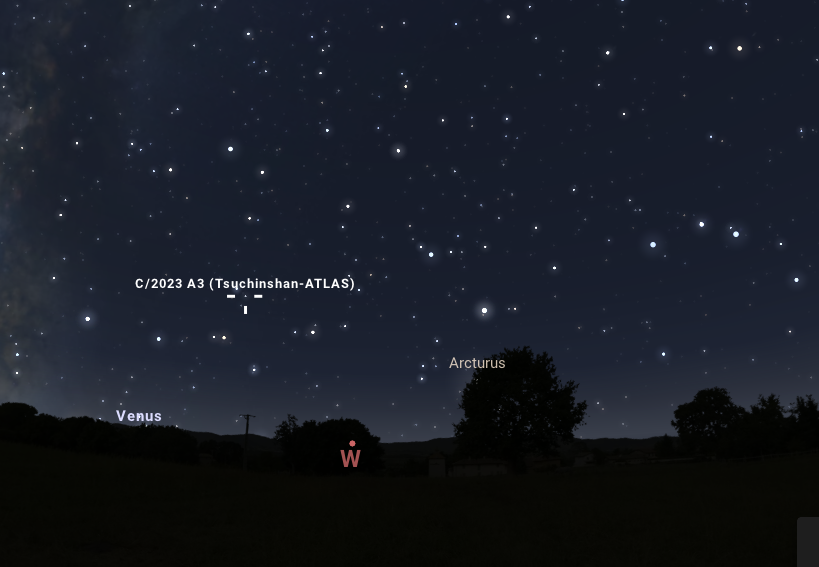
Simulated location of Comet C/2023 A3 (Tsuchinshan-ATLAS) on October 16, 8:30 p.m. E.T from Toronto/ Screenshot: Stellarium
Apps like Star Walk 2 or Stellarium can help you pinpoint the comet’s exact location in the sky, making it easier to track as it moves rapidly each night.
If you want to capture this sight, set up a camera on a sturdy tripod and use a longer exposure time to capture the comet’s tail. You can attach your camera to a telescope for even clearer images if you have a telescope.
Comet C/2023 A3 completes an orbit around the Sun once every 80,660 years, making this a rare, once-in-a-lifetime event. After its appearance this October, it will fade from view and won’t return for thousands of years. So, don’t miss this chance to see this rare comet as it streaks across the sky!


