Cape Breton Island
Approval ratings for Canada’s premiers are moving in different directions, with some leaders holding steady while others face clear declines tied to policy decisions, economic pressures, and controversy.

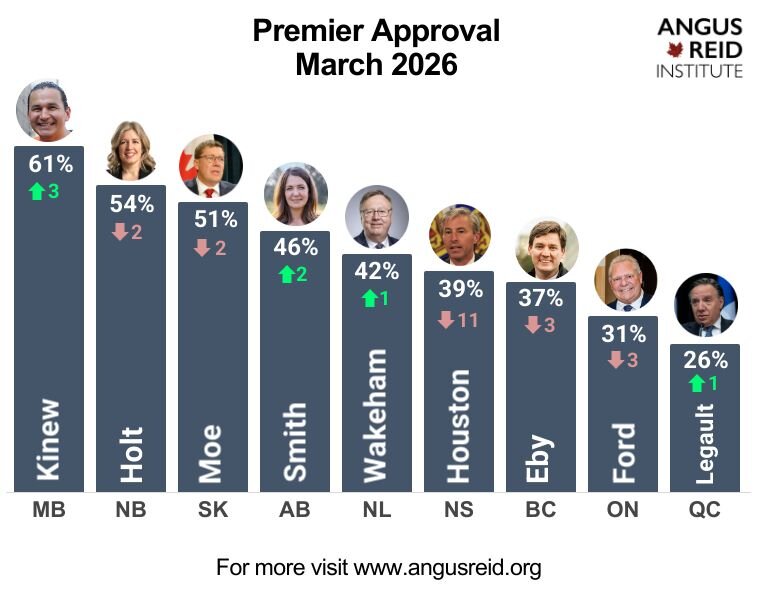
New data from the Angus Reid Institute, based on an online survey of 4,005 Canadian adults conducted March 11–17, 2026, shows how approval ratings are being shaped by economic pressures, policy decisions, and recent controversies across the country.
Here are the Survey Highlights:
- Wab Kinew (61%): Manitoba’s premier continues to lead the country, maintaining strong approval in eight of his 10 quarters in office. His government has faced criticism on health care and education, but affordability-focused measures, including fuel tax reductions and fixing milk prices for 2026, appear to be resonating with residents.
- Susan Holt (54%): New Brunswick’s premier continues to maintain majority support, even as she acknowledges missed targets in health care and education. With a record-high deficit looming, she has signalled that difficult fiscal decisions are ahead.
- Scott Moe (50%): Saskatchewan’s premier holds steady approval, supported in part by international economic gains, including a $2.6-billion uranium deal with India. However, expected budget deficits linked to global trade pressures could test that support.
- Danielle Smith (46%): Alberta’s premier remains relatively stable in public opinion. Despite a projected $9.4-billion deficit and debates around immigration and public spending, her approval has held consistent since taking office in 2022.
- Tony Wakeham (42%): Newfoundland and Labrador’s premier remains unchanged in approval. His government is balancing new economic opportunities, including the Bay du Nord oil project, with the challenge of managing the province’s high debt levels.
- Tim Houston (39%): Nova Scotia’s premier recorded one of the largest declines this quarter, dropping 11 points. The shift follows backlash over proposed spending cuts that were later reversed, as the province faces a projected $1.2-billion deficit and ongoing fiscal pressure.
- David Eby (37%): British Columbia’s premier has seen a sharp drop in support, down 16 points from 53 per cent a year ago. The decline comes amid ongoing concerns around the province’s deficit, health care challenges, and controversy linked to an Aboriginal title agreement involving the Musqueam Indian Band, raising broader questions about leadership and direction.
- Doug Ford (31%): Ontario’s premier has slipped back near previous lows after a temporary surge in popularity last year. That boost, tied to external political tensions, has faded, leaving Ford once again with support from roughly three in 10 Ontarians.
- François Legault (26%): Quebec’s premier continues to have the lowest approval rating in the country for a third straight quarter. His declining popularity is seen as a factor in his decision to step down ahead of the upcoming provincial election.
Due to its small population, Prince Edward Island was excluded from the survey because it is not possible to draw reliable samples across multiple survey waves.