 Toronto
In 2023, Canada’s rental market witnessed a significant 9% surge in asking rents, reaching a new peak of $2,178 per month in December, according to the National Rent Report by Rentals.ca and Urbanation.
This increase marks a 22% rise over two years, translating to an additional $390 monthly on average. This record high followed a consistent upward trend, with a 12.1% hike in 2022 and a 4.6% rise in 2021, contrasting sharply with a 5.4% decrease in 2020 due to the COVID-19 pandemic.
“The rate of rent growth in Canada was stronger than expected in 2023, mainly due to a surge in non-permanent residents, a resilient economy, and a sharp pullback in home buying activity,” said Shaun Hildebrand, President of Urbanation in a news release.
“While rents are expected to continue rising in 2024, there should be less upward pressure on the market this year as demand increases at a somewhat slower speed and more supply is added.”
Increase in Apartment Rents:
The steepest rent growth was seen in traditional apartments, which, despite being the most affordable at $2,076 on average, grew by 12.8%. In comparison, condominium and home rentals, averaging $2,340 and $2,354 respectively, experienced more modest increases of 6.9% and 5.9%.
One-bedroom apartments led the way with a 13% growth, reaching $1,932 on average. Studio apartments followed closely with an 11.9% increase, averaging $1,552. Meanwhile, two-bedroom and three-bedroom apartments saw their rents climb to $2,301 and $2,579, up by 9.8% and 9.9% respectively.
Alberta Rents Increase Rapidly; B.C. Remains the Priciest
Per the latest report, Alberta emerged as the province with the most rapidly growing rents, recording a 15.6% increase to an average of $1,691. In contrast, British Columbia maintained its status as the priciest province despite a slight 1.4% decrease in rents, averaging $2,500. Ontario and Quebec followed, with rents averaging $2,446 and $1,953, marking increases of 3.7% and 10.0% respectively.
Nova Scotia saw a 2.4% decrease in rents after a substantial 31.4% increase in 2022.
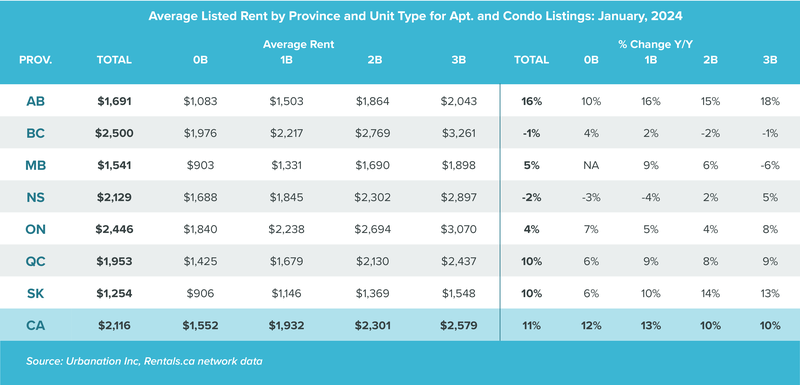
Credit: National Rent Report/ Rentals.ca
Rents Increase Across Canadian Cities
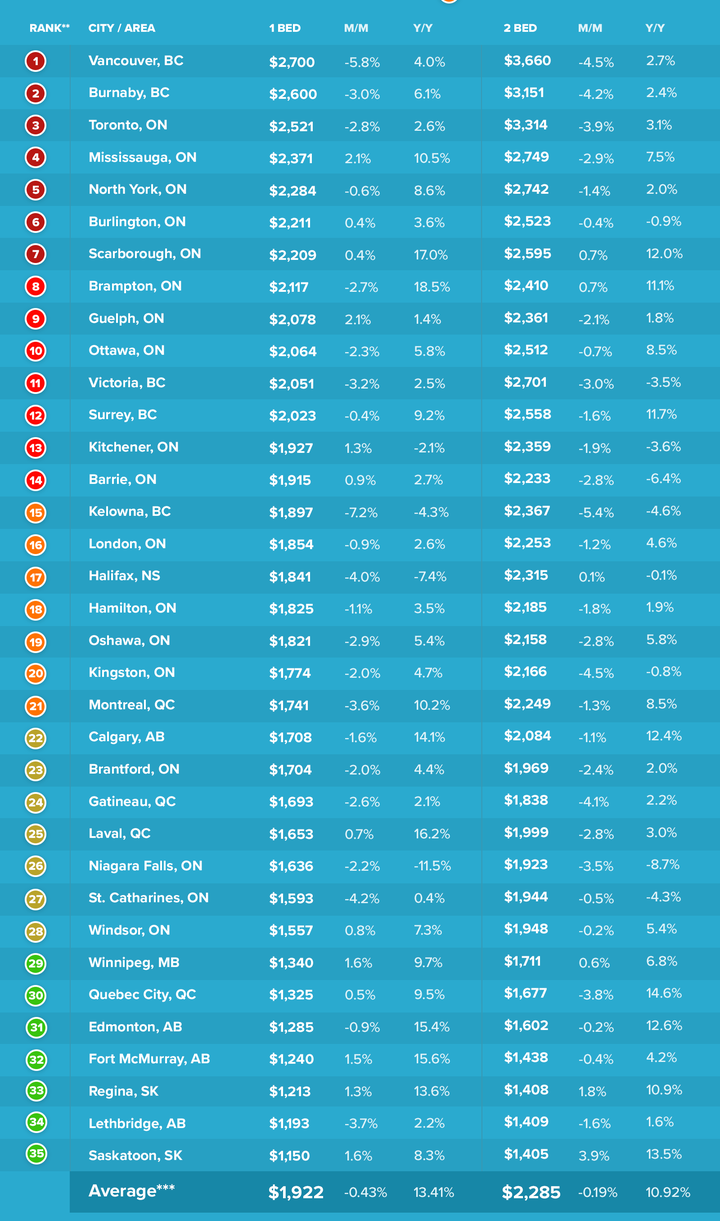
In major cities, Calgary led with a 14.0% increase in rents, followed by Edmonton and Montreal, with 13.5% and 11.3% increases respectively. Conversely, Vancouver and Toronto, the most expensive markets, saw a slowdown in rent increases.
Vancouver tops the chart as the priciest city for renters, with one-bedroom and two-bedroom units costing $2,700 and $3,660, respectively. Burnaby trails closely with rents at $2,600 for a one-bedroom and $3,151 for a two-bedroom apartment. Toronto also stands out with significant rental prices at $2,521 for one-bedroom and $3,314 for two-bedroom units. Ontario cities of Mississauga and North York complete the top five, demanding $2,371 and $2,284 for one-bedroom units and $2,749 and $2,742 for two-bedroom apartments, respectively.
Credit: National Rent Report/ Rentals.ca
Conversely, Saskatoon offers the lowest rental prices, with one-bedroom units at $1,150 and two-bedroom apartments at $1,405. Lethbridge follows with $1,193 for a one-bedroom and $1,409 for a two-bedroom. Regina and Fort McMurray provide affordable options as well, with one-bedroom rents at $1,213 and $1,240, and two-bedroom rents at $1,408 and $1,438 respectively. Edmonton rounds out the five most budget-friendly cities, with one-bedroom apartments at $1,285 and two-bedroom units at $1,602.
Rentals.ca expects that the Canadian rental market will stabilize with a projected 5% growth rate in 2024. Despite a slowdown due to economic factors, demand remains robust. Increased apartment completions and higher tenant turnover are anticipated to enhance supply, contributing to a more balanced market.
The report states, “Relatively affordable markets, such as those in Alberta, should continue to experience above-average rent increases, while more expensive markets, such as those in B.C. and Ontario, should continue to experience rent increases below the national average.”
The National Rent Report analyzes monthly, quarterly, and annual rental market rates and trends on a national, provincial, and municipal level across all listings on the Rentals.ca Network for Canada. Urbanation, a Toronto-based real estate research firm, analyzes Rentals.ca Network data and writes the report.
A detailed report is available here.


