 Toronto
The Ontario government is launching a new Ultra-Low Overnight price plan on May 1, 2023, which allows electricity customers to save money by shifting their usage to overnight hours when electricity demand is lower.
The ultra-low overnight rate is set at 2.4 cents per kilowatt-hour, 67% lower than the current off-peak rate, in exchange for a higher on-peak rate.
The new pricing structure is a third option for electricity customers, in addition to the existing Time-of-Use (TOU) and Tiered plans.
The ULO rate structure is divided into four rate periods: ULO, on-peak, mid-peak, and weekend off-peak. The new pricing plan is available to all eligible Regulated Price Plan (RPP) TOU and Tiered consumers.
The lowest pricing on ultra-low overnight plan (2.4 cents per kWh) is available from 11 p.m. to 7 a.m. all year, while electricity usage from 4 p.m. to 9 p.m. on weekdays will be charged at the maximum rate of 24 cents per kWh.
In comparison, Time-of-Use (TOU) off-peak rates are 7.4 cents per kWh for usage between 7 p.m. to 7 a.m. on weekdays and all weekends. TOU on-peak rates are 15.1 cents per kWh for 11 a.m. in 5 p.m. in summer and 7 a.m. to 11 a.m. and 5 p.m. and 7 p.m. in winter.
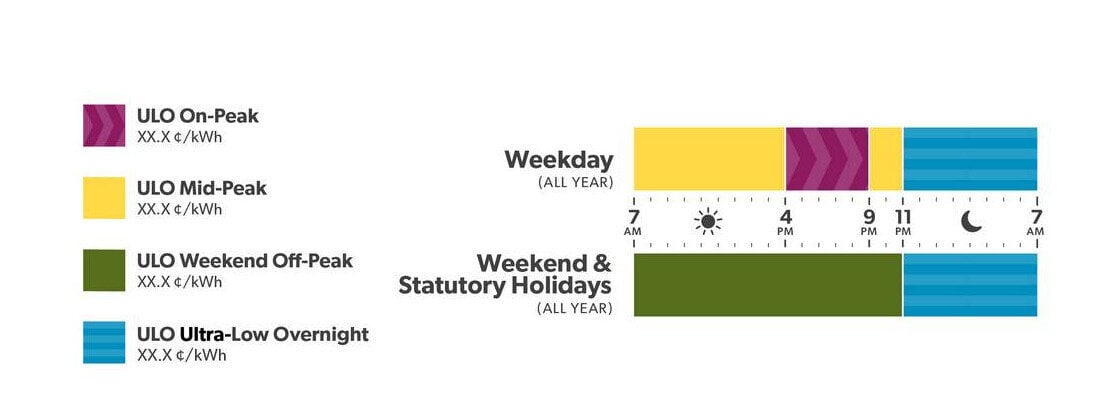
Ultra-low overnight hours/Credit: oeb.ca
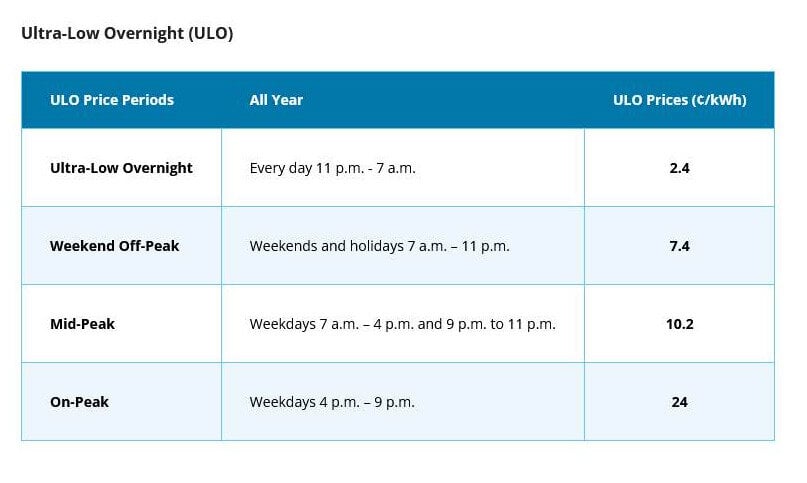
Ultra-low overnight rate/Credit: oeb.ca
Per the news release, customers who use more electricity overnight, including shift workers and those with electric heating or EV charging needs, could save up to $90 per year.
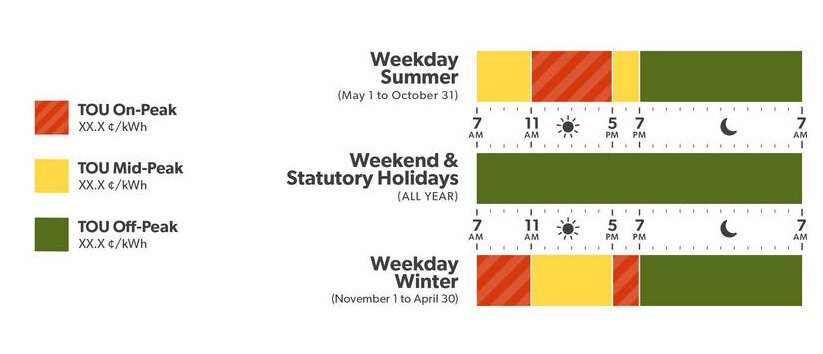

Time-of-Use (TOU) Rate Plan/Credit: oeb.ca
Starting May 1, 2023, customers of Toronto Hydro, London Hydro, Centre Wellington Hydro, Hearst Power, Renfrew Hydro, Wasaga Distribution, and Sioux Lookout Hydro can opt-in to this new optional electricity price plan, with all utilities required to offer it to customers within six months.
If you are considering changing plans, the Ontario Energy Board’s Bill Calculator can help you determine which plan suits your needs and saves you the most money.
The province says shifting electricity usage to overnight hours can increase grid efficiency and reduce capacity costs for the electricity system by up to $5.7 million per year.
According to the news release, the ultra-low overnight rate is made possible by Ontario’s excess clean electricity during overnight hours, which can help reduce emissions by encouraging the use of zero-emissions resources like nuclear, hydro, and wind power.


