 Calgary
With Daylight Saving Time beginning on March 9, 2025, it’s interesting to look back to see why it was put in place and what the future of DST in Canada looks like.

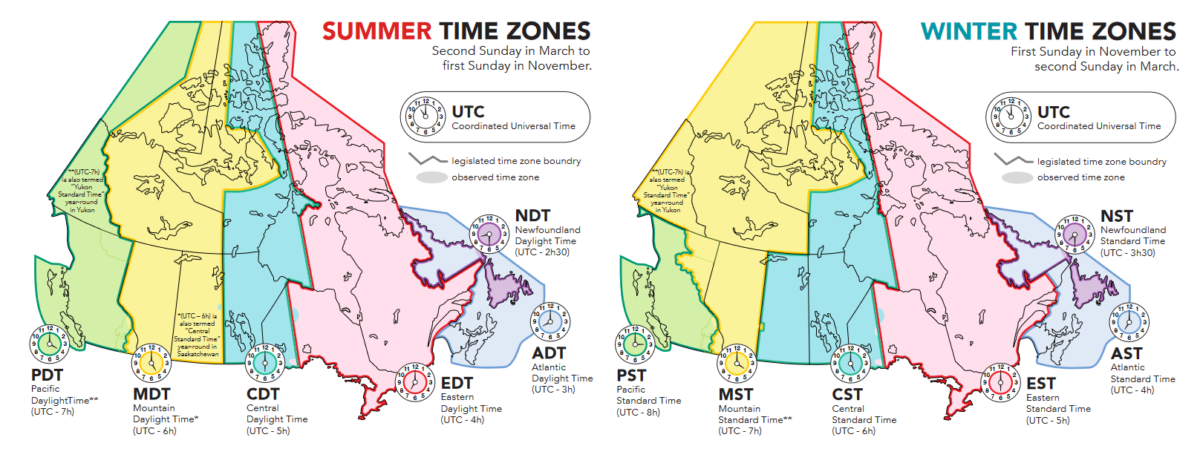
Credit: National Research Council Canada/Govt. of Canada
Spring Ahead & Fall Behind
Daylight Saving Time, the practice of adjusting clocks by one hour in spring and fall, may be unfamiliar to newcomers in Canada, especially if you are coming from a tropical country.
In U.S. and Canada, the time changes occur on the second Sunday of March and the first Sunday of November, respectively.
Canada has six standard time zones, and the changes in time during fall and winter can be confusing as some areas do not change when others do, and boundaries may not align with time zones.
Thunder Bay First Followed DST in Canada
John Hewitson from Port Arthur, Ontario, petitioned to adjust the clocks to Eastern Time in the summer months in 1908 to enjoy more summer sunshine. The towns of Port Arthur and Fort William (now Thunder Bay), implemented the first “spring ahead” on May 1, 1908.
Daylight Saving Time (DST) was later introduced in Canada during World War I to increase production by using the extra hour of daylight.
Time changes were initially regulated by municipalities to avoid confusion, but by 1987, the provincial, territorial, and federal governments oversaw DST.
The US shifted DST to March and November in 2005 to reduce energy consumption and costs, and various provinces in Canada followed suit.
Saskatchewan Time
Canada has some other interesting history when it comes to time zones and how they are affected by Daylight Saving Time, especially in the province of Saskatchewan.
Saskatchewan’s time zones have been affected by Daylight Saving Time, with a maze of time zones caused by municipalities choosing their own standard times.
The Time Act was implemented in 1966, creating a single standard time for the province, except for Battle River (Lloydminster), which follows MST during the winter.
Saskatchewan remains on CST throughout the year, sharing the same time as Alberta during summer and Manitoba for winter.
Yukon Standard Time
Yukon switched to Mountain Standard Time permanently after November 1st, 2020. This means Yukon shares the same time as Alberta, northeastern B.C., and NWT in winter and with B.C. in summer.
- Drive the Alaska Highway – Road Trip From Edmonton to Whitehorse
Other Places Which Do Not Observe DST
Other than Saskatchewan and Yukon, there are some pockets in Canada that do not observe Daylight Saving Time.
Communities of Chetwynd, Dawson Creek, Hudson’s Hope, Fort St. John, Taylor and Tumbler Ridge in Peace River Regional District in B.C. do not observe DST.
Fort Nelson stopped following DST in 2015 and is in Mountain Standard Time. Creston and the East Shore of Kootenay Lake also do not observe DST and follow Mountain Standard Time year-round. This means that parts of Peace River Regional District, Fort Nelson and Creston are on the same time as Alberta in winter and with the rest of B.C. except parts of the East Kootenay region in summer.
The East Kootenay region is on Mountain Time (observes DST) and is on the same time as Alberta. The main reason for this time zone, as per the Creston Museum website, is “the change between Pacific Standard Time and Mountain Standard Time happens in the Crows Nest Pass, but when the CPR built through the Creston Valley in 1898, the train tracks ended at Kootenay Lake, so Creston, and every other community in the East Kootenay, were included in the Calgary (i.e., Mountain) division of the CPR.”
Pickle Lake, Atikokan, and New Osnaburgh in Ontario, as well as Southampton Island in Nunavut, follow Eastern Standard Time all year.
Le Golfe-du-Saint-Laurent Regional County Municipality in Quebec observes Atlantic Standard Time throughout the year.
Current Status of Eliminating Time Change in Canada
Following the Yukon’s decision to end Daylight Saving Time, there is growing debate about whether other provinces and territories in Canada should do the same.
Studies have shown that even minor changes in time can have negative health effects, including increased risks of heart attacks, strokes, and accidents.
While Alberta held a referendum on whether to keep DST in 2021, over half of the voters chose to maintain the practice.
Ontario passed a bill to end DST, but it’s awaiting similar changes in New York and Quebec.
Similarly, British Columbia’s adoption is delayed until California agrees to end DST.
The Sunshine Protection Act, passed in the U.S. Senate in 2022, proposed to make daylight saving time permanent in the United States, eliminating the practice of changing the time twice per year. It stalled in the House and was not enacted in the previous Congress.
The decision to adopt permanent DST in various provinces would depend on when the U.S. makes the change.
For the moment, the majority of provinces and territories still observe it, which means that you may have to set your clock forward by one hour on Sunday, March 9, 2025 at 2:00 am.




I thought BC was going to keep the time change as us from the “move clocks ahead” in March 2023