Toronto
Half of Canadian adults now say they either don’t have a family doctor or struggle to see the one they do, according to new survey data released by the Angus Reid Institute.
It’s a noticeable shift from a decade ago and comes despite the overall supply of family physicians remaining largely unchanged.
Here are the highlights of the survey:
- Finding a family doctor is taking longer: Canadians without a family doctor now report greater difficulty than a decade ago. In 2015, 31% of those searching for a GP said they had been looking for more than a year. That share has grown to 45% in 2025.
Credit: Angus Reid Institute
- More people are giving up entirely: Among those without a family doctor, the proportion who say they have stopped searching has increased from 21% in 2015 to 25% today. Across the full population, this translates into a rise from 10% to 13% of Canadians who have either searched for more than a year or abandoned the search altogether.
Credit: Angus Reid Institute
- Regional stability in the West, pressure elsewhere: Western provinces show relatively little change since 2015, with shifts remaining within the margin of error. The picture is different in other regions, where longer searches are becoming more common.
- More Quebec residents stop looking: One-quarter of Quebec residents say they have been searching for a family doctor for more than a year or have stopped looking, the highest rate in Canada. This marks a seven-point increase compared to 2015.
- Atlantic Canada also falling behind: Atlantic provinces are seeing a growing share of residents unable to secure a family doctor within one year, adding to long-standing access challenges in the region.
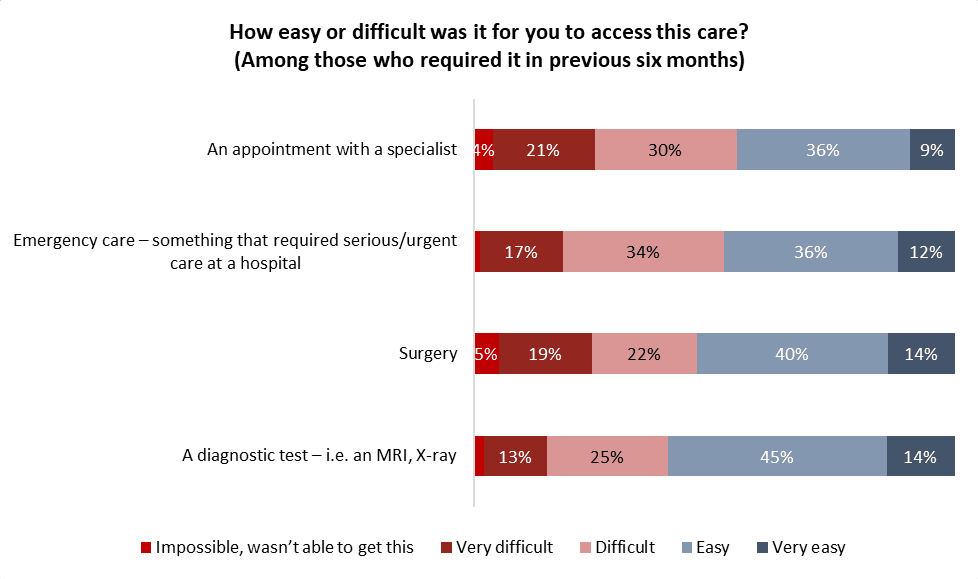
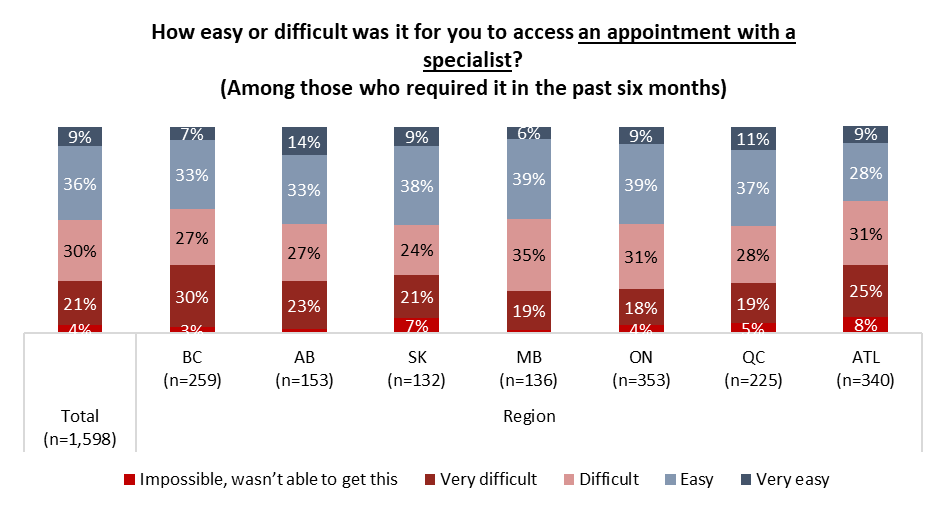
- Access problems extend beyond family doctors: Among Canadians who needed care in the past six months, 55% found it difficult or impossible to see a specialist. Another 51% struggled to access urgent hospital care. Difficulties were also reported for surgery by 41%, while 38% faced barriers to diagnostic tests.
- British Columbia leads in diagnostic delays: Diagnostic testing is especially challenging in B.C. Nationally, 13% say testing was very difficult and 25% say it was difficult. In B.C., 20% report it was very difficult to get tests such as imaging or lab work.
Credit: Angus Reid Institute
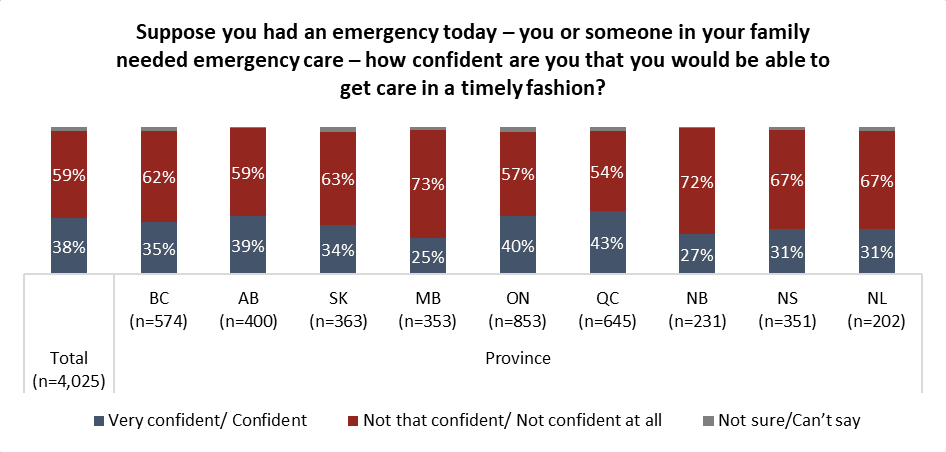
- Low confidence in emergency care: Only 38% of Canadians feel confident they could receive timely emergency care if needed. Confidence is higher among men (45%) than women (32%) and drops to 27% in New Brunswick and 25% in Manitoba.
- Dissatisfaction with provincial health systems: Majorities in every region say they are dissatisfied with how health care is handled. Seven in ten or more express dissatisfaction in British Columbia, Saskatchewan, Ontario, and Quebec. Debate around Quebec’s Bill 2, described by the Canadian Medical Association, has intensified criticism in that province.
Seven in ten Canadians believe health care has deteriorated over the past 10 to 15 years, with at least two-thirds in every region sharing that view.
The survey was conducted online from Nov. 26 to Dec. 1, 2025, among 4,025 Canadian adults who are members of the Angus Reid Forum. Results were weighted to reflect the national population by region, gender, age, income, and education.