Calgary
A new study says Canada’s highest-earning families are carrying a larger share of the tax load than their share of income.
Credit: Fraser Institute
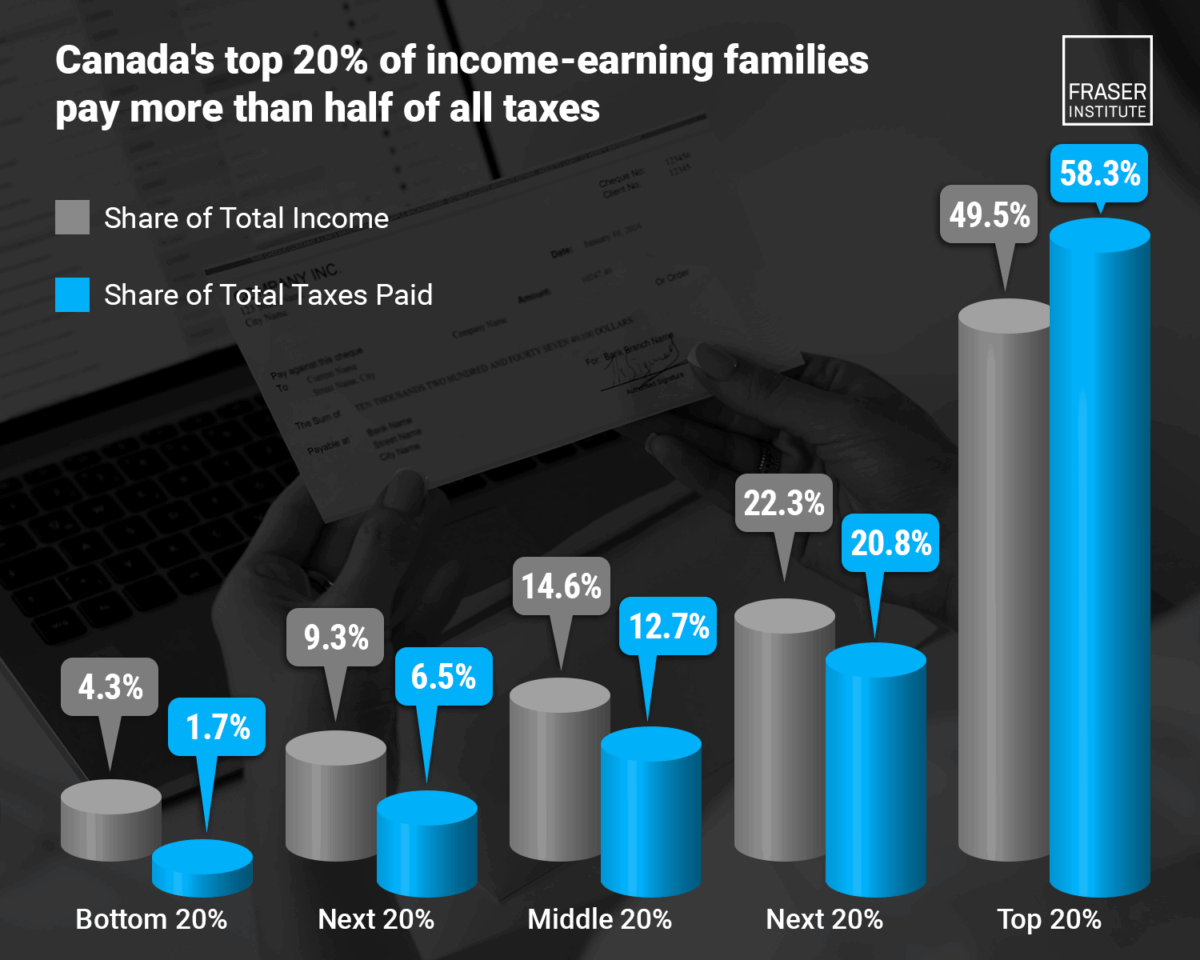
The study, Measuring Progressivity in Canada’s Tax System, 2026, by the Fraser Institute, looks at how taxes are distributed across Canadian families by income group. Its central finding is that the top 20 per cent of income-earning families pay 58.3 per cent of all taxes in Canada. That includes personal income taxes, sales taxes and property taxes.
Their share of total family income is 49.5 per cent.
That comparison matters, the study argues, because it is one way to assess whether the tax system is progressive. In simple terms, a progressive system means higher-income groups pay a larger share as income rises.
Jake Fuss, director of fiscal studies at the Fraser Institute and co-author of the study, said the numbers push back against the idea that top earners are not paying their fair share.
“The idea that top earners don’t pay their ‘fair share’ of taxes ignores the evidence that these families pay a disproportionately large share of the total tax bill,” Fuss said.
The gap is even wider when looking only at personal income taxes. According to the study, the top 20 per cent of families pay 65.3 per cent of all federal and provincial personal income taxes.
At the other end of the scale, the bottom 20 per cent of income-earning families earn 4.3 per cent of total family income and pay 1.7 per cent of total taxes. The study estimates that this same group pays 0.7 per cent of all federal and provincial personal income taxes.
The report divides Canadian families into five income groups. The bottom 20 per cent includes families earning $0 to $63,068. The second quintile ranges from $63,089 to $111,354. The middle group earns $111,355 to $171,298, while the fourth quintile earns $171,299 to $270,472. The top 20 per cent includes families earning more than $270,472.
The study also cautions against assuming higher taxes on top earners would automatically produce a major revenue boost. It says previous research has found that some taxpayers respond to higher rates through tax planning, avoidance or evasion, which can reduce taxable income.
The report also argues that higher taxes could make Canada less attractive for skilled workers, including doctors, scientists, managers and software engineers.
“The assertion that the top 20 per cent of earners in Canada are not paying their fair share is simply not supported by the evidence,” Fuss said.