Toronto
Canada’s labour market gained ground in July, with employment rising by 75,000, or 0.4%, according to the latest Statistics Canada Labour Force Survey.
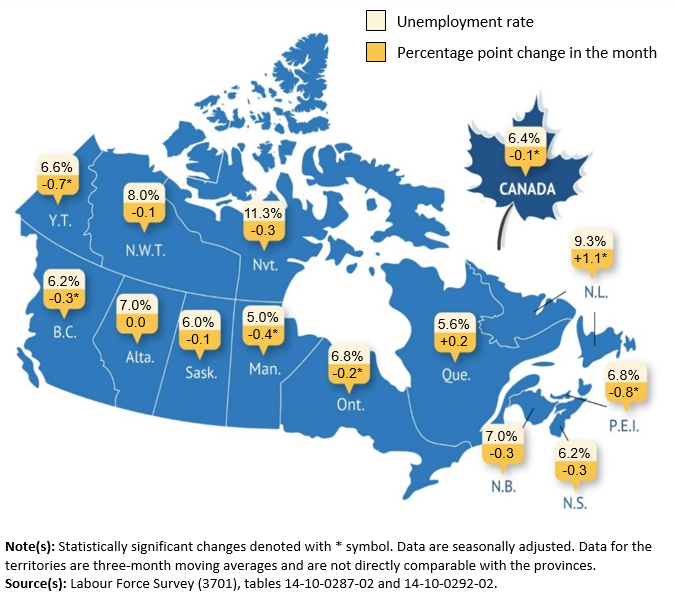
Source(s): Labour Force Survey (3701), tables 14-10-0287-02 and 14-10-0292-02/Credit: Statistics Canada
The employment rate edged up to 60.9%, while unemployment fell to 6.4%, continuing a gradual improvement seen since the spring. Wage growth also continued, though at a slower annual pace than in June.
Employment growth continues: Canada added 75,000 jobs in July, with increases divided between full-time and part-time work. Since April, employment has grown by 181,000, largely because full-time employment increased by 193,000. Private-sector employment rose by 58,000 in July and self-employment increased by 44,000, while public-sector employment declined by 27,000.
Unemployment falls for third straight month: The national unemployment rate slipped 0.1 percentage points to 6.4%, which Statistics Canada described as the “lowest level in two years.” It was the third consecutive monthly decline and was 0.5 percentage points below April. The job-finding rate reached 20.8%, up from 18.5% a year earlier, but remained below the 2017-to-2019 average of 26.6%.
Core-aged women see stronger gains: Workers aged 25 to 54 accounted for much of July’s increase, adding 51,000 jobs. Core-aged women gained 33,000 positions, helping push their unemployment rate down to 5.2%. Their employment rate climbed to 81.2%. Core-aged men added 18,000 jobs, while their unemployment rate remained little changed at 5.8%.
Youth unemployment remains high: Youth unemployment held near 12.6%, down from 14.3% in April but still above the pre-pandemic average of 10.8%. Among major racialized groups, Black youth recorded the highest rate at 22.6%. The unemployment rate was 15.4% for Chinese youth and 13.9% for South Asian youth in July 2026.
Retail, finance and construction add workers: Wholesale and retail trade led industry gains with 21,000 additional jobs. Finance, insurance, real estate, rental and leasing added 18,000, while professional, scientific and technical services gained 17,000. Construction employment rose by 16,000. Public administration moved the other way, losing 15,000 jobs, while agriculture employment fell by 9,600.
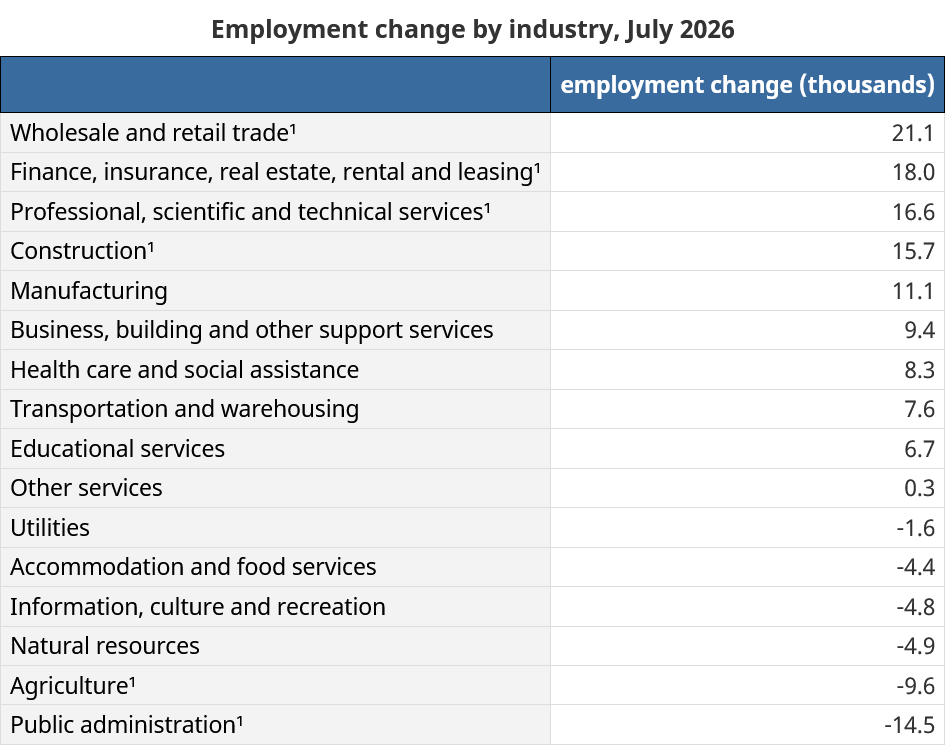
Source(s): Labour Force Survey (3701), table 14-10-0355-01/Credit: Statistics Canada
Ontario leads provincial job gains: Ontario added 52,000 jobs in July and its unemployment rate fell to 6.8%. British Columbia gained 18,000 jobs, Manitoba added 5,900 and Nova Scotia gained 4,600. Alberta employment was little changed during the month but remained 91,000 higher than a year earlier, while Quebec employment and unemployment were largely unchanged.
Wage growth slows from June: Average hourly wages reached $37.17 in July, up $1.01, or 2.8%, from a year earlier. That marked a slower pace of annual wage growth than the 3.3% recorded in June. The figures were not seasonally adjusted.
While Canada added 75,000 jobs, the U.S. market lost 23,000 jobs with the unemployment rate at 4.1 percent in July.
Labour Force Survey, July 2026