 Calgary
Recent discussions around provincial separation have gained renewed political momentum in Alberta and Saskatchewan, as both premiers have made space for potential referendums.

Alberta Premier Danielle Smith has outlined conditions under which a vote could occur, despite stating she does not support separation. Saskatchewan Premier Scott Moe also said he wouldn’t oppose a referendum, though his government doesn’t support the idea of leaving Canada.
According to new polling data from the Angus Reid Institute, support for separation in both provinces remains limited.
Here are the highlights of the poll:
- Support for Separation Remains a Minority View: Only 36% of Albertans and 34% of Saskatchewanians back the idea. Even fewer are firm in their stance — just 19% in Alberta and 15% in Saskatchewan say they would “definitely” vote to leave if a referendum were held. Half of residents in both provinces indicate they would “definitely” vote to remain in Canada.
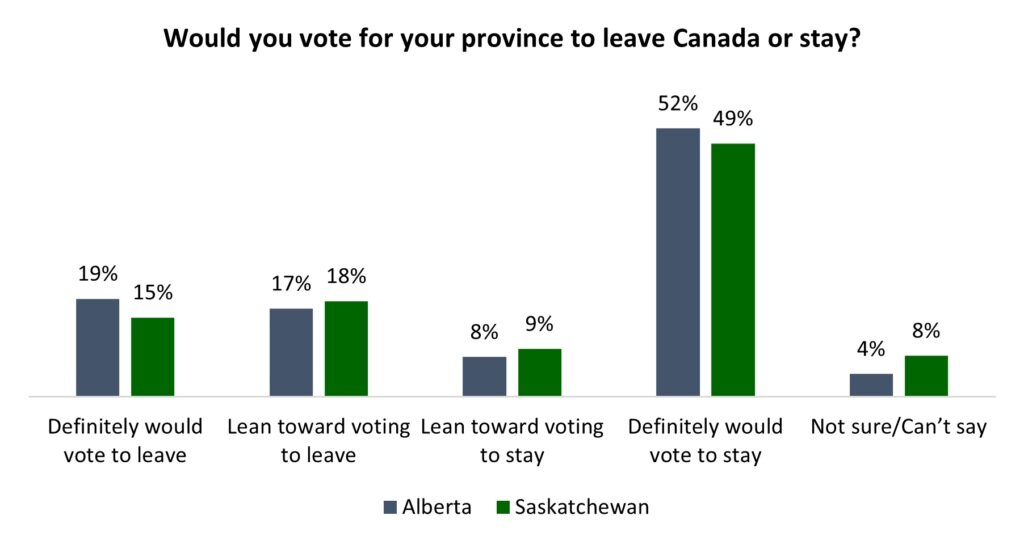
Credit: Angus Reid Institute
- Political Lines Drawn on Referendum Support: Views on simply holding a referendum reveal political divides. In Alberta, support and opposition are nearly even (51% support, 49% oppose), but opponents are more resolute. Most supporters of the United Conservative Party (UCP) favour a referendum, while Alberta NDP voters are largely against it. Saskatchewan shows a similar pattern: Saskatchewan Party supporters back holding a vote, whereas most NDP voters oppose even the idea of a referendum.
- Federal Government Policies Seen as Key Triggers: Much of the unrest ties into dissatisfaction with federal environmental and energy policies. Smith has presented demands to incoming Prime Minister Mark Carney’s Liberal minority government, including reviving east-west pipelines, removing emissions caps on oil and gas, and repealing Bill C-69 — legislation which expanded environmental assessments for resource projects.
- A significant portion of those currently leaning toward voting to leave indicate that if these demands were met, they would be more inclined to vote to stay.
- Reviving a project like Energy East would sway one-third of definite leave voters in Alberta and one-quarter in Saskatchewan.
- Removing the emissions cap or repealing Bill C-69 would have a similar impact, particularly among those undecided or leaning toward leaving.
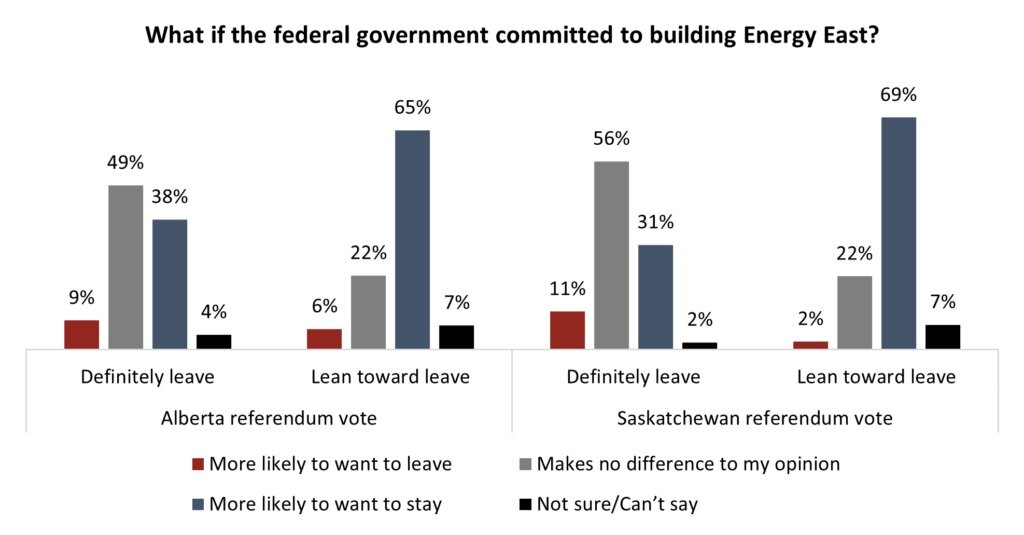
Credit: Angus Reid Institute
- Liberal Government Fuels Separation Sentiment: The recent federal election outcome, which saw the Liberals retain power under Carney, appears to have intensified separatist sentiment. During the campaign, Angus Reid polling showed that about 30% of respondents in both provinces favoured leaving Canada if the Liberals won. Now, the data suggest that many of these same individuals would be likely to stay if the Conservatives had formed government. Around three-quarters of current “leave” supporters in both provinces say they would switch to the “stay” side under Conservative leadership.
- Indigenous Opposition Not Dissuading Separatists: Indigenous leaders in both provinces have voiced strong opposition to separation, citing treaty rights and constitutional concerns. However, the poll indicates these protests may have limited influence on separatist voters, many of whom report that Indigenous opposition would actually reinforce their desire to leave.
- External Roadblocks Could Deepen Divisions: Potential future actions by other provinces may influence separatist sentiment. A scenario in which British Columbia blocks tidewater access to an independent Alberta or Saskatchewan could strengthen the case for leaving among current leaners. Likewise, strong opposition from Quebec to future pipeline projects could intensify separatist resolve in both provinces, with four-in-five “leave” leaners saying they would be more likely to support separation under those conditions.
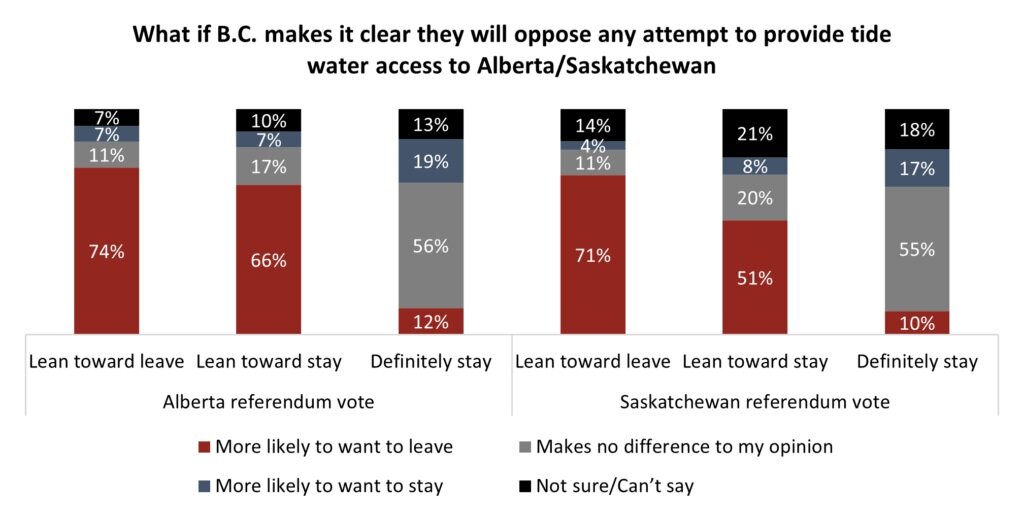
Credit: Angus Reid Institute
- Outlook: Separation Unlikely Despite Debate: Despite political developments and renewed discussion, a clear majority in both provinces do not expect a referendum to result in separation. About 75% of residents in Alberta and Saskatchewan predict such a vote would fail. Even among those who would vote to leave, only the most committed believe a successful outcome is likely.
The Angus Reid Institute’s survey of 790 Albertans and 577 Saskatchewanians was conducted online between May 6 and 8, 2025. The results were weighted for demographic representation and carry a margin of error of approximately ±3 percentage points for Alberta and ±4 points for Saskatchewan.


