Cape Breton Island
If you’ve been watching Canada’s rental market, August brought another sign that asking rents are cooling.
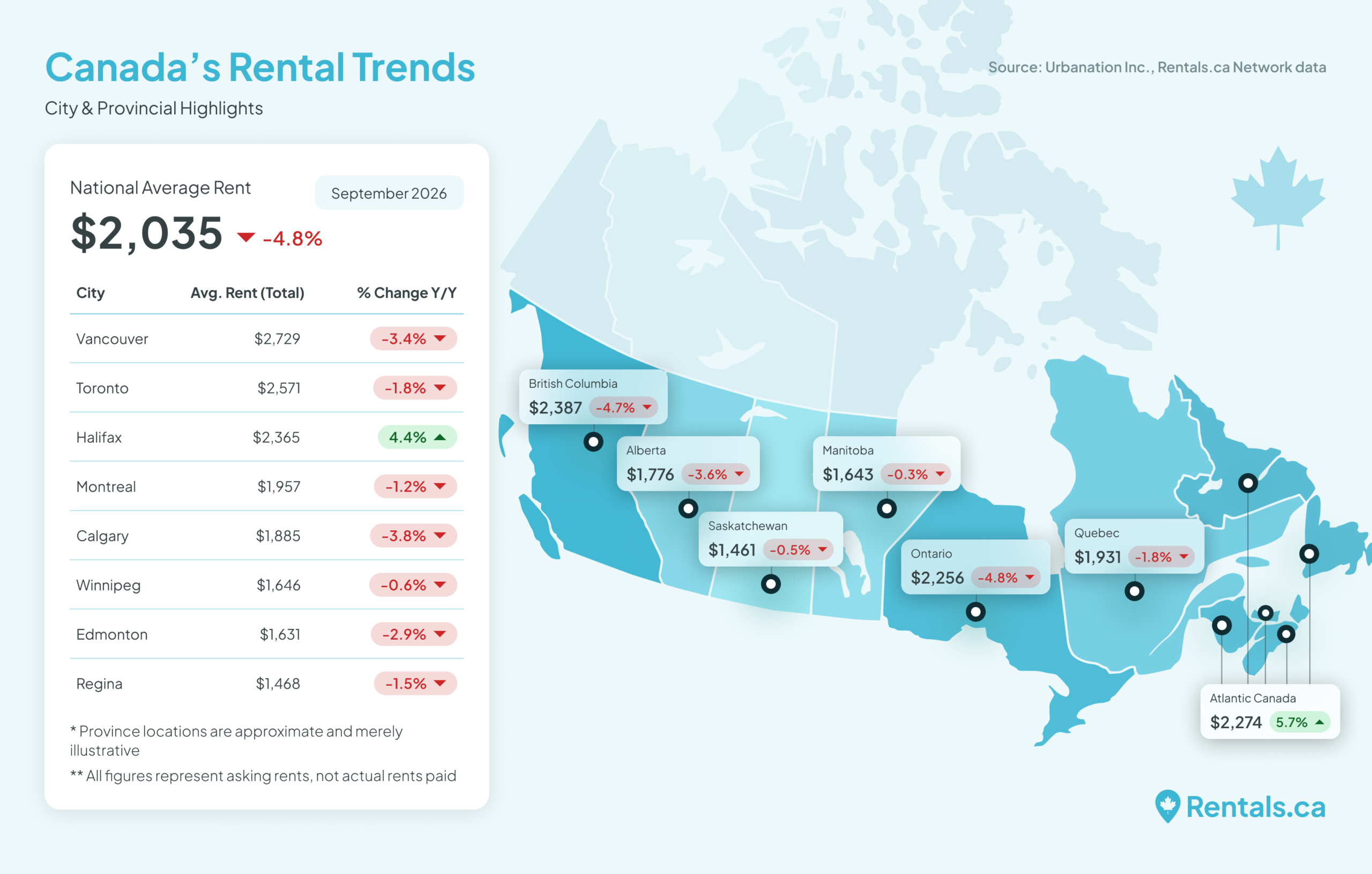
The national average fell to $2,035, down 4.8% from a year earlier, according to the latest National Rent Report from Rentals.ca and Urbanation.
Credit: National Rent Report/ Rentals.ca
That marks the 23rd straight month of annual declines and the sharpest drop since March 2026. Rents also slipped 0.1% from July, breaking a run of four monthly increases, while the two-year decline has now reached 7%.
National rents move lower again
- The average asking rent across all residential properties fell to $2,035 in August.
- That was 4.8% lower year over year and the lowest August level since 2022.
- Apartment and condo rents averaged $2,040, down 0.2% from July.
- Urbanation President Shaun Hildebrand said the seasonal lift seen in spring and summer has faded, while trade tensions have introduced fresh uncertainty around employment, consumer confidence and construction costs.
Purpose-built rentals hold up better
- Purpose-built rental asking rents declined 3.3% annually to $2,038, making them the most resilient property type.
- Three-bedroom purpose-built units slipped just 1.4% to $2,734.
- Condo rents saw a much steeper 7.7% annual decline to $2,050.
- Studio condo rents dropped 9.3%.
- Houses, townhomes and other secondary-market rentals posted the largest decline, falling 8.3% to $2,014.
British Columbia, Alberta and Ontario lead annual declines
- Among the largest provinces, British Columbia fell 4.6%, Alberta 4.3% and Ontario 3.5% year over year.
- Nova Scotia rose 3.1%, while Manitoba increased 0.2%.
- Nova Scotia remained Canada’s most expensive province for apartment and condo rents at $2,356, just ahead of British Columbia at $2,353.
- On a monthly basis, Manitoba fell 1.5% and Nova Scotia declined 0.9%.
Ottawa and Vancouver rise month over month
Credit: National Rent Report/ Rentals.ca
- Four of Canada’s six largest rental markets posted monthly increases.
- Ottawa rose 1.1% to $2,168, while Vancouver climbed 1% to $2,704.
- Montreal increased 0.8% to $1,955, and Edmonton rose 0.7% to $1,520.
- Toronto slipped 0.3% to $2,570, while Calgary edged down 0.2% to $1,825.
- Calgary posted the largest annual decline among the six major markets at 4.5%.
The most and least expensive markets
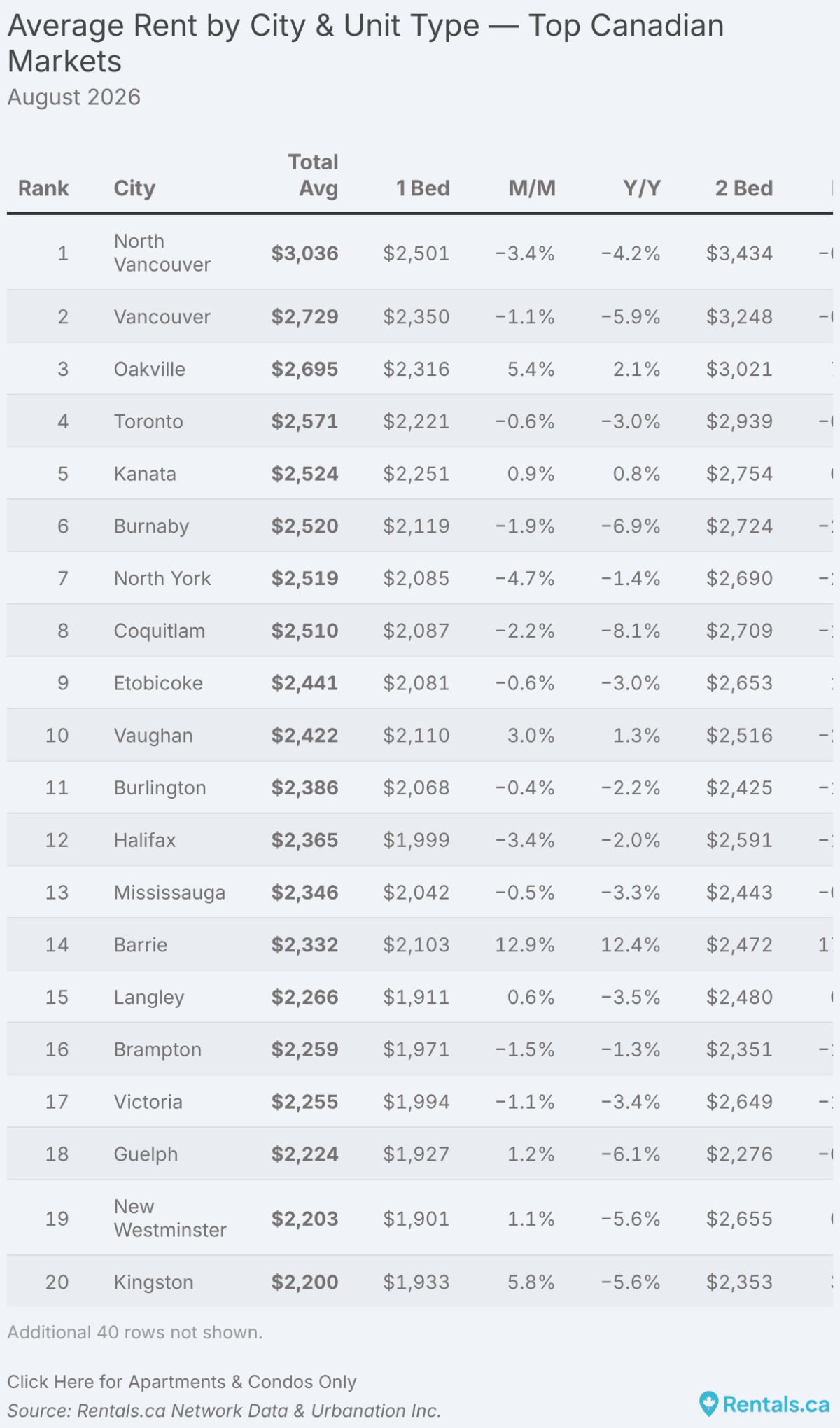
- North Vancouver remained the most expensive market outside the six largest cities at $3,018, followed by Oakville at $2,684 and Richmond at $2,570.
- At the other end, Fort McMurray averaged $1,277, Lloydminster $1,330 and Medicine Hat $1,345.
- Barrie posted the largest annual increase at 14.3%, while Longueuil recorded the steepest decline at 12.5%.