 Kelowna
Minister of Immigration, Refugees and Citizenship Marc Miller has unveiled the 2024-2026 Immigration Levels Plan.
The plan aims to stabilize permanent resident levels at 500,000 from 2026.
Last year, the federal government set an ambitious target of granting permanent residency to 465,000 in 2023, 485,000 in 2024 and 500,000 in 2025. The 2024-2026 Immigration Levels Plan maintains the target.
From 2026, permanent resident levels will stabilize at 500,000, allowing time for successful integration and labour market enhancement. The government plans to recalibrate temporary resident admissions in the coming year to ensure the sustainability of the immigration system.
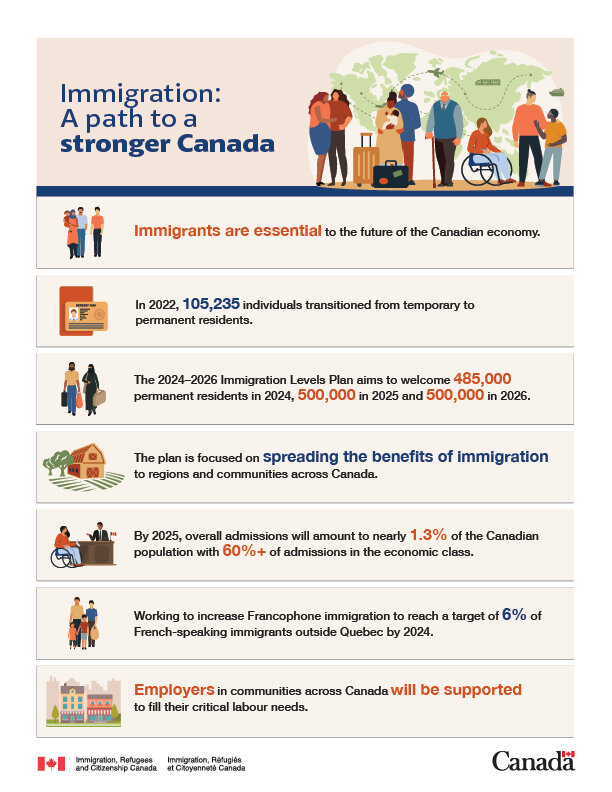
Key highlights of the plan include a continued focus on economic growth, with over 60% of permanent resident admissions dedicated to the economic class by 2025. Additionally, the government commits to upholding its humanitarian tradition by responding to global crises.
The plan introduces ambitious Francophone immigration targets outside Quebec, representing 6% of total immigration in 2024, 7% in 2025, and 8% in 2026, to support and economically prosper Francophone minority communities across Canada.
Per the news release, Canada resettled over 46,500 refugees from 80 countries last year, and last October, the country achieved its goal of welcoming at least 40,000 vulnerable Afghans, making it one of the largest Afghan resettlement programs globally.
2024-2026 Immigration Levels Plan
| Immigrant Category | 2024 | 2025 | 2026 | |||||||
|---|---|---|---|---|---|---|---|---|---|---|
| Target | Low Range | Low Range | High Range | Target | Low Range | High Range | ||||
| Overall Planned Permanent Resident Admissions | 485,000 | 430,000 | 532,500 | 500,000 | 442,500 | 550,000 | 500,000 | 442,500 | 550,000 | |
| Overall French-speaking Permanent Resident Admissions outside Quebec | 26,100 | – | – | 31,500 | – | – | 36,000 | – | – | |
| Economic | Federal High Skilled | 110,770 | 90,000 | 116,000 | 117,500 | 96,500 | 124,000 | 117,500 | 96,500 | 124,000 |
| Federal Economic Public Policies | – | 0 | 3,000 | – | – | – | – | – | – | |
| Federal Business | 5,000 | 3,500 | 7,000 | 6,000 | 4,000 | 8,000 | 6,000 | 4,000 | 8,000 | |
| Economic Pilots: Caregivers; Agri-Food Pilot; Rural and Northern Immigration Pilot; Economic Mobility Pathways Project | 10,875 | 6,500 | 14,500 | 14,750 | 9,000 | 19,750 | 13,750 | 9,000 | 19,750 | |
| Atlantic Immigration Program | 6,500 | 4,000 | 9,000 | 8,500 | 5,000 | 13,000 | 8,500 | 5,000 | 13,000 | |
| Provincial Nominee Program | 110,000 | 105,500 | 117,000 | 120,000 | 113,000 | 130,000 | 120,000 | 113,000 | 130,000 | |
| Quebec Skilled Workers and Business | To be determined | To be determined | To be determined | |||||||
| Total Economic | 281,135 | 250,000 | 305,000 | 301,250 | 265,000 | 326,000 | 301,250 | 265,000 | 326,000 | |
| Family | Spouses, Partners and Children | 82,000 | 77,000 | 88,000 | 84,000 | 79,000 | 90,000 | 84,000 | 79,000 | 90,000 |
| Parents and Grandparents | 32,000 | 27,000 | 36,000 | 34,000 | 29,000 | 42,000 | 34,000 | 29,000 | 42,000 | |
| Total Family | 114,000 | 105,000 | 130,000 | 118,000 | 107,000 | 135,000 | 118,000 | 107,000 | 135,000 | |
| Refugees and Protected Persons | Protected Persons in Canada and Dependents Abroad | 27,000 | 24,000 | 38,000 | 29,000 | 26,000 | 40,000 | 29,000 | 26,000 | 40,000 |
| Resettled Refugees – Government Assisted | 21,115 | 16,750 | 26,000 | 15,250 | 12,000 | 17,000 | 15,250 | 12,000 | 17,000 | |
| Resettled Refugees – Privately Sponsored | 27,750 | 20,000 | 31,000 | 28,250 | 23,000 | 32,000 | 28,250 | 23,000 | 32,000 | |
| Resettled Refugees – Blended Visa Office-Referred | 250 | – | 400 | 250 | – | 400 | 250 | – | 400 | |
| Total Refugeesand Protected Persons | 76,115 | 66,000 | 93,000 | 72,750 | 64,000 | 80,000 | 72,750 | 64,000 | 80,000 | |
| Humanitarian & Compassionate and Other | Total Humanitarian & Compassionate and Other | 13,750 | 9,000 | 17,500 | 8,000 | 6,500 | 12,000 | 8,000 | 6,500 | 12,000 |
The 2024 target of 485,000 new immigrants to Canada amounts to 1.2% of the country’s current population.
Canada’s population surged by 1.15 million in one year, reaching 40 million people in June 2023.


