 Banff
Banff 
The month of December is the time when you get to see the annual Geminids meteor shower.
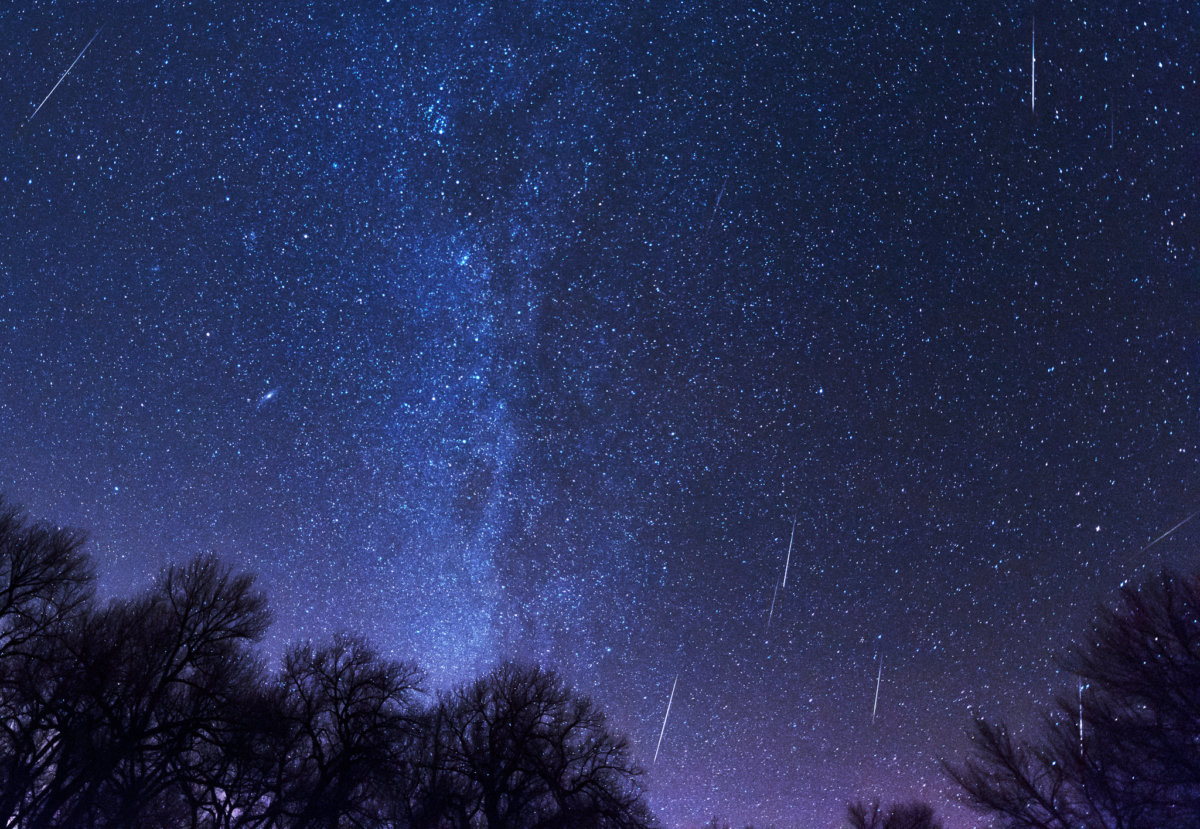
Geminid meteor shower 2015 over a 15-minute period north of Limon, Colorado. Credit: Shannon Dizmang/Flickr
Unlike the usual meteor showers, the Geminids do not originate from a comet. These showers are caused by asteroid 3200 Phaethon. Usually seen every December, the Geminids are expected to peak on the night of December 13/14.
What is a Geminid Meteor Shower:
Geminid Meteor Showers are showers that occur when trails of dust or meteoroids of 3200 Phaethon (considered as an asteroid or extinct comet) burn up in the Earth’s atmosphere. All meteor showers have similar orbits and appear to come from a single point, called the radiant. The Geminid showers appear to radiate from a point in the constellation Gemini, hence the name Geminids.
When to See the Geminid Meteor Showers:
The shower peaks on the night of December 13/14, i.e., from Saturday night, December 13, to the early dawn of Sunday, December 14.
You can start seeing Geminids around 6 p.m., with the best time to watch these showers at around 2 a.m., the time when the shower’s apparent radiant point, the bright star Castor in the head of the constellation Gemini (The Twins), is at its highest in the sky.
You can expect to see as many as 100 meteors per hour at its peak, as the moon is a waning crescent with ~30% illumination. The new moon was on December 12th.
When: December 4 to 17, 2025, with the best views on the early dawn of December 14.
How & Where to see Geminid Meteor Shower:
Although the radiant point of the Geminids seems to coincide with the Gemini constellation, you don’t need to find Gemini to see the showers. However, if you want to find Gemini, turn in the opposite direction of the north star, Polaris. There you can find Orion the Hunter, with the red star Betelgeuse on the right shoulder. To the left of Betelgeuse, you can find stars Pollux and Castor at the head of the constellation Gemini.
It is better to avoid watching the radiant because the meteors close to it are easily missed because they will have short trails.
The Geminid showers can appear in all parts of the sky. So lie back and enjoy the show. Remember to dress for the weather.
WHERE TO GO TO SEE THE SHOWER:
Meteor showers can be observed with the naked eye. You won’t need binoculars or a telescope. If possible, try to move away from city lights and give your eyes some time (at least 20 minutes) to adjust to the darkness.
Required Conditions: Clear Sky away from city lights — Check your area’s clear sky (cloud) conditions.
–The best way to see it is to get away from city lights, preferably to Dark Sky Preserves. If not, visit open sky areas (so that you have a 360-degree view of the sky) away from city lights, like provincial/regional parks (where you can typically see a million stars on a clear starry night), around midnight and look up. If you live in the countryside, there is a good possibility that you can see the meteor shower from your yard.
- Where to Stargaze in Ontario: Dark Sky Areas and Observatories
- Where to Stargaze in Alberta: Dark Sky Areas and Observatories
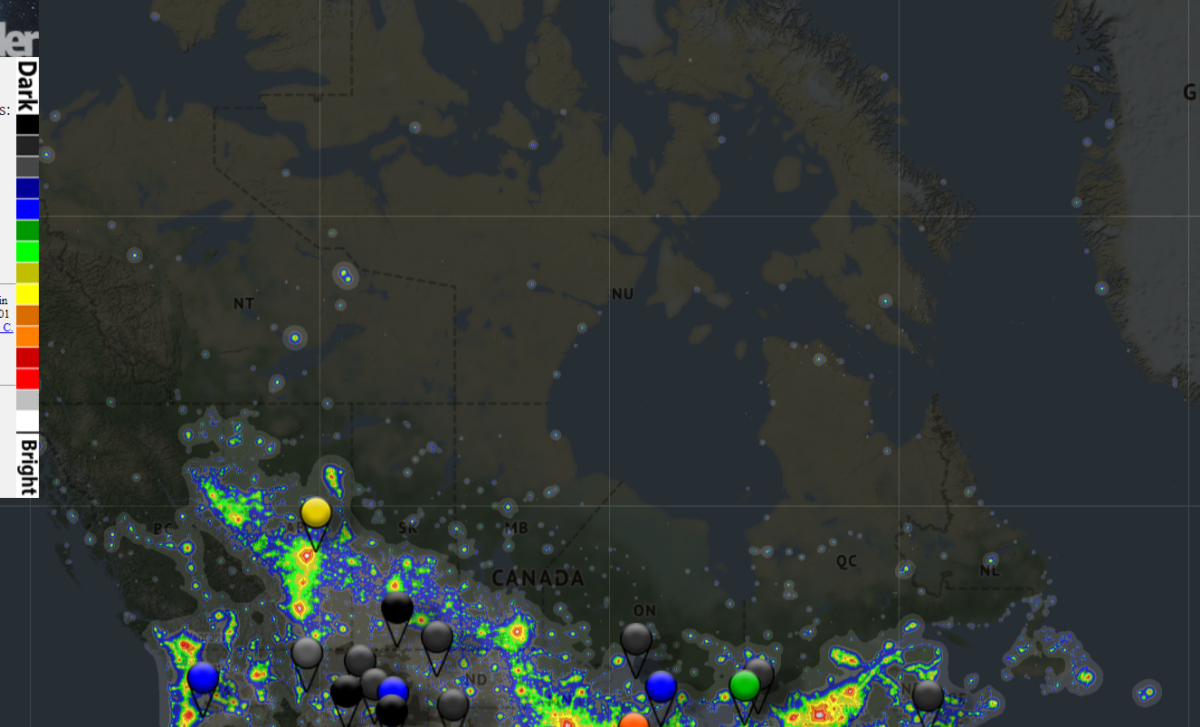
Screengrab: DarkSiteFinder Light Pollution Map.
To find reasonably dark areas near your location, use the Dark Sky Finder map. Search for a park (or a safe place with no streetlights and away from roads/traffic) within the areas coloured dark (mustard), yellow, green, blue, grey or black (transparent). (Before travelling, please check cloud cover.)
Take a blanket or a lawn chair so that you can sit comfortably to watch the shower.
Once you are at the location:
— Make sure you switch off the phone, and your eyes need ~ 30 minutes to get adjusted to the dark. If you are carrying a flashlight, cover it with a red cellophane wrap or some kind of red filter so that it doesn’t interfere with viewing.
— Watch the night sky for at least 15 to 20 minutes for a chance to spot meteors.
You may like:


very helpful that Gemini can be found opposite the north star