 Moncton
With Daylight Saving Time ending on November 2, 2025, it’s interesting to look back to see why it was put in place and what the future of DST in Canada looks like.
Spring Ahead & Fall Behind
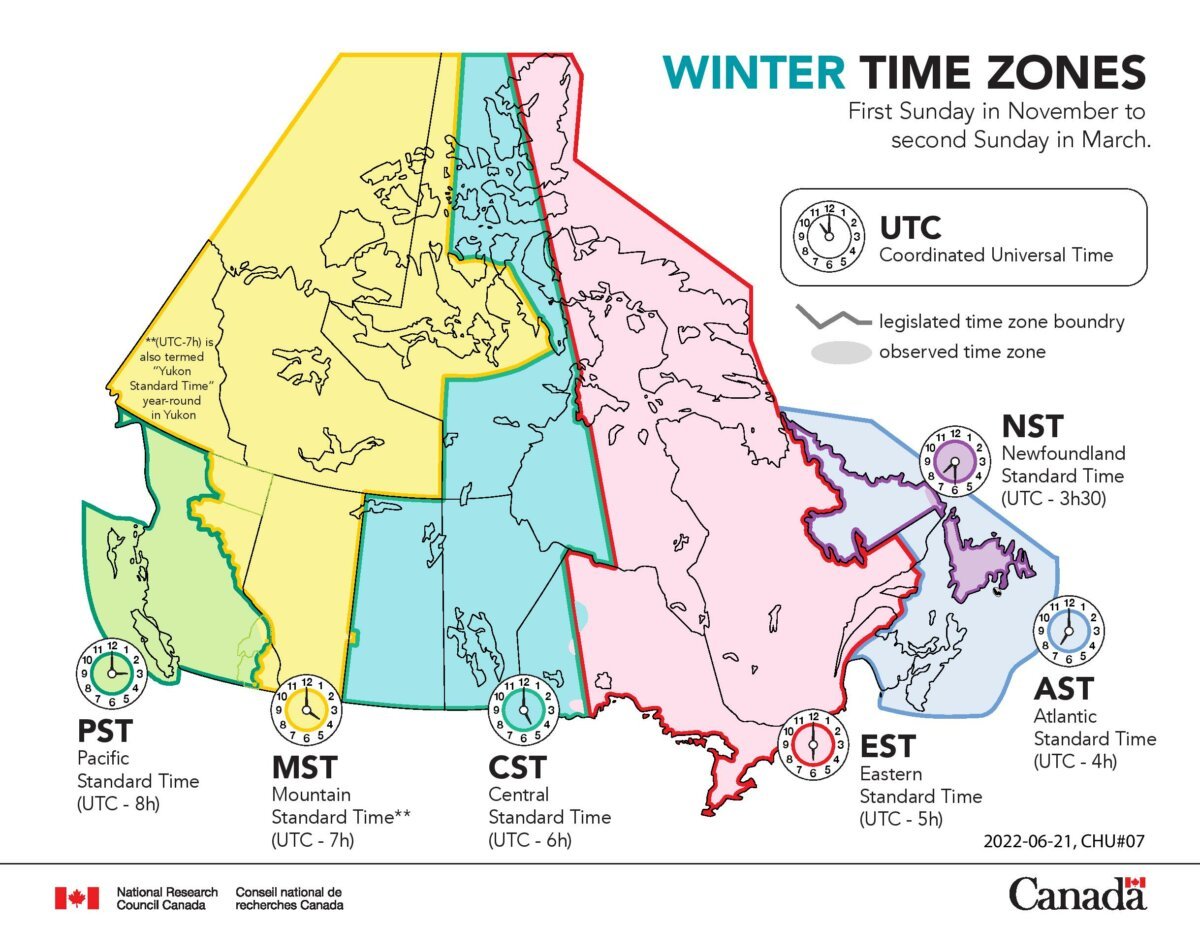
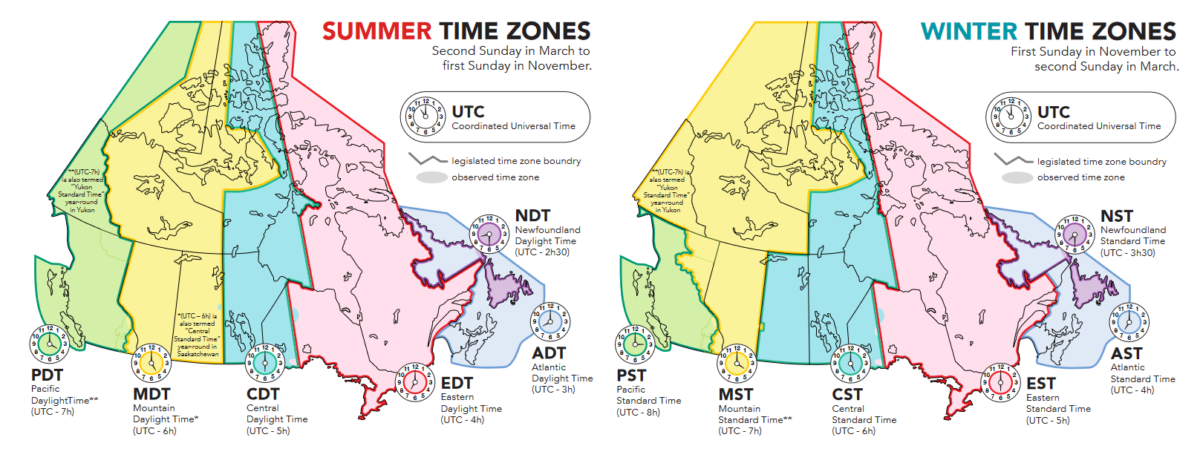
For those who may be new to Canada or unfamiliar with the concept of Daylight Saving Time, it is the practice of moving our clocks ahead one hour in the spring (second Sunday of March) and behind one hour in the fall (first Sunday of November). Canada has a total of six standard time zones, and the changes of time in fall and winter can be overly confusing, depending on where you are, as several areas don’t change when the others do, and boundaries may be different than time zones.
Thunder Bay First Followed DST in Canada
Many people question why Daylight Saving Time was put into place and why we continue with it today. As with many countries, including Germany, Britain and the U.S.A., Canada introduced the concept in 1918, during the First World War. The governments decided to use the extra hour of daylight to increase production. Of course, the practice lapsed after the war ended, only to be reintroduced during the Second World War.
Early on, time changes were regulated by municipalities, who had to put something into place due to confusion over businesses in the same area using different times. However, by 1987, any regulations over DST were being overseen by the provincial, territorial and federal governments.
In 2005, the U.S.A. introduced a shift from the original pattern of moving time on the first Sunday of April and the last Sunday of October to the current schedule of March and November. The reasoning was that people would not need to have their lights on as early in the evenings, reducing energy use and costs. US legislation required the Department of Energy to report to Congress within nine months after the implementation regarding the impact on energy consumption so that Congress could determine whether to keep the expanded DST or revert to the previous system. However, even though the rest of the countries on DST followed suit because of ease of business, travel, and communications, there has been no proven data on reduced energy consumption because of the shift.
Many people don’t realize that we can go even farther back in history in Canada when it comes to the concept of changing time, all thanks to a man named John Hewitson from Port Arthur, Ontario. In 1908, he petitioned the towns of Port Arthur and Fort William (now Thunder Bay) to adjust the clocks to Eastern Time in the summer months and switch back in the fall. His reason? More summer sunshine to enjoy! Surprisingly, the towns agreed, and on May 1, 1908, the towns implemented the first “spring ahead”.
Saskatchewan Time
Canada has some other interesting history when it comes to time zones and how they are affected by Daylight Saving Time, especially in the province of Saskatchewan. There have been time constants and time changes depending on where you are in the province.
There is quite a history as to why this happened, starting well before 1966, but the most important aspect of this situation was the implementation of the Time Act in that year. Before that, municipalities could choose if they were using MST (Mountain Standard Time), CST (Central Standard Time) or DST (Daylight Savings Time), which created a maze of time zones within the province.
In 1966, that changed, and the decision was made to remain on CST all year. That means that all of Saskatchewan except Battle River (Lloydminster) is at the same time year-round, sharing the same time observed by Alberta during the summer months and the same time as Manitoba for the winter months. Lloydminster follows MST during the winter.
Other Places Which Do Not Observe DST
While British Columbia is in the Pacific Time Zone, and most of the province changes clocks in step with DST, communities of Chetwynd, Dawson Creek, Hudson’s Hope, Fort St. John, Taylor and Tumbler Ridge in the Peace River Regional District do not observe DST.
Fort Nelson stopped following DST in 2015 and is in Mountain Standard Time. Creston and the East Shore of Kootenay Lake also do not observe DST and follow Mountain Standard Time year-round.
This means that parts of Peace River Regional District, Fort Nelson and Creston are on the same time as Alberta in winter and with the rest of B.C.except parts of East Kootenay region in summer.
The East Kootenay region is on Mountain Time (observes DST) and is on the same time as Alberta. The main reason for this time zone, as per the Creston Museum website, is “the change between Pacific Standard Time and Mountain Standard Time happens in the Crows Nest Pass, but when the CPR built through the Creston Valley in 1898, the train tracks ended at Kootenay Lake, so Creston, and every other community in the East Kootenay, were included in the Calgary (i.e., Mountain) division of the CPR.”
In addition, Pickle Lake, Atikokan, and New Osnaburgh in Ontario and Southampton Island in Nunavut observe Eastern Standard Time year-round while Le Golfe-du-Saint-Laurent Regional County Municipality in Quebec observes Atlantic Standard Time all year.
Yukon Standard Time
Yukon provides another anomaly in the standard use of Daylight Savings Time in Canada. The daylight hours during the summer are already long, and winter brings darkness throughout the day, so the Territory decided that there was not much use in continuing with DST.
The Territory “fell back” for the last time on November 1st, 2020 and is now permanently on Mountain Standard Time. That means that during the winter, the Yukon has the same time as Alberta, NWT and northeastern B.C.; during the summer, they have the same time as B.C.
Current Status of Eliminating Time Change in Canada
Now that the Yukon has abolished this century-old practice, the big question is if the rest of the provinces and territories will follow suit. There are many studies around the world that state that changing the time, even by an hour, is bad for our health.
Heart attacks, strokes, and accident rates are always up the day after the time change and can create a phenomenon called “social jet lag”, which causes suffering from disrupted sleep, mental and physical fatigue and other stresses.
Alberta held a referendum on DST in 2021, providing residents with a referendum to see if they agreed, but it turns out they didn’t, as more than half of those who voted said they would like to keep it.
Ontario tabled and unanimously passed a private member’s bill called the Time Amendment Act in 2020, which would allow it to discard the practice of using DST. However, the province is currently waiting for New York and Quebec to get on board, as the areas share trade and Canadian federal government operations are spread across the two provinces, making it necessary to be on the same time year-round.
Lastly, the province of British Columbia passed a similar bill in 2019, but again is being delayed because the U.S. state of California has yet to agree.
Liberal MP Marie-France Lalonde introduced Bill C-248 on Oct. 6, 2025 seeking a national agreement with provinces, territories, and Indigenous leaders to end daylight saving time and adopt one standard time.
There are around 25 countries in the world that still use Daylight Savings Time. In the future, we may see that Canada drops from that list, but for the moment, the majority of provinces and territories still observe it, which means that you may have to set your clock back one hour on Sunday, November 2, 2025, at 2:00 am.


If Alberta had asked to not have DST it probably would have passed. The referendum was to make DST permanent.