Calgary
Median-income households increasingly struggle to enter Canada’s housing market, and even six-figure earners no longer have guaranteed paths to homeownership.
Rising housing costs and wage disconnects have reduced its ability to guarantee homeownership or long-term stability.
A new report from Zoocasa examines which Canadian cities still offer house or condo options for those earning $100,000 annually.
Using the CIBC Mortgage Affordability Calculator, the analysis tested whether a single earner earning $100,000 could afford the average home price in Canadian cities. The model assumed a 25-year amortization period, a 3.89% interest rate, and average non-mortgage debt from Equifax’s November 2025 report. Instead of a flat 20% down payment, it used average provincial salaries from Statistics Canada, reflecting savings and family assistance.
Where You Can Afford a House With $100K Income
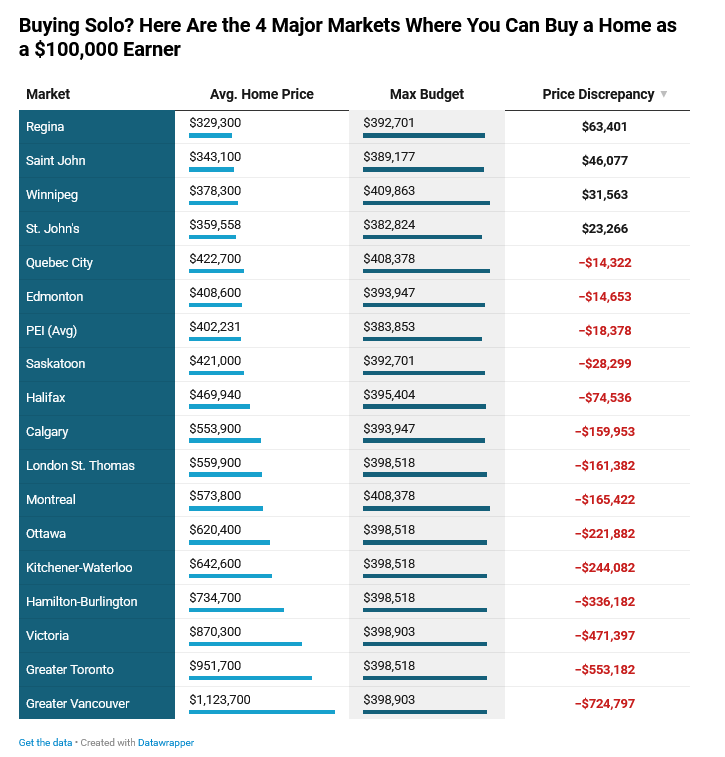
Affordability was strongest in the Prairies and Atlantic Canada. Regina ranked as the most accessible market, with an average home price of $329,300 and a surplus of $63,401 for a $100,000 earner. Saint John and Winnipeg followed, with surpluses of $46,077 and $31,563.
Credit: Zoocasa
In contrast, major urban centres showed large deficits. A single earner in the Greater Toronto Area faces a $553,182 gap, while the shortfall in Greater Vancouver reaches $724,797. Calgary, once considered affordable, now shows a deficit of $159,953.
Where You Can Afford a Condo With $100K Income
A $100,000 annual income can still support condo ownership in several Canadian cities, though affordability varies widely by region.
Prairie and smaller markets show the strongest margins, led by Edmonton, where the average condo price of $193,577 sits more than $200,000 below a $393,947 budget. Winnipeg, Saskatoon, and Regina also offer six-figure earners significant price cushions. In contrast, affordability tightens sharply in larger urban centres.
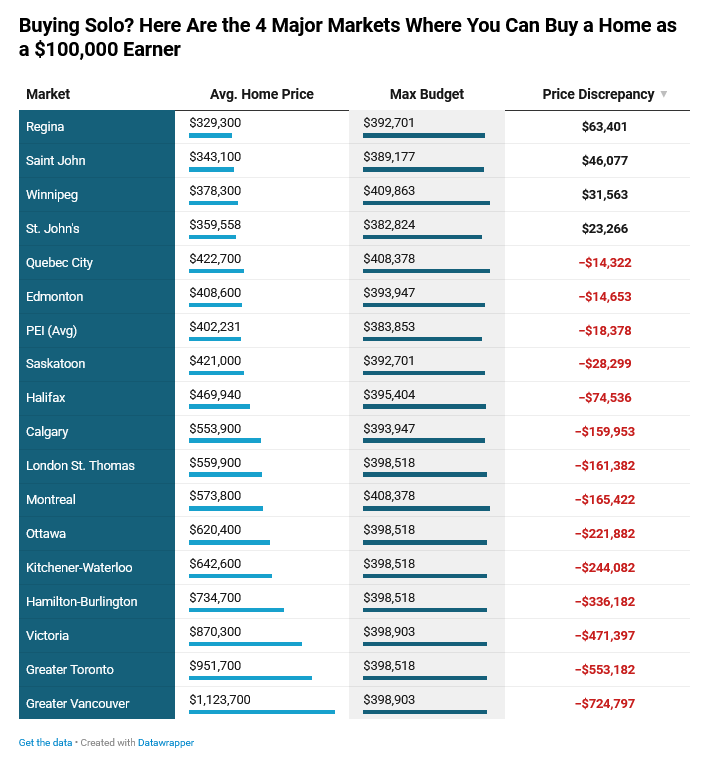
Average condo prices in Greater Toronto, Victoria, and Greater Vancouver exceed budgets by more than $250,000, with Vancouver showing the largest shortfall at $311,097.
Zoocasa’s analysis reconfirms that, even with house prices declining, Canada’s largest cities remain out of reach for many single earners, as a $100,000 salary cannot cover average prices without a second income. In Greater Vancouver, Toronto, Victoria, and Hamilton–Burlington, large price gaps persist, driven by inflation, high living costs, and rising debt, making affordability heavily dependent on local market conditions.