Calgary
Employment slipped slightly in January, with 25,000 fewer people working nationwide, bringing overall employment down by 0.1%. The employment rate also edged lower, falling 0.1 percentage points to 60.8%, marking its first decline since August 2025.
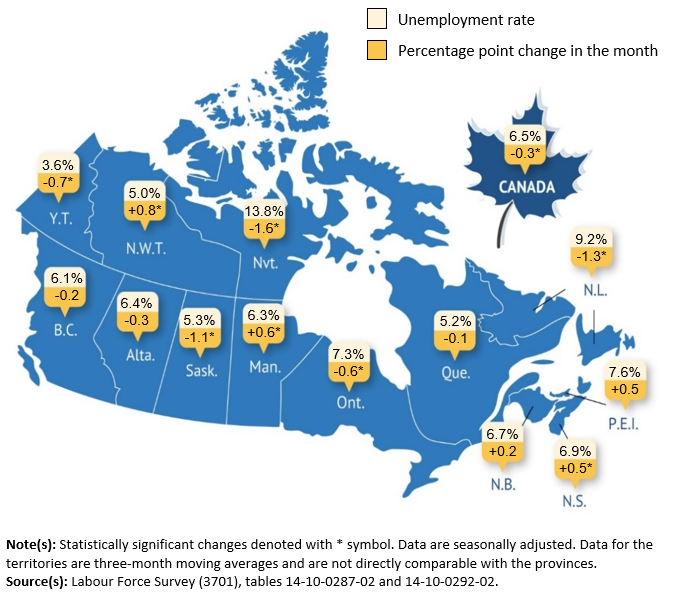
Despite the dip in employment, the unemployment rate moved in the opposite direction. It fell 0.3 percentage points to 6.5%, the lowest level since September 2024.
The drop was not driven by stronger hiring, but by fewer people looking for work. The number of job seekers declined by 94,000, pulling the labour force participation rate down 0.4 percentage points to 65.0%. This pullback was concentrated in Ontario.
Employment losses were uneven across groups. Core-aged women aged 25 to 54 experienced a 27,000 decline in employment, whereas employment among other major demographic groups changed little. Part-time work declined sharply, down 70,000, while full-time employment rose by 45,000. Compared with a year earlier, total employment was still higher by 134,000, largely due to gains in full-time jobs.
By industry, manufacturing recorded the largest decline, losing 28,000 jobs, with most of the drop occurring in Ontario. Educational services shed 24,000 positions, and public administration fell by 10,000. At the same time, gains were posted in information, culture and recreation (+17,000), business, building and other support services (+14,000), agriculture (+11,000), and utilities (+4,200).
Regionally, Ontario stood out with a loss of 67,000 jobs. Even so, its unemployment rate fell to 7.3% as fewer residents searched for work. Alberta added 20,000 jobs, while Saskatchewan and Newfoundland and Labrador also posted gains.
Wage growth remained steady. Average hourly wages rose 3.3% year over year to $37.17 in January.
Additional survey data showed growing job mobility intentions. About 7.1% of permanent employees planned to leave their jobs within the next year, up from 6.1% a year earlier, with youth most likely to say they were preparing for a change.