 Winnipeg
Canada’s premiers are ending the year with sharply contrasting levels of public support, according to the Angus Reid Institute’s final approval ratings for 2025.

Credit: Canada Summer Games/Flickr
While several leaders enter the holiday period with durable backing, others face significant dissatisfaction tied to economic strain, policy disputes, and internal political pressures. Pipeline tensions between Alberta and British Columbia also remain unresolved, leaving approval for both premiers largely unchanged.
- Ontario: Doug Ford experienced one of the steepest drops this quarter, falling from 41 to 34 per cent. Despite international attention from an ad referencing Ronald Reagan and U.S. tariff politics, voters have turned their focus to provincial issues: a projected $13.5-billion deficit, plans to drop emissions-reduction commitments, and development in the Ring of Fire.
- Quebec: Premier François Legault remains the lowest-rated leader at 25 per cent. The adoption of Bill 2, altering physician compensation, drew warnings of clinic closures from Montreal doctors. Criticism has also mounted over cost overruns tied to the SAAQclic online platform. The province continues to post modest economic growth but anticipates significant deficits in 2025/26.
- Alberta: Premier Danielle Smith records 44 per cent approval, down two points. Her government faces skepticism over an energy memorandum with Ottawa, intensified by separatist tensions within her party and criticism of policies affecting renewable energy.
- Newfoundland and Labrador: Premier Tony Wakeham, newly elected, begins with 41 per cent approval. His administration contends with a large deficit and ongoing debate over the Churchill Falls power agreement, which he plans to review independently before a referendum.
- British Columbia: Premier David Eby sits at 40 per cent, challenged by an expected $11-billion deficit and concerns about slow progress on housing, cost-of-living commitments, and health care. Pipeline discussions with Alberta and federal officials remain a central point of scrutiny. Meanwhile, B.C.’s Conservative Party is in disarray following leader John Rustad’s resignation.
- Manitoba: Premier Wab Kinew leads all premiers, though his approval has declined by ten points since June. He reported that the search for the Brady Road landfill is now underway. Manitoba did not receive a federal “major project,” but both Kinew and Prime Minister Mark Carney highlighted the Port of Churchill Plus project as a shared priority.
- New Brunswick: Premier Susan Holt holds 56 per cent approval. Tariffs affecting one-third of the province’s GDP have pushed the projected deficit from $668.7 million to $834.7 million. A new physician agreement supports plans for 30 collaborative care clinics.
- Saskatchewan: Premier Scott Moe remains stable at 50 per cent, amid calls from health-care workers for more resources and concerns over trade pressures.
- Nova Scotia: Premier Tim Houston also sits at 50 per cent, facing the province’s first billion-dollar deficit while advancing the $60-billion Wind West offshore project and navigating continued strain on emergency care.
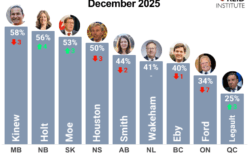
Credit: The Angus Reid Institute
The Angus Reid Institute surveyed 4,025 Canadian adults online from November 26 to December 1, 2025, and weighted the results to national demographics. A comparable probability sample would have a ±1.5-point margin of error. Results were self-commissioned, with rounding discrepancies possible. Prince Edward Island data was excluded due to its small population.


