Calgary
You can buy 4 houses in Edmonton for the price of one in Vancouver says the Alberta government in the new campaign, Alberta is Calling.
To Do Canada
Kenney government unveiled a campaign today to bring attract skilled, educated and motivated people to Alberta.
The campaign highlighting the Rocky Mountains, great festivals, no provincial sales tax and one of the highest median after-tax income in Canada launched in Vancouver and Toronto today.
The effort, as per the news release, comes as job vacancy rates are high in the province with more than 100,000 open jobs, and 78% of Alberta businesses reporting shortages.
Through the campaign, the province wants the rest of Canada to know that:
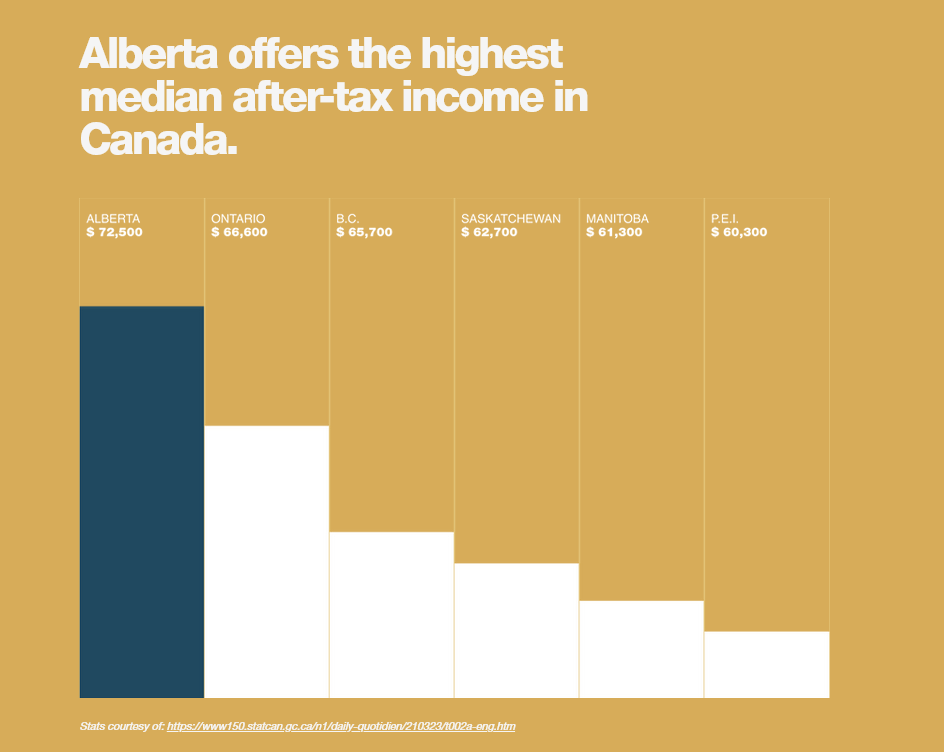
1. Alberta workers have the highest earnings across all provinces:
Credit: Alberta is Calling
-
- Alberta’s $1,251 average weekly earnings (May 2022) are the highest in the country (second highest is Ontario at $1,197/week and third is B.C. at $1,159/week).
- According to Statistics Canada’s 2020 Canadian Income Survey, released in March 2022, Alberta families earned a median after-tax income of $104,000 in 2020, which is more than $7,000 higher than Ontario and nearly $10,000 higher than families in British Columbia.
2. Housing is more affordable in Alberta than in Vancouver or Toronto.

Credit: Alberta is Calling
-
- The Demographia International Housing Affordability study, released in March 2022, named Edmonton and Calgary among the top 10 most affordable housing markets when compared to 92 major cities around the world.
- According to Canadian Real Estate Association (CREA) data, the average home sale price over the last three years in Edmonton was $383,000 – 34% of the price in Greater Vancouver, and 38% of the price in Greater Toronto, respectively.
- The average home sale price in Calgary was $484,000 – 43% of the price in Greater Vancouver, and 48% of the price in Greater Toronto, respectively.
- CREA data shows that home prices are significantly more stable in Alberta as well:
- Over the last 10 years, home sale prices in Edmonton have grown by 18% and in Calgary by 21%.
- Over the same period, home sale prices in Vancouver increased by 52% and in Toronto by 135%.
- CMHC’s February 2021 Rental Market Report shows that rents are more affordable in Alberta. Over the last three years:
- Average rent in Edmonton was 71% of that in Vancouver, and 79% of that in Toronto.
- Average rent in Calgary was 74% of that in Vancouver, and 82% of that in Toronto.
- The Demographia International Housing Affordability study, released in March 2022, named Edmonton and Calgary among the top 10 most affordable housing markets when compared to 92 major cities around the world.
You may like: $99K in Edmonton, $328K in Vancouver: This is How Much You Need to Earn to Afford a Home in Canadian Cities in 2022
3. Alberta families generally pay lower personal taxes (for 2022, considering annual family incomes of $75k, $150k, and $300k).
-
- Compared to B.C., an Alberta family with two children will pay on average $1,400, $4,900 and $13,100 less in taxes respectively.
- Compared to Ontario, an Alberta family with two children will pay on average $3,800, $8,700, and $20,700 less in taxes respectively.
- Alberta has no provincial sales tax, payroll tax or health premiums.
You may like: Comparing Taxes in the US States & Canada -2019
4. Workers in Edmonton and Calgary spend less time commuting.
-
- In the 2016 Census, workers in Edmonton and Calgary spent on average 25.9 and 26.5 minutes commuting to work (one-way), respectively. This compares to 34.0 minutes in Toronto* and 29.7 minutes in Vancouver.
5. Alberta has seen the highest employment growth in the country in 2022:
- Between December 2021 and July 2022, employment in Alberta increased by 68,200 jobs compared to an increase of 47,800 in Ontario and 45,400 in British Columbia, despite both having larger populations.
Some of the other interesting facts highlighted for the campaign are:
- Livable City: Calgary was recently named the world’s third most livable city by the Economic Intelligence Unit’s rankings
- Zero Fuel tax: Currently, Alberta has zero fuel tax.
- Household disposable income: Calgary has a high average household disposable income at $41,252, means you’ll have enough money to live comfortably.
- Fringe Festival: Edmonton is home to the longest running (est. 1982) & largest in North America. It’s also the 2nd biggest fringe festival in the world.
- Owning a home in Alberta: In Edmonton, home ownership, on average, takes well under a third of your annual income.
- Canada’s sunniest city: Calgary tops the sunniest places in Canada and receives over 300 days of sunshine a year.
- Canada’s largest urban park: Edmonton’s River Valley has 160 kilometres of maintained pathways, trails, and major parks.
- Tight-knit communities: 80% of locals engage in volunteering activities.
- Endless opportunities: Alberta has some of North America’s largest companies and the most head offices (per capita).
The government says the province has seen growth in sectors including film and television, technology, agriculture, renewable energy, aviation and logistics and that Alberta saw the highest net interprovincial migration in Canada, at 5,351 people, in the first three months of 2022.
The $2.6-million dollar ‘Alberta is Calling’ campaign will make a splash across social media and other digital spaces, on radio, and in high-traffic locations across Vancouver and Toronto in two phases – the first phase today and the second phase in mid-September.
If you are interested in moving to Alberta, you can check out high-paying jobs online and learn more about the campaign on the Alberta is Calling website.