Toronto
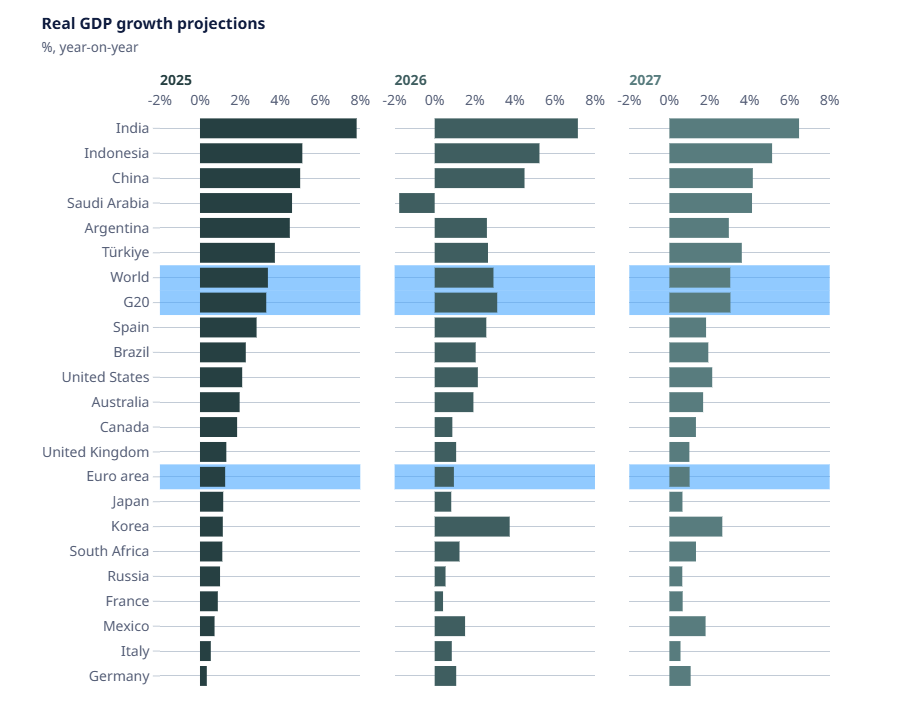
Canada’s economy is expected to grow only modestly this year, with the OECD forecasting real GDP growth of 0.9 per cent in 2026, followed by a somewhat stronger 1.3 per cent in 2027.

Credit: sebastiaan stam/ Unsplash
The September 2026 OECD Economic Outlook paints a picture of a Canadian economy being pulled in different directions. Investment tied to artificial intelligence and data centres has provided some momentum, while new U.S. tariffs and broader uncertainty around North American trade are creating fresh pressure.
For Canadians, the 2027 forecast offers some improvement. The OECD expects stronger private consumption and government investment, along with a gradual recovery in business investment, to help growth pick up next year.
U.S. tariffs are another hurdle
Trade is one of the clearest risks in the Canadian outlook.
The OECD says new U.S. tariff rates of 12.5 percentage points apply to a wide range of goods from Canada and 37 other countries. Canada also faces additional U.S. tariffs of 50 per cent on selected goods, while Canada has introduced retaliatory measures.
The OECD describes the new tariffs on Canadian exports as a “headwind for certain industries,” although it expects the overall economic effect to be limited because the measures apply to a relatively narrow range of trade.
There is another uncertainty hanging over the outlook. The OECD says questions about the future of the United States-Mexico-Canada Agreement are likely to weigh on regional trade growth.
AI investment is providing some lift
One of the more interesting bright spots is technology investment.
Canada was among the countries where investment in data-centre structures and technology equipment helped boost real GDP growth in the second quarter of 2026, according to the OECD. The United States and Australia saw a similar effect.
That matters because the wider global economy has been losing momentum. Global growth slowed to an annualized 2.6 per cent in the first half of 2026, from 3.6 per cent in the second half of 2025. The OECD now expects global GDP to grow 2.9 per cent in 2026 and 3.0 per cent in 2027.
Higher energy prices following disruptions in the Middle East, rising borrowing costs and weaker household purchasing power are among the forces holding growth back.
For interest rates, the OECD’s assumption is fairly uneventful for Canada. It expects Canadian policy rates to remain unchanged until late 2027. In contrast, the OECD projects one more U.S. rate increase in the fourth quarter of 2026, followed by a federal funds target range of 4 to 4.25 per cent through 2027.
For Canadians, the comparison with the United States is striking. The OECD expects the U.S. economy to grow 2.2 per cent in 2026, compared with just 0.9 per cent in Canada. In practical terms, the economy south of the border is forecast to expand at more than twice Canada’s pace this year.
That does not mean every American household will necessarily feel better off. GDP growth is a measure of the broader economy, not individual living standards. But the gap does underline how slowly Canada is expected to grow while its largest trading partner continues to expand more strongly. In 2027, the difference narrows somewhat, with Canada forecast to grow 1.3 per cent, compared with 2.1 per cent in the United States.
The broader message for Canadians is that 2026 remains a slow-growth year. The OECD sees some improvement ahead, but that recovery depends on stronger household spending and investment taking hold while Canada navigates a more uncertain trading relationship with the United States.
OECD Economic Outlook, Interim Report September 2026