Regina
Canada is still growing, but the pace has slowed sharply.
Statistics Canada estimates the country had 41,798,407 people on July 1, 2026, up 189,425 from a year earlier. That works out to annual growth of just 0.5 per cent.
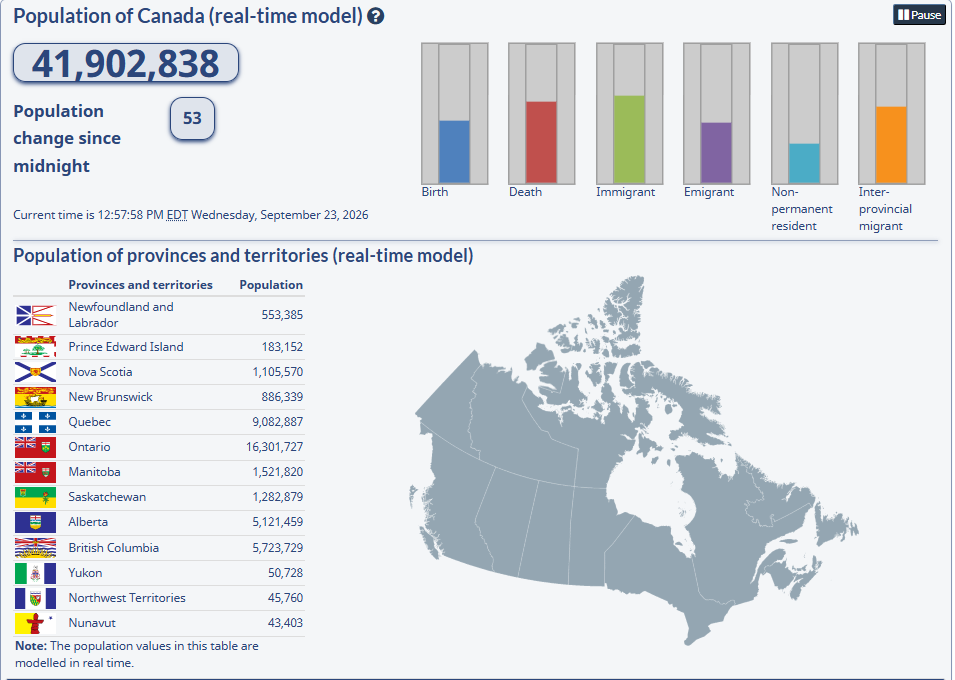
The number itself is notable. Per the news release, Canada has not recorded such a low percentage increase since 1915/1916, when population growth was 0.3 per cent. In absolute numbers, the latest increase is the smallest since 1944/1945. Statistics Canada says the rapid shifts seen in population growth since 2020 have been driven almost entirely by changes in international migration.
Here are the main takeaways from the latest estimates:
- Canada added 189,425 people in one year: The population increased from July 1, 2025, to July 1, 2026, but the 0.5 per cent growth rate was well below the 1.1 per cent recorded the previous year and the 2.8 per cent peak reached in 2023/2024. Between April and July 2026 alone, Canada added 80,343 people.
- The non-permanent resident population fell by a record amount: Canada had an estimated 2,779,774 non-permanent residents on July 1, accounting for 6.7 per cent of the population. That was down 154,614 people from a year earlier, the largest annual decline since comparable records began in 1971/1972. Study permit holders recorded the biggest decrease, falling by 140,827.
- Canada has about 39 million residents excluding temporary residents: Of Canada’s estimated 41.8 million people on July 1, 2026, about 2.78 million were non-permanent residents. Removing that group leaves approximately 39.02 million Canadian citizens and permanent residents combined.
- Canada welcomed fewer permanent immigrants: There were 368,224 new immigrants between July 2025 and July 2026, marking a fourth consecutive annual decline. It was also the first time since 2021/2022 that the annual total fell below 400,000. During the second quarter of 2026, Canada welcomed 99,148 immigrants, 4.2 per cent fewer than during the same period in 2025.
- Alberta remained the fastest-growing province: Alberta’s population increased 1.5 per cent, ahead of every other province. New Brunswick and Saskatchewan followed at 1.0 per cent each. Ontario grew by 0.3 per cent, Quebec by 0.2 per cent and British Columbia by 0.1 per cent. The Northwest Territories was the only province or territory to record a decline, down 127 people, or 0.3 per cent.
- Canada is getting older again: Statistics Canada says “Canada’s population is aging once again.” The country’s median age reached 40.9 years, while the average age was 42.1. Very high immigration between 2021 and 2024 had temporarily lowered or stabilized these measures because international migrants tend to be younger.
- Canada lost nearly 155,000 people in their 20s: The number of people aged 20 to 29 declined by 154,973, or 2.8 per cent, over the year. The largest decreases were among those aged 20 to 24, down 63,838, and 25 to 29, down 91,135. Statistics Canada links this pattern with the decline in study permit holders.
- One in five Canadians is now 65 or older: People aged 65 and over represented 20.0 per cent of Canada’s population on July 1, compared with 15.0 per cent for children aged 14 and younger. Ontario’s corresponding figures were 19.5 per cent and 14.6 per cent.
In calendar year 2025, 372,521 babies were born in Canada, according to Statistics Canada. That was 1.6% more than in 2024. Boys accounted for 51.3% of births and girls 48.7%. Canada’s total fertility rate remains at 1.26 children per woman in 2025.
Statistics Canada notes that these are preliminary demographic estimates, not results from the 2026 Census. The first 2026 Census population and dwelling counts are scheduled for release in February 2027.
Canada’s population estimates: Age and gender, 2026