Calgary
The Economist Intelligence Unit, a sister company of the UK-based The Economist newspaper, has released its annual Global Liveability Index, and 3 Canadian cities feature in the top 10 of the most livable cities in the world.
Adi K/Pexels
Based on the year’s survey, Global Liveability Index ranks 173 cities based on five categories: stability, healthcare, culture and environment, education and infrastructure. The total score for each category was then converted to a range of 1-100.
Categories and Weight:
- Stability (weight: 25% of total) — Prevalence of petty crime, Prevalence of violent crime, Threat of terror, Threat of military conflict, Threat of civil unrest/conflict
- Healthcare (weight: 20% of total) — Availability of private healthcare, Quality of private healthcare, Availability of public healthcare, Quality of public healthcare, Availability of over-the-counter drugs, General healthcare indicators
- Culture & Environment (weight: 25% of total) — Humidity/temperature rating Adapted from average weather conditions, Discomfort of climate for travellers, Level of corruption, Social or religious restrictions, Level of censorship, Sporting availability, Cultural availability, Food and drink, Consumer goods and services
- Education (weight: 10% of total): Availability of private education, Quality of private education, Public education indicators
- Infrastructure (weight: 20% of total): Quality of road network, Quality of public transport , Quality of international links, Availability of good-quality housing, Quality of energy provision, Quality of water provision, Quality of telecommunications
10 Most Liveable Cities:
Based on their survey and rating based on the above factors, Vancouver, Calgary, and Toronto were ranked the ten most livable cities among 173 cities worldwide, with Vancouver being the most livable city in North America.
Calgary was ranked 3rd most livable last year, followed by Vancouver in 4th and Toronto in 8th.
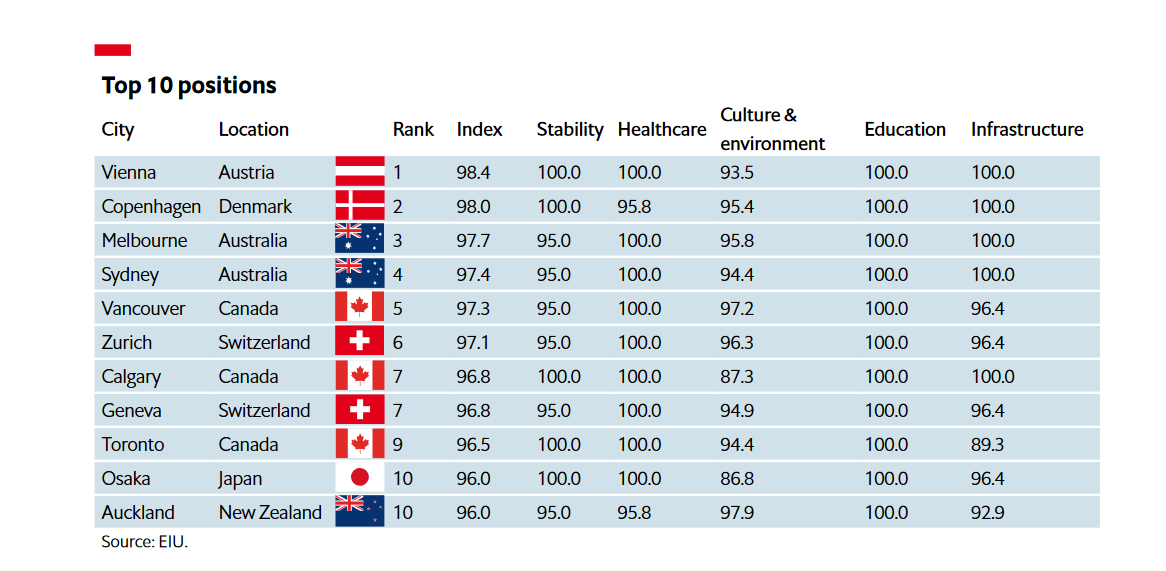
Despite surpassing Vancouver in all areas except Culture & Environment, Calgary fell short in overall ranking due to its lower score in this particular category, which accounts for 25% of the total ranking. Vancouver scored 97.2 in Culture & Environment, significantly higher than Calgary’s score of 87.3.
EIU says stability scores of Canadian cities of Vancouver (5), Calgary (7th), and Toronto (9) are up compared to last year as anti-vaccine protests impacted them.
Vienna, the Austrian capital, recaptured its title as the world’s most liveable city, demonstrating exceptional stability, robust infrastructure, and high-quality education and healthcare services, complemented by rich cultural and entertainment offerings. Copenhagen maintained its second place, with Melbourne and Sydney ascending to third and fourth positions, previously held by Western European cities.
Credit: EIU
- Vienna, Austria — Rank 1, Index – 98.4
- Copenhagen, Denmark — Rank 2, Index – 98.0
- Melbourne, Australia — Rank 3, Index – 97.7
- Sydney, Australia — Rank 3, Index – 97.4
- Vancouver, Canada — Rank 5, Index – 97.3
- Zurich, Switzerland — Rank 6, Index – 97.1
- Calgary, Canada — Rank 7, Index – 96.8
- Geneva, Switzerland — Rank 7, Index – 96.8
- Toronto, Canada — Rank 9, Index – 96.5
- Osaka Japan — Rank 10, Index – 96
- Auckland, New Zealand — Rank 10, Index – 96
Worst Places to Live:
With living conditions weighed down by wars, conflicts and terrorism, the capital of Syria is the worst place to live. Kyiv now ranks 165 out of the 173 cities, with its stability and infrastructure damaged by the war.
- Douala, Cameroon — Rank -164
- Kyiv, Ukraine — Rank 165
- Harare, Zimbabwe — Rank 166
- Dhaka Bangladesh — Rank -166
- Port Moresby, Papua New Guinea — Rank -168
- Karachi Pakistan — Rank -169
- Lagos, Nigeria — Rank -170
- Algiers Algeria — Rank -171
- Tripoli Libya — Rank – 172
- Damascus Syria — Rank – 173