Toronto
Canada’s job market took a step back in February, with employment dropping and the unemployment rate inching higher.
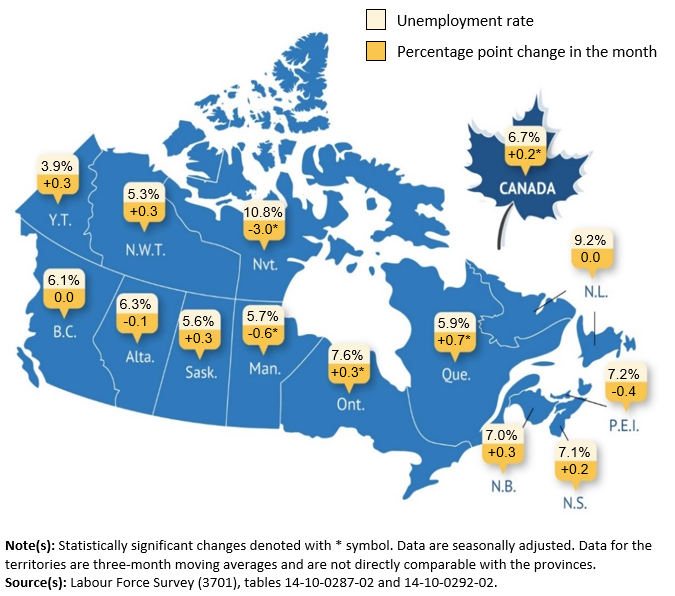
The latest labour data by Statistics Canada shows 84,000 fewer people employed, while the unemployment rate rose to 6.7%, up 0.2 percentage points from the previous month. The employment rate slipped to 60.6%, marking the second monthly decline.
Here are the key developments from February’s labour report:
- Employment drops for the second straight month: Employment fell by 84,000 (-0.4%) in February, following a smaller decline of 25,000 in January. These losses reversed some of the gains seen in late 2025. The employment rate fell to 60.6%, down 0.2 percentage points, and now sits just above the recent low of 60.5% recorded in August 2025.
- Full-time and private sector jobs take the biggest hit: The sharpest decline came in full-time employment, which dropped by 108,000 jobs. Meanwhile, the number of people working part-time remained largely unchanged. The private sector lost 73,000 jobs, continuing a downward trend after gains late last year. Employment in the public sector and among self-employed workers showed little change.
- Youth and core-aged men see the largest losses: Young workers faced the steepest drop. Employment among people aged 15 to 24 declined by 47,000, pushing the youth unemployment rate to 14.1%, up 1.3 percentage points. Among men aged 25 to 54, employment fell by 41,000, and the unemployment rate rose to 5.7%. Employment for core-aged women remained steady, while the unemployment rate for people 55 and older dropped slightly to 4.9%.
- Job losses spread across several industries: Both major sectors saw declines. Services-producing industries lost 56,000 jobs, including 18,000 in wholesale and retail trade and 14,000 in personal and repair services. In goods-producing industries, employment fell by 28,000, with smaller declines in construction (-12,000) and manufacturing (-9,200).
- Employment declines in several provinces: Job losses were concentrated in Quebec (-57,000) and British Columbia (-20,000), with additional declines in Saskatchewan (-5,500) and Manitoba (-4,000). Newfoundland and Labrador added 2,100 jobs, while employment levels in other provinces changed little.
Unemployment Rates by Province & Territories (February 2026):
- Newfoundland and Labrador – 9.2%,
- Prince Edward Island – 7.2%,
- Nova Scotia – 7.1%,
- New Brunswick – 7.0%,
- Quebec – 5.9%,
- Ontario – 7.6%,
- Manitoba – 5.7%,
- Saskatchewan – 5.6%,
- Alberta – 6.3%,
- British Columbia – 6.1%.
- Yukon – 3.9%,
- Northwest Territories – 5.3%,
- Nunavut – 10.8%.
- Wages continue to rise despite job losses: Even as employment fell, pay continued to climb. Average hourly wages reached $37.56 in February, a 3.9% increase year over year, following 3.3% growth in January.
- Women’s participation in the workforce grows over time: Women accounted for 10 million workers in February, representing 47.3% of total employment. That share has increased significantly over the past 50 years, rising from 36.9% in 1976. Among women aged 25 to 54, the employment rate reached 80.1%, compared with 48.2% in 1976. Even so, a wage gap remains. In February 2026, women earned $0.88 for every dollar earned by men. The average hourly wage for women aged 25 to 54 was $37.62, compared with $42.55 for men.
In total, about 1.5 million Canadians were unemployed during the month, with 22.8% searching for work for at least 27 weeks.