Calgary
Canada’s latest Food Price Report reveals that food affordability will remain a key concern in the new year despite slower-than-expected price increases in 2024.
The 2025 report forecasts a 3% to 5% increase in overall food prices. An average family of four is expected to spend $16,833.67 on food next year, which is up to $801.56 more than in 2024.
This annual analysis, now in its 15th year, is a collaborative effort involving experts from Dalhousie University, the University of Guelph, the University of Saskatchewan, and the University of British Columbia. The research team utilizes historical data, machine learning algorithms, and predictive analytics to forecast food prices across the country.
Predicted Price Changes by Food Category for 2025:
- Meat: 4%–6%
- Vegetables: 3%–5%
- Restaurants: 3%–5%
- Bakery: 2%–4%
- Dairy: 2%–4%
- Other: 2%–4%
- Fruits: 1%–3%
- Seafood: 1%–3%
Contributing Factors Influencing Food Prices:
- Currency Fluctuations: The weakening Canadian dollar against the U.S. dollar is expected to reduce importers’ buying power in 2025. With 60% of Canada’s agri-food exports going to the U.S., increased American purchases deepen Canada’s reliance on its southern neighbor. The re-election of Donald Trump may widen trade gaps due to his policies on farming costs and environmental regulations. Dr. Sylvain Charlebois of Dalhousie University notes, “The election of Donald Trump signals a trend toward an increasingly clustered agri-food trading world.”
- Climate Change and Extreme Weather: Unpredictable weather events like high temperatures, floods, and droughts have disrupted food production and increased crop diseases. Western Canada’s wildfires have blocked rail lines, affecting shipments. “Some impacts of adverse weather are starting to be reflected in food prices, such as more expensive meat due to lengthy droughts in Canada’s beef-producing regions,” says Dr. Stuart Smyth of the University of Saskatchewan.
- Supply Chain Disruptions: Shutdowns and strikes at major railways and ports have stalled millions of dollars in daily trade, slowing domestic shipments and straining export commitments. Post-pandemic labour shortages in the manufacturing and agriculture sectors have further reduced production volumes.
You may like:
Predicted Annual Food Expenditure – 2025
The report also gives examples of various kinds of household compositions and their predicted annual food expenditure for 2025 to help Canadians plan their financials for the new year:
- Four People: Man (31-50), Woman (31-50), Boy (14-18), Girl (9-13) — $16,833.67
- Three People: Woman (19-30); Boy (4-8), Child (1-3) — $9,566.40
- Four People: Two Women (31-50), Girl (14-18), Boy (9-13) — $15,827.86
- Two People: Man (51-70), Woman (51-70) — $7,969.78
- Six People: Woman (70+Years), Man (31-50), Woman (31-50), Girl (9-13), Boy (4-8), Child (6-11 Months) — $22,017.24
- Two People: Man (19-30), Pregnant Woman (19-30) — $9,020.18
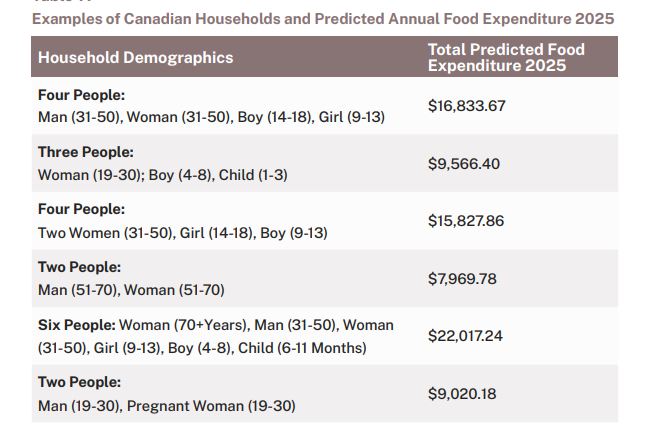
Credit: 2025 Canada’s Food Price Report
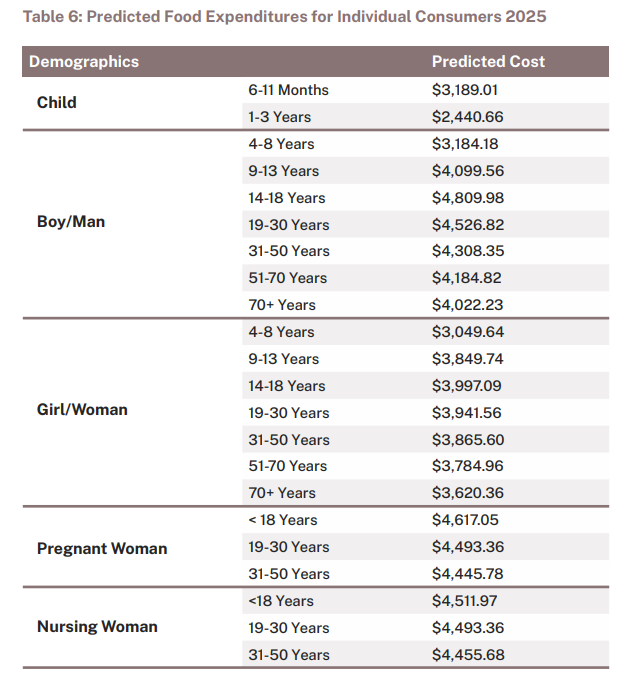
Credit: 2025 Canada’s Food Price Report
Comparing last year’s prediction to actual food price increases, the report states, “Our projections for 2024 food price increases were within the expected range or showed a lower than anticipated rise.” No categories surpassed predictions, and some, like bakery (-0.1%) and seafood (-1.6%), experienced price decreases. The total food category forecast was a 2.5% to 4.5% increase, while the actual change was 2.8%.
An analysis of last year’s report revealed that predicted annual expenditures were generally higher than actual spending, with the largest discrepancy of $75.75 for males aged 14–18. This shows that the Food Price Report remains a valuable source for Canadians to plan their annual budget and understand their grocery bills.
See more here: Canada’s Food Price Report 15th Edition 2025