Calgary
Canada’s latest Food Price Report points to another challenging year ahead for household budgets, with researchers warning that grocery spending will keep rising.
The 2026 edition of the report estimates that a typical family of four will spend $17,571.79 on food, up by $994.63 from 2025. Overall prices are projected to increase between 4% and 6%, and food is now 27% more expensive than it was five years ago.
This is the 16th annual edition of Canada’s Food Price Report, produced by eight universities, including Dalhousie, the University of Guelph, the University of Saskatchewan, UBC, and Université Laval. Their forecast draws on systemized predictive models that examine factors such as climate impacts, shifting policies, and global events.
Researchers note that one-quarter of Canadian households face food insecurity, and several key pressures shaped pricing over the past year. The temporary GST/HST holiday, part of the federal All Canadians Act, briefly pushed inflation into negative territory in January. But a U.S. trade dispute introduced new volatility after both countries imposed tariffs, raising costs for the food industry.
Beef drove the highest inflation, with prices jumping 19% in early 2025 and remaining 23% above the five-year average due to drought, shrinking cattle herds, and rising production costs. Canada increased beef imports from Mexico and Australia to help stabilize supply and reduce pressure on retail prices.
Other contributors include labour shortages tied to changes in the Temporary Foreign Worker Program, and restructuring in major food manufacturing companies that resulted in job losses and reduced output.
Predicted Price Changes by Food Category for 2026:
- Bakery: 2% – 4% (+/- 0.65 – uncertainty range)
- Dairy & Eggs: 2% – 4% (+/- 0.40 )
- Fruit: 1% – 3% )+/- 0.40 )
- Meat: 5% – 7% )+/- 1.12 )
- Other: 4% – 6% )+/- 0.87 )
- Restaurants: 4% – 6% )+/- 0.67 )
- Seafood: 1% – 2% )+/- 0.49 )
- Vegetables: 3% – 5% )+/- 0.85 )
- Total Increase in Food Prices: 4% – 6% )+/- 0.70 )
The uncertainty range tells you how much the actual price change could reasonably vary above or below the forecast, based on historical volatility and model error.
Contributing Factors Influencing Food Prices in 2026:
Looking ahead, the report outlines several trends for 2026:
- Inflation is projected to ease to around 2%, though GDP growth may slow to between 1.2% and 1.4%.
- The U.S. trade dispute continues, but the rollback of tariffs on over 200 food products offers some relief.
- Labour shortages could worsen as Temporary Foreign Worker Program caps take effect, raising operating costs for agriculture-dependent industries.
- The One Canadian Economy Act aims to improve interprovincial trade and competition.
- The Grocery Code of Conduct becomes fully operational, though its enforcement remains uncertain.
- New front-of-pack nutrition labels become mandatory, and dairy milk will contain nearly double the vitamin D.
- Chicken prices are expected to climb further due to increased demand and constrained beef supply, despite new beef import partnerships with Mexico and Australia.
- Severe weather events will remain a major disruptor, continuing to strain agricultural output and supply chains.
You may like:
Predicted Annual Food Expenditure – 2026
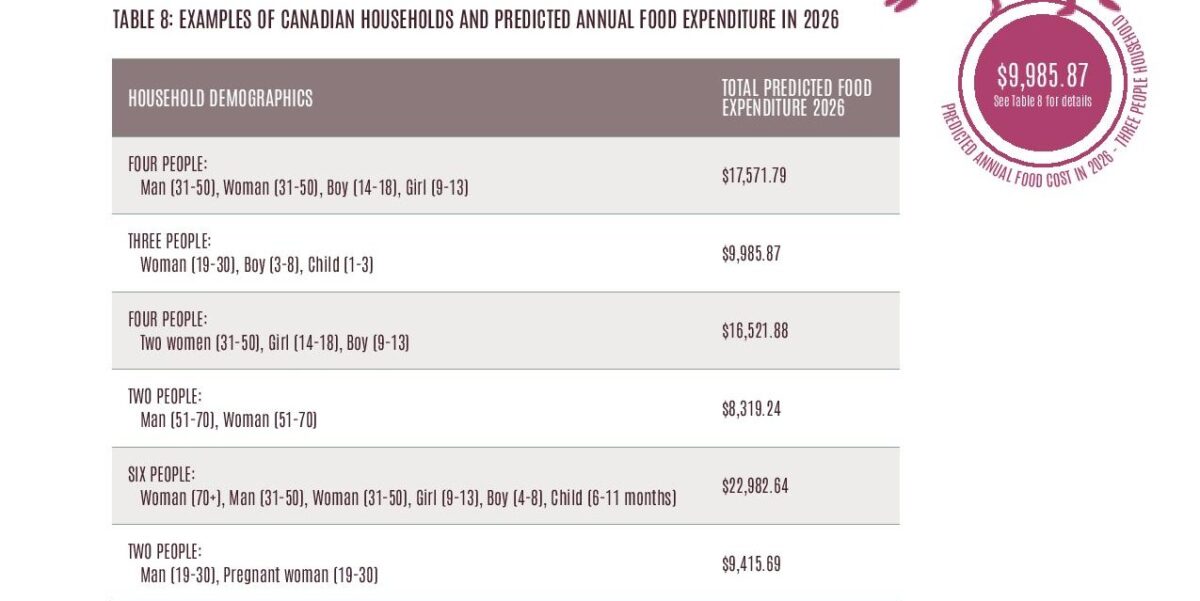
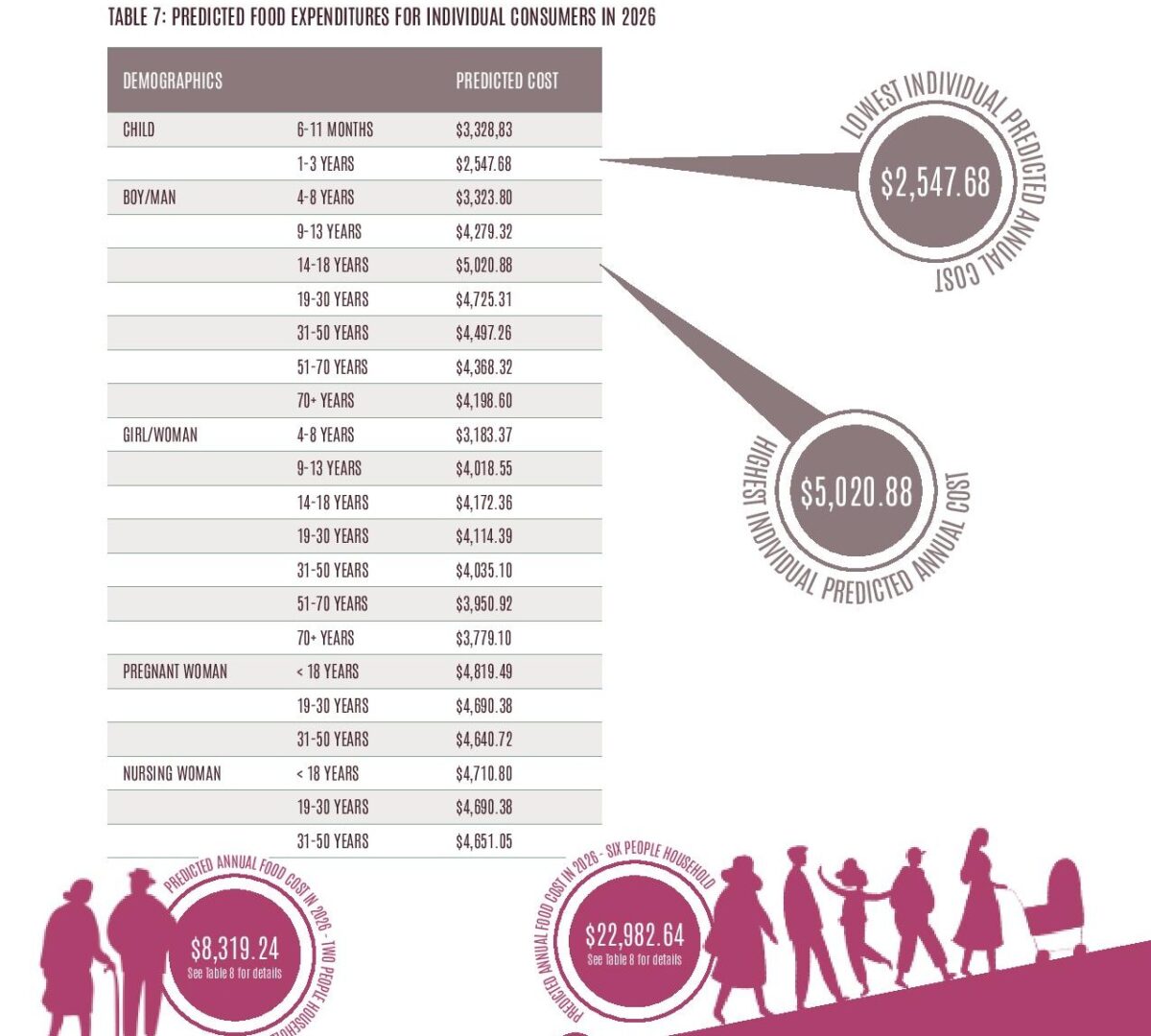
The report also gives examples of various kinds of household compositions and their predicted annual food expenditure for 2026 to help Canadians plan their finances for the new year:
- Four People: Man (31-50), Woman (31-50), Boy (14-18), Girl (9-13) — $17,571.79
- Three People: Woman (19-30); Boy (4-8), Child (1-3) — $9,985.87
- Four People: Two Women (31-50), Girl (14-18), Boy (9-13) — $16,521.88
- Two People: Man (51-70), Woman (51-70) — $8,319.24
- Six People: Woman (70+Years), Man (31-50), Woman (31-50), Girl (9-13), Boy (4-8), Child (6-11 Months) — $22,982.64
- Two People: Man (19-30), Pregnant Woman (19-30) — $9,415.69
-

Credit: 2026 Canada’s Food Price Report
Credit: 2026 Canada’s Food Price Report
Comparing last year’s prediction to actual food price increases, the report says price increases unfolded largely as predicted, with overall food inflation reaching 4%, within the expected 3% to 5% range.
Dairy, seafood and restaurant prices matched forecasts, while meat rose faster than expected.
“We predicted last year that beef would be a big story in 2025 — and it certainly was. We don’t see how beef prices could normalize before mid-2027,” states the report.
A family of four was projected to spend $16,833.67 but actually spent $16,577.16.
“Despite steadier inflation, Canadian families are still feeling the squeeze at the grocery store,” says Dr. Sylvain Charlebois, Project Lead at Dalhousie University. “Food affordability will remain a major pressure point in the year ahead.”
See more here: Canada’s Food Price Report 16th Edition 2026