Toronto
Canada’s police-reported crime picture improved in 2025, according to Statistics Canada, with both the volume and severity of offences moving lower.
Credit: Police-reported crime in Canada, 2025/Statistics Canada
The conventional crime rate, which counts Criminal Code offences relative to the population but gives each offence equal weight, fell 2% to 5,585 incidents per 100,000 people.
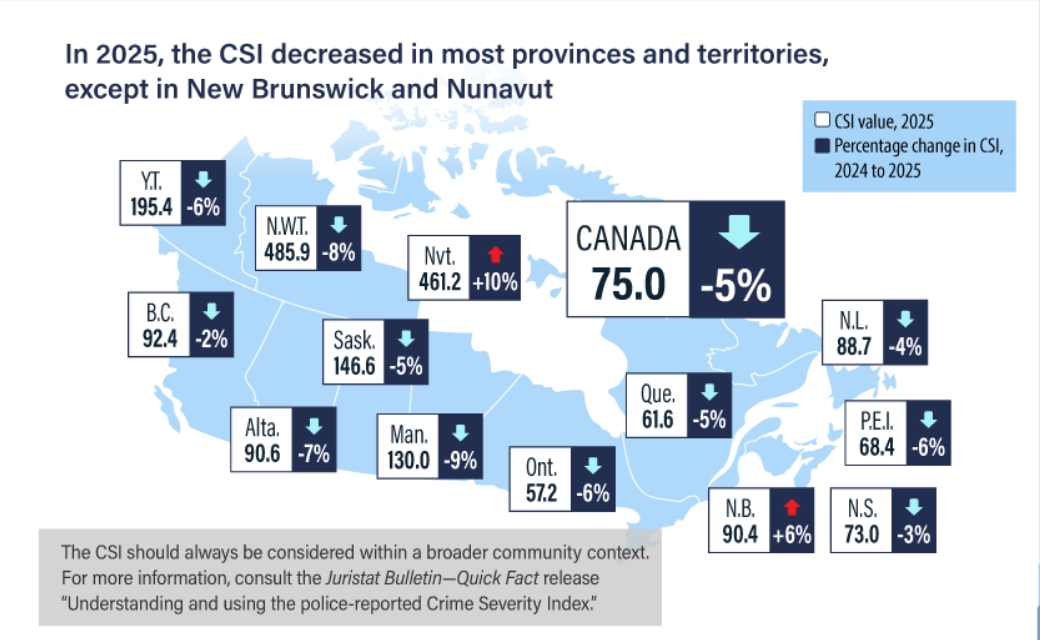
The Crime Severity Index, or CSI, goes a step further. It measures both the number and seriousness of police-reported offences, assigning greater weight to more severe crimes. The CSI declined 5% to 75.01, suggesting crime severity fell more sharply than overall crime volume.
-
Overall crime severity moved lower: The CSI declined for a second consecutive year after reaching 81.27 in 2023. At 75.01, it was 37% below the 1998 peak and 25% under the 2006 benchmark of 100. Violent crime severity fell 4%, while non-violent severity dropped 5%. New Brunswick and Nunavut were the only provinces or territories to record increases during the year across Canada. Manitoba recorded the largest provincial drop at 9%, while the Northwest Territories fell 8%. Nunavut rose 10%, the sharpest increase, and New Brunswick climbed 6%. The Northwest Territories posted the highest CSI at 485.9, followed by Nunavut at 461.2.
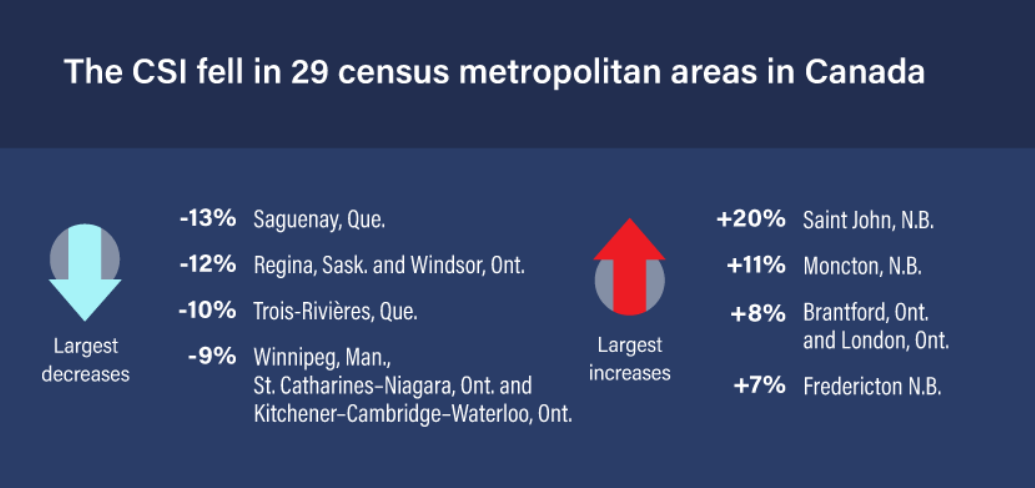
- CSI also fell in 29 census metropolitan areas in 2025. Saguenay recorded the largest decrease at 13%, followed by Regina and Windsor at 12%, and Trois-Rivières at 10%. Winnipeg, St. Catharines–Niagara and Kitchener–Cambridge–Waterloo each fell 9%. Saint John posted the largest increase at 20%, ahead of Moncton at 11%, Brantford and London at 8%, and Fredericton at 7%.
-
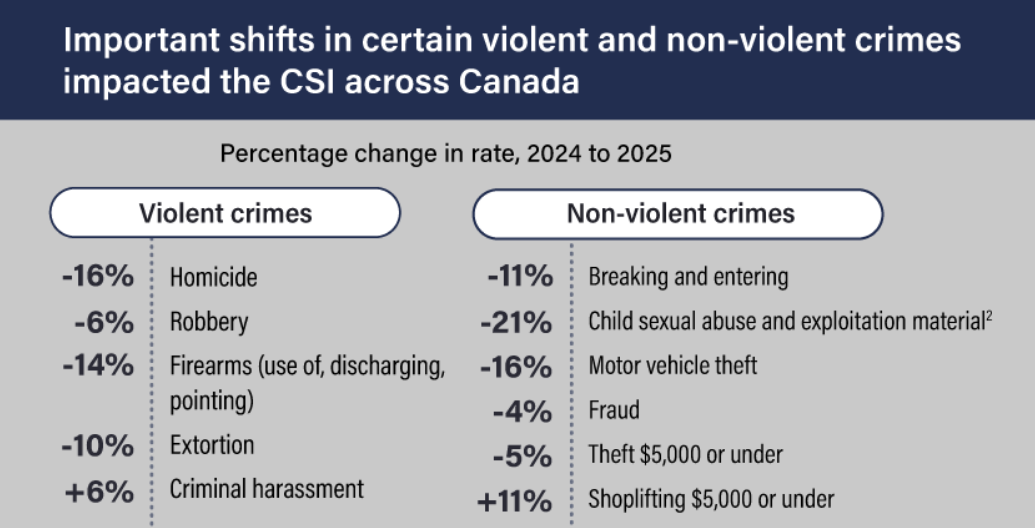
Break-ins and vehicle theft fell sharply: Breaking and entering made the largest contribution to the lower CSI. Its rate fell 11% to 264 incidents per 100,000 people, representing 109,753 cases. Motor vehicle theft also declined, dropping 16% to 201 incidents per 100,000, or 83,652 incidents. It was the second straight annual decrease after three consecutive years of increases in the national rate.
-
Shoplifting continued to climb; Not every national trend improved. Police recorded 208,941 shoplifting incidents involving $5,000 or less, equal to 502 incidents per 100,000 people. That was an 11% increase from 2024 and the fifth yearly rise in a row. Since 2015, the shoplifting rate has climbed 79%, even as other minor theft fell 5% for the third consecutive year nationwide.
Credit: Police-reported crime in Canada, 2025/Statistics Canada
-
Fraud, extortion and online abuse declined: The rate of total fraud declined 4% to 492 incidents per 100,000 people, although it remained 61% above the 2015 level. Extortion fell 10% to 29 incidents per 100,000. Child sexual abuse and exploitation material offences dropped 21% to 15,075 incidents, though Statistics Canada cautioned that investigative complexity and police capacity can affect annual reporting totals nationally.
-
Hate crime eased after years of growth: Police reported 4,708 hate crimes in 2025, down 3% from 4,841 a year earlier. Incidents targeting religion fell 18% to 1,115, while those targeting sexual orientation declined 19% to 534. Race- or ethnicity-motivated incidents were almost unchanged at 2,391, but hate crimes connected to other motivations rose 52% to 562 incidents during the same period.
-
Homicide reached its lowest rate since 2014: Police reported 672 homicides, 125 fewer than in 2024. The rate declined 16% to 1.61 per 100,000 people, which Statistics Canada called “the largest year-over-year decline since 1986.” Gang-related homicides fell to 119 from 155 during the year. Still, the Indigenous homicide rate was 9.59 per 100,000, about eight times the non-Indigenous rate of 1.13.