 Kelowna
A recent survey by the Angus Reid Institute reveals a sharp decline in Canadians’ sense of pride and emotional attachment to their country, highlighting growing divisions and dissatisfaction.
The survey, conducted among 4,004 Canadian adults, shows that only 34% of Canadians are “very proud” to be Canadian, a dramatic drop from 78% in 1985. Furthermore, just 49% feel a deep emotional attachment to Canada, down from 65% in 1991.

Pride and Emotional Connection in Decline: The survey highlights a dramatic reduction in national pride over the past decade. While 52% of Canadians felt “very proud” of their nationality in 2016, this has dropped by 18 percentage points to 34%.
Broadly, those identifying as “proud” or “very proud” of being Canadian fell from 79% in 2016 to 58% in 2024. Emotional attachment also waned, with fewer Canadians describing their connection to the country as deep and increasingly associating it with a good standard of living instead — nearly 37% are now expressing attachment to the country “only as long as it provides a good standard of living.”
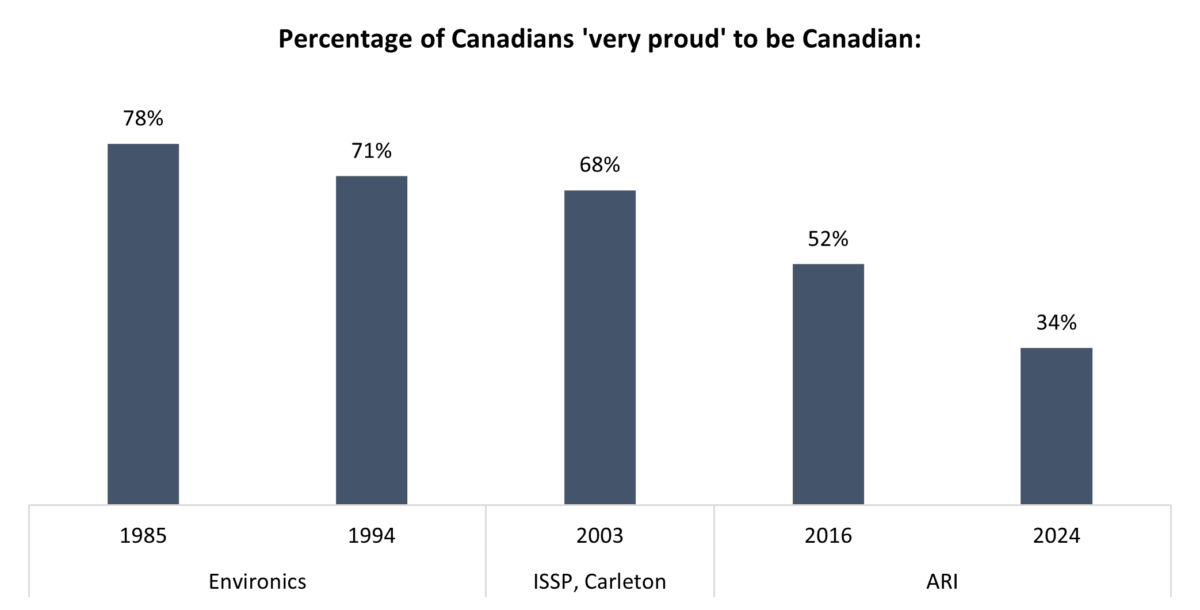
Credit: Angus Reid Poll
Regional Variations: Pride and attachment declines are consistent nationwide, though Quebec remains the least attached province. Only 30% of Quebecers report a deep emotional connection to Canada, while 44% tie their attachment to economic benefits.
Alberta and Saskatchewan, which have seen sovereignty movements emerge, also experienced significant declines.
In Alberta, attachment dropped from 67% in 2016 to 47% in 2024, and pride plummeted by 25 percentage points.
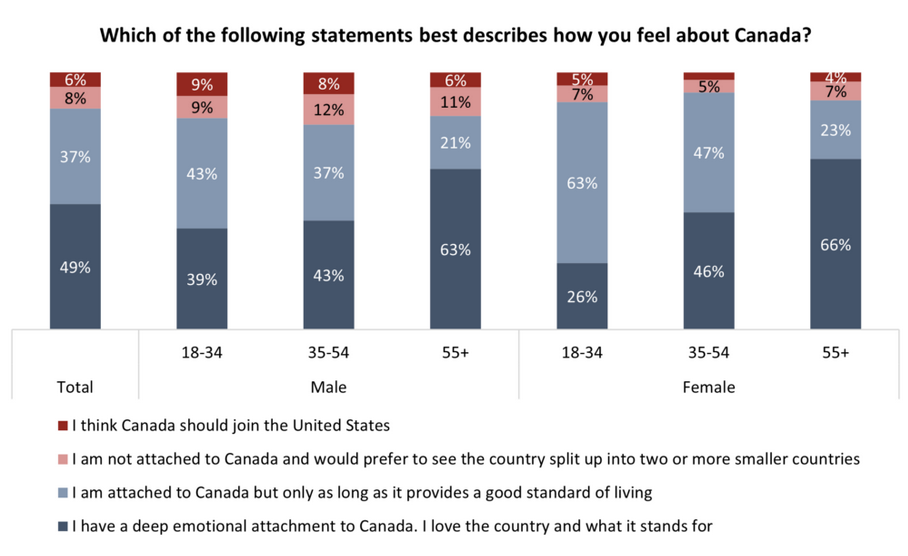
Credit: Angus Reid Poll
Generational Shifts: Younger Canadians exhibit notably less national attachment and pride.
Among women aged 18–34, only 25% report a deep emotional connection, compared to over 60% among those 55 and older. 63 per cent of young women say they are attached to Canada as long as it provides a good standard of living.
Younger men also show sharp declines in pride and attachment, reflecting a more transactional relationship with the country.
Income and Immigration: Income influences pride, with those earning over $200,000 more likely to express pride (65%) compared to those earning under $25,000 (48%).
Among newer Canadians, pride has declined significantly, from 75% in 2016 to 46% in 2024. Many new immigrants link their attachment to the quality of life provided by Canada, a sentiment shared by 51% of those who have lived in Canada for less than a decade.
The findings by Angus Reid point to a profound transformation in how we view our country over the last few decades, underscoring a challenging era for Canadian unity as pride and attachment continue to erode across generations and regions.
In a “postnational” state, are these results surprising?


I doubt very much that 34% is satisfied with Canada today,,Trudeau, according to comments is the main reason for this sad truth and mishandling Canada from day one,,I for a taxpayer would rather support Trump’s regime that our own TRUDEAU REGIME as he’s proven to us he is out of control…