Winnipeg
Manitoba is asking residents a simple but long debated question: should the province stop changing the clocks twice a year?
Municipal and Northern Relations Minister Glen Simard announced a public consultation inviting Manitobans to weigh in on whether to adopt permanent standard time or permanent daylight time. The move comes as other parts of Canada reconsider the seasonal shift.
Ontario passed legislation in 2020 that would allow it to adopt permanent daylight time if neighbouring regions follow suit. British Columbia and Alberta are set to move in that direction in 2026, while Saskatchewan has stayed on standard time year round since 1966.
Right now, Manitoba follows the familiar pattern, setting clocks forward in March and back in November under The Official Time Act. But that routine has drawn increasing scrutiny, particularly from a health perspective.
A recent analysis by Manitoba Health suggests that eliminating the twice-yearly change would be better for overall population health. The spring shift to daylight time appears to be the most disruptive, linked to sleep disturbances, short term increases in cardiovascular events, and a higher risk of injuries and traffic collisions.
What replaces the current system is less clear. Both permanent standard time and permanent daylight time come with trade-offs, especially in a province where daylight hours vary sharply by season.
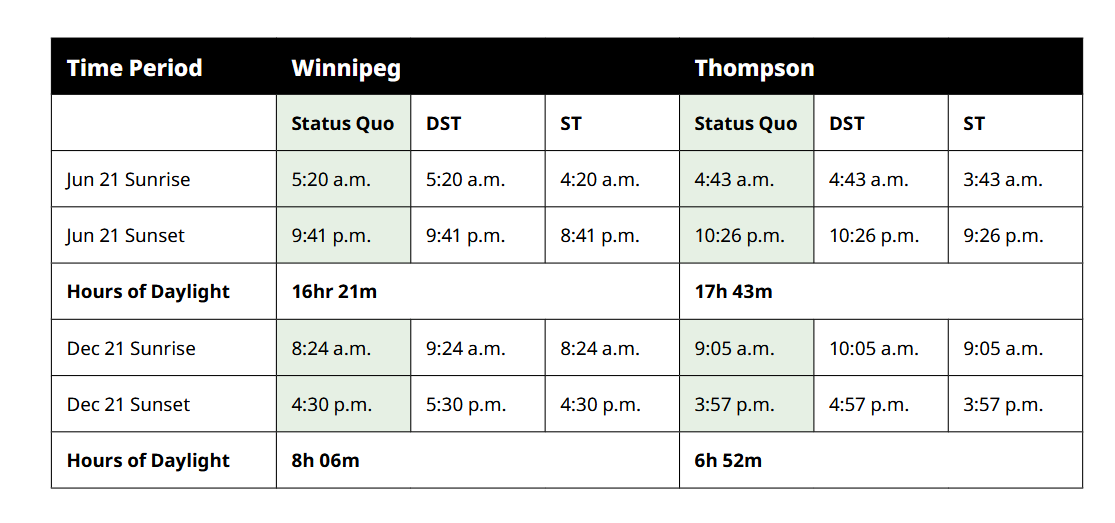
Credit: Health Implications of Time Policy/Manitoba
In Winnipeg, for example, adopting permanent standard time would mean a summer sunrise as early as 4:20 a.m., while in Thompson it could be 3:43 a.m. On the other hand, permanent daylight time would push winter sunrises much later, to 9:24 a.m. in Winnipeg and 10:05 a.m. in Thompson, shifting more light into the afternoon.
Per Health Implications of Time Policy report, research shows no clear winner when it comes to long-term health outcomes. Some studies suggest both options could reduce stroke and obesity rates, though results depend heavily on geography. Evidence around mental health is also mixed, with no consistent link to either system.
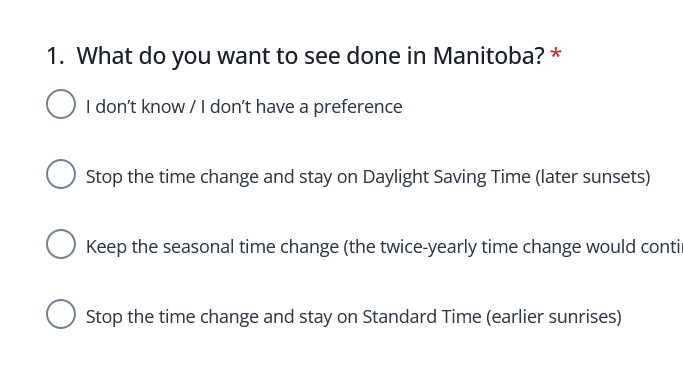
The Future of Time Change in Manitoba / Survey/ Credit: Manitoba.ca
Consultations are now open. Manitobans can share their feedback online.
Report: Health Implications of Time Policy