Toronto
A new study from the Fraser Institute suggests Toronto’s economic performance has been weaker than many assume.
In Stagnant Living Standards in the City of Toronto, the independent public policy think tank examines trends dating back to 2000, focusing on unemployment, median employment income and before-tax household incomes. The findings point to rising joblessness and limited income growth in Canada’s largest metropolitan area.
By 2024, Toronto’s unemployment rate reached 8.0 per cent. That is 2.1 percentage points higher than the average across all major Canadian census metropolitan areas, which stood at 5.9 per cent. It is also 1.7 percentage points above the average for large metropolitan areas in Ontario, at 6.3 per cent.
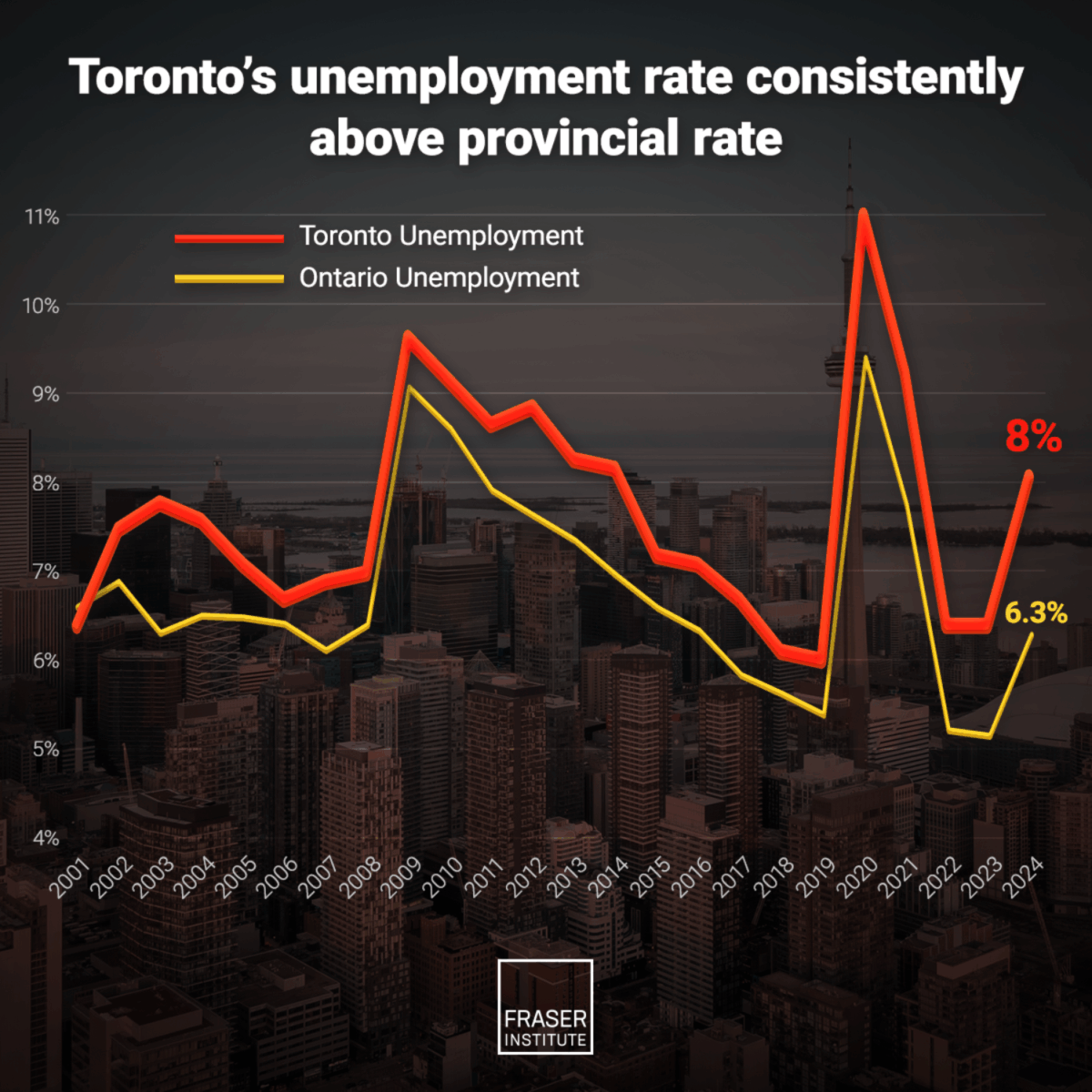
Credit: Fraser Institute
The study builds on earlier Fraser Institute research that found relatively strong job creation in Toronto after 2008 compared to other Ontario cities. This latest analysis expands the timeline and incorporates more recent labour market and income data. Over the longer period, the picture looks less favourable.
Between 2000 and 2023, inflation-adjusted median employment income in Toronto declined slightly, by 0.2 per cent. Over the same span, the average across other Canadian metropolitan areas rose by 15.1 per cent. In other words, while incomes grew elsewhere, they effectively stalled in Toronto when adjusted for inflation.
Ben Eisen, a senior fellow at the Fraser Institute and co-author of the study, said the city now trails other large urban centres on key economic measures. He pointed to persistently higher unemployment and slower median-income growth as signs that living standards have not kept pace with the rest of the country.
The report argues that Toronto’s economic stagnation matters beyond the city itself. With roughly 20 per cent of Canada’s national economy tied to Toronto, its underperformance has broader implications for overall economic growth across the country.